

Cryptocurrency Market Analysis [February 11]
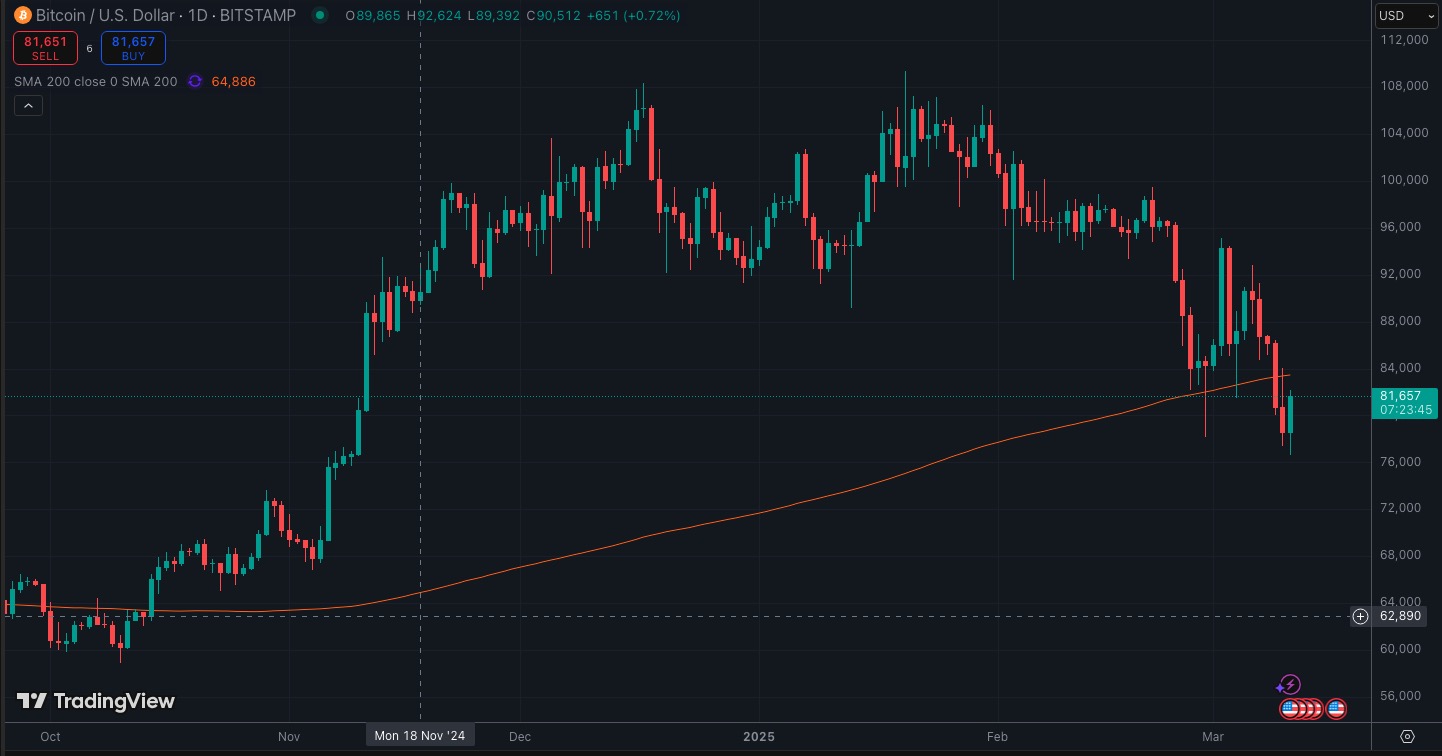
Bitcoin dropped rapidly from last week's $92,000 to briefly $76,000, then somewhat rebounded and is now around the $80,000 level. It has recorded five consecutive down days (negative) and we are waiting to see what will happen today. Will it be six in a row?
Also, the red line on the chart, the 200-day moving average, is an important indicator for catching the price direction, but it has broken below it. Therefore, many investors are now looking at it with a bearish outlook.
A major factor being cited is the United States' tariff policy.
That is said to be a source of market turmoil.
Arthur Hayes, a notable figure in the cryptocurrency space, is predicting a drop to around $70,000.
In such a crash, of course, the usual response is a bearish stance and a hesitation to buy.
However, I am not worried about anything besides price in particular.
The strategic stockpiling of Bitcoin and regulatory easing for cryptocurrencies are factors that are larger positives for me.
The cryptocurrency market will be more influenced by government actions than before, but I believe it has a structural advantage as a hedge asset against fiat currency.
Therefore, even if prices fall, I think what matters most is at what perspective you are looking at things.
Also, last weekend the Cryptocurrency Summit began, and notable figures in the crypto industry were invited to the White House. From my perspective, having started investing in cryptocurrencies since 2016, I never imagined something like this would happen.
◯ On Bitcoin's Strategic Stockpile
Sachs’ special envoy reported on X that “President Trump signed an executive order minutes ago to establish a strategic Bitcoin reserve. This reserve consists of bitcoins owned by the federal government that were seized as part of criminal or civil asset forfeiture. This would incur no burden on taxpayers.”X report
The U.S. government is estimated to own about 200,000 Bitcoins (about 2.6 trillion yen), but there has never been a full audit. The recent executive order directs a full accounting of federal cryptocurrency holdings.
Mr. Sachs also said, “Moreover, the Secretary of the Treasury and the Secretary of Commerce have been authorized to develop a budget-neutral strategy to acquire additional Bitcoins. However, these strategies must not impose additional costs (such as extra taxes) on U.S. taxpayers,” he told CoinPost.
ーーーー
The executive order from last week has finally been activated. The plan is to hold on to Bitcoin now without selling, and to hold it in a way that does not burden taxpayers.
With no new purchases funded by government money, this announcement caused the cryptocurrency market to dip, but I think holding current Bitcoin and preserving it without burdening taxpayers is a rational decision at this stage.
If, in the future, conditions in the market improve and Bitcoin’s value rises significantly, I may consider additional purchases. I’m staying with the wording that I will explore potential purchases in the future.
I don’t think there is anything wrong with prices falling.
◯ Trump Administration: Will it use the market crash to pursue rate cuts?
There is a theory that the Trump administration is intentionally raising uncertainty in the stock market to pressure Federal Reserve Chair Jerome Powell to cut rates.FRB chair
According to Pumpiliano, recent market turmoil is partly due to Trump's tariff policy, and at the same time, it is seen as part of an effort to lower the yield on 10-year U.S. Treasuries to favor the bond market.
If the market continues to fall as is, Pumpiliano noted, we may enter a situation where “which side will break first,” and suggested that tensions between Trump and Powell could intensify.
“The big goal is to cut interest rates. If rates fall, access to cheap capital becomes possible and economic activity will pick up. If you provide people with cheap capital, you can use it to drive the economy.”
ーーーー
There is no doubt that Trump is attempting to lower rates and stimulate the economy, but he is facing a major issue with tariffs.
Even recently, he has spoken about tariffs against Canada, showing a stance of producing under U.S. leadership.
◯ Is the cryptocurrency market sound?
Regarding this latest crash, investors’ anxiety is spreading, but a prominent crypto figure has conducted a survey as follows.
・Other than price, things are favorable…66%
・Despairing…21%
・Other…12%
These are the results.
The U.S. stockpiling Bitcoin, the U.S. government's appointment of crypto-friendly officials, and the SEC’s easing of crypto regulations and dropping lawsuits—these indicate there are no structural negative factors for crypto; rather, positives.
So I remain generally optimistic.
It is true that the United States has significantly entered the crypto space, and the crypto market may evolve differently than before (influenced by the government).
◯ Shuzo Narita
In a sense, Bitcoin, born as a “dollar-destroying” concept, would become something like “a reserve asset under the American state” by putting it under the state as a form of reserve, thereby maintaining “dollar hegemony.” An ironic line of thought.
This is interesting. It suggests that Bitcoin is moving away from its original vision of a non-sovereign, decentralized currency and toward a state-controlled direction.
But,
1) as digital gold, it is moving toward a direction close to gold, and
2) Bitcoin is capped in supply(=)
3) Gold and Bitcoin have nearly a tenfold difference in market capitalization
Given that, it’s easy to imagine how Bitcoin’s value will evolve.
ーーー
He shares the same perspective.
※In the paid subscription section, we provide deeper stock analysis. Even beyond Bitcoin and Ethereum, we want to go deeper into investment. If you want to understand the future flow of the cryptocurrency market and ride that wave, please consider subscribing. Continuous research is very important.
(This article has been distributed since 2016)