
DAY 29: The Importance of a Trade Journal
By DAY 28, we have learned mainly about a “hybrid operation” that combines discretionary trading with automated trading.
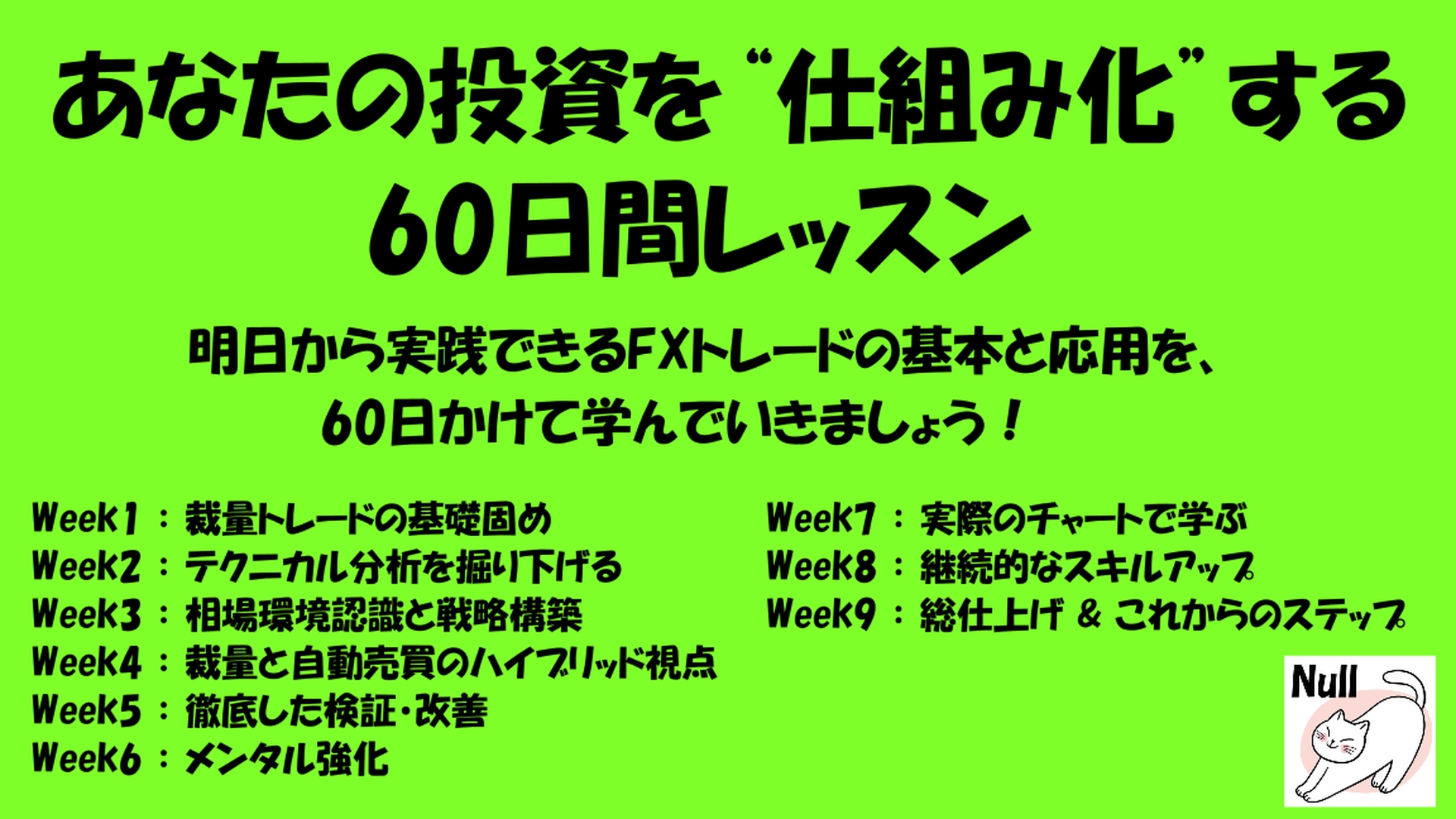
From today, as a new step, we begin Week 5 with the theme of “verification, verification, and more verification.” First, as DAY 29,focus on the importance of a trading journal.Let’s focus on DAY 29: “The Importance of a Trading Journal.”.
It is often said that keeping a trading journal is good, but surprisingly few people use it correctly.The advantages of a trading journal for “learning efficiency” and “mental stability”will be confirmed again, and we will introduce how to keep a journal and tips to keep it up.
1. Why is a trading journal important?
Allows objective reflection
- During trading, emotions tend to run high, and there are many cases where one extends a loss or exits too early.
- By recording in the journal, you create an objective “evidence” to review later, reducing ambiguity.
Clarifies your strengths and weaknesses
- If you classify winning and losing patterns in the journal, you can clearly see which market conditions and entry reasons you are good at or bad at.
- You can identify “weak currency pairs” and “times of day” and use them to improve and adjust operation.
Helps with mental management
- Reviewing the journal helps clarify the causes of anxiety after a losing streak or the urge to revenge trade.
- It creates a space to calmly consider “how to avoid repeating the same mistake.”
Makes updates to rules and logic easier
- By correcting recurring failure patterns, trading accuracy improves.
- Comparing with backtest results also reveals differences between real trading and testing.
2. Items to write in a trading journal
(1) Basic information
- Date and time: Entry and exit timestamps and dates.
- Currency pair: USD/JPY, EUR/USD, etc.
- Trade direction: Buy (long) or Sell (short).
- Entry price, stop loss, take profit: Actual execution rate and settlement rate.
(2) Trade justification & strategy
- Clearly state entry reasons such as “moving average golden cross” or “breach of resistance.”Entry reason
- Record the basis for stop loss and take profit (Fibonacci 61.8%, a touch beyond recent high/low, etc.) so it’s easy to review later.
(3) Result & P/L
- Record pips gained andprofit/loss so you can tally win rate and total P&L.
- If you also track the number of consecutive losses or wins, it helps mental analysis.
(4) Emotions & psychological state
- Describe emotions and decision processes at the time, such as “fear of buying at a high, late entry after a big drawdown,” etc.The emotional state at that time.
- Don’t turn a losing trade into “just a loss”; use it as fuel to improve the next trade, so psychological notes are important.
(5) Chart screenshots (if possible)
- A note app or handwritten journal is fine, but if you can include a chart image, it makes review easier later.
- Attach images of key points such as before/after trades and at entry/exit candlesticks to enhance understanding.
3. Tips for continuing a trading journal
- Prioritize simplicity
- If you add too many items, it becomes cumbersome and you may stop quickly.
- As you get used to it, you can add more detail as needed.
- Habit of daily or weekly review
- Right after trading, keep only minimal notes, and at day end or weekend take time to review carefully.
- Setting aside time for thorough analysis helps you see your habits and market swings from a bird’s-eye view.
- Innovate your recording tools
- Choose what’s easy to use: paper notebook, Excel/Sheets, note app (OneNote, etc.), or dedicated tools (TradingView’s recording feature, etc.).
- Prioritize ease of maintenance. If you want to paste images or links, digital tools are convenient.
- Analyze both successes and failures
- For winning trades, articulate why you won.
- If you only focus on failures, your mental state may deteriorate, so it’s good to also confirm strengths learned from success cases.
4. Practical examples using a trading journal
(1) Case of S: Substantial contribution to mental stability
- Background: When losses pile up, anxiety grows and there is a tendency to shift stop losses.
- Journal use:
- Record each time in about three lines: “entry justification,” “stop loss basis,” and “emotions after exit.”
- Review losing trades at the weekend and confirm that “if the initial stop loss had been kept, damage would have been smaller” before entering the next week.
- Result:
- Prevents self-destructive thoughts like “I’ll surely break the stop loss and average down.”
- When you simply follow the rules, win rate increases and anxiety decreases.
(2) Case of T: Analysis progresses and focuses on winning patterns
- Background: Trading was impressionistic, but win rate was unstable.
- Journal use:
- Always paste a chart screenshot at entry with the justification and the result.
- After one month, analysis showed that a reversal strategy using Bollinger Bands + RSI won about 80% of the time.
- Result:
- Rebuild rules to focus on high-win patterns, reducing wasted trades and stabilizing the equity curve.
- Realize that breakout-focused losing patterns may not suit you.
(3) Case of U: Helpful for managing hybrid operation
- Background: Running EA and discretionary trading simultaneously made total P/L and position management complex.
- Journal use:
- Automatically record trades taken by the EA (export MT4 history) and manually add notes for discretionary trades.
- At the weekend, compare “EA winning patterns” with discretionary winning patterns to decide next week’s lot sizing and on/off operation.
- Result:
- Clear understanding that the discretionary can compensate for EA weaknesses, reducing wasteful positions and stabilizing profits.
- Managing discretionary trading and EA movements in one notebook makes risk assessment easier.
5. Summary & Next Preview
Summary
- A trading journal is effective in many aspects, including improving win rate, mental stability, and refining rules.
- Record items: At minimum, date/time, currency pair, direction, justification, result, and emotion are helpful for later analysis.
- Tips to continue:
- Use simple tools that are easy to maintain.
- Make weekend summaries a habit.
- Analyze both successes and failures in a balanced way.
- Applications:
- In hybrid operation, manage EA trading history collectively and optimize the coordination between discretionary and automated trading.
- Identify your strengths and update your trading strategy accordingly.
Next (DAY 30) theme: Past verification – strengths and limits
- Next, we will deepen Week 5’s verification theme and explain the merits and demerits of “past verification.”
- With the combined approach of journaling and manual backtesting, there is much to learn from past markets, but there are also limits.
- Understanding the differences between past verification and real trading will reveal smarter verification methods. Stay tuned!
If you are interested in automated trading, please also check the link below.
https://www.gogojungle.co.jp/users/147322/products
If this was helpful, I would appreciate it if you click “Read more.”
Thank you.