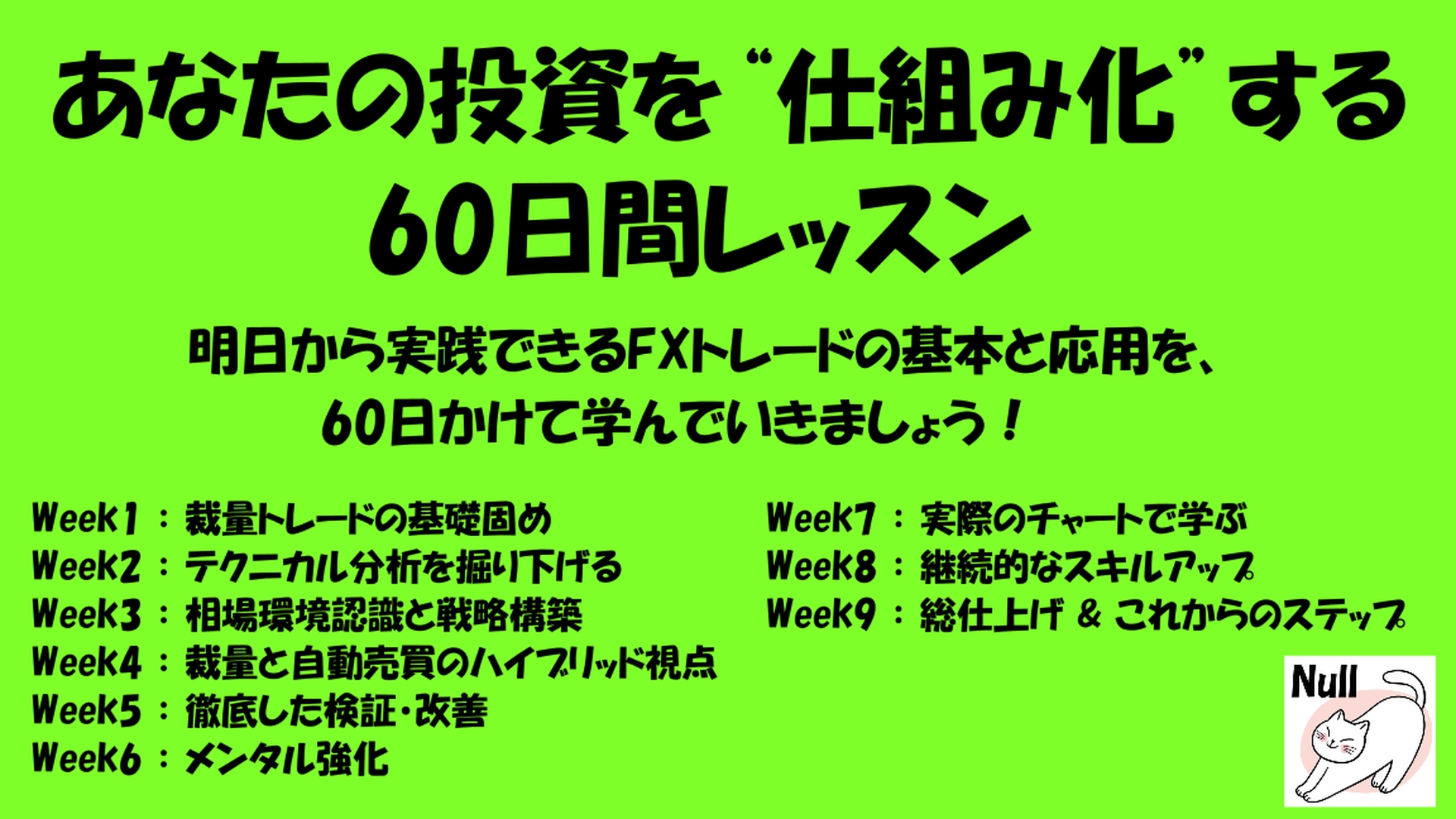

DAY 28: This Week's Summary & Q&A
From DAY 22 to DAY 27, we covered the theme of "Discretion and automation in a hybrid perspective."
By learning the basics of automated trading (EA) and concrete examples of hybrid operation, I think there was a lot of know-how that would be useful even for discretionary traders.
Today, we will comprehensively review this week's content and, while addressing questions and doubts commonly raised by readers, reorganize the key points of hybrid trading.Common reader questions & answers, and then summarize the points of hybrid operation once more.
1. Review of DAY 22–27
DAY 22: What is system trading? – Basic concept
- Point: Automated trading (EA) trades mechanically according to rules, so there is less “emotional deviation.”
- Benefits: Elimination of emotion, 24-hour operation, easy to verify
- Drawbacks: Weak to sudden market changes and overfitting
DAY 23: The essence of discretion derived from automated trading
- Point: The process of “rule-making” necessary for automation is also helpful in reducing the ambiguity of discretion.
- Mutual reinforcement: If winning and losing patterns become clear with EA, they can be applied to discretion, and you can also automate discretionary strengths to speed up testing.
DAY 24: How to backtest effectively for discretionary traders
- Point: Manually stepping through past charts in a backtest helps validate trade rules in advance and also serves as mental training.
- Note: Be wary of look-ahead bias and use replay features. Do not leave stop losses vague.
DAY 25: Hybrid Trade ① – Entry automated, exit discretionary
- Point: EA enters to prevent missing entries and timing delays caused by psychology.
- Exit: Use discretionary judgment to take profits or cut losses as needed.
- Benefits: Combines mechanical entries with human judgment for the best of both worlds.
DAY 26: Hybrid Trade ② – Divide EA and discretion by currency pair
- Point: Assign currency pairs to discretion where you excel and leave EA to handle difficult or high-volatility currencies, distributing roles by pair.
- Advantages: You can focus on your strengths, improving time efficiency and risk diversification.
- Note: Manage costs and correlation risk, so be mindful of capital allocation.
DAY 27: Learn from hybrid success stories
- Point: Common traits among people who have successfully implemented hybrid trading include “turn EA ON/OFF based on market conditions,” “focus discretion on patterns you are good at,” and “regularly check performance instead of neglecting EA.”
- Mindset: Do not view discretion and automation as opposites; treat them as complementary.
2. Frequently asked questions & answers
Q1: “I thought EA would make money if left running, so isn’t it still more work to manage discretion?”
- A: Indeed, expecting “complete neglect” can lead to big losses during market surprises or when EA is temporarily underperforming.
- However, simply performing the minimum ON/OFF management according to market conditions substantially reduces time and mental load compared to discretion alone.
- “Discretion would require hours of chart watching daily” → “Let EA handle entries and/or a subset of currency pairs”, which is not perfect but significantly more comfortable.“Halfway easier” is a meaningful improvement.
Q2: “I don’t know which EA to use. Any tips for choosing?”
- A: First, choose logic that fits your strengths, weaknesses, and market view.
- Understand whether it is trend-following or range-reversing, whether it uses averaging down or martingale, and the overall strategy characteristics.
- Look for EA with published backtest and forward-test results showing stability and long-term performance on sales sites or communities.
- Finally, always test on a demo or small lots to verify it suits current market conditions.
Q3: “People say their discretionary trading improved after introducing automated trading; why is that?”
- A: Studying EA logic clarifies “under what conditions to enter and where to cut losses/take profits”; even discretionary traders get clearer guidelines.
- Additionally, EA backtests reveal data on favorable market patterns and challenging ones, helping discretionary traders align entries with those tendencies.
- Additionally, EA backtests reveal data on favorable market patterns and challenging ones, helping discretionary traders align entries with those tendencies.
Q4: “If you do too much with hybrid operation, won’t loss-cutting and lot sizing become sloppy?”
- A: Indeed, holding multiple EAs plus discretionary positions can make it hard to grasp total risk and entry points.
- Thus, use trading tools or management sheets (e.g., spreadsheets) to visualize “how many lots you currently hold long/short” and whether you are carrying correlated currency pairs, which is better.
- Start by limiting the number of currency pairs and EAs to build familiarity.
Q5: “How do you determine when the market environment is unfavorable for EA?”
- A: Each EA has its own favorable market conditions, generally assessable by criteria such as:
- Trend-following EAs: Losses rise when ranges persist. If moving averages flatten, consider stopping.
- Range-reversal EAs: They tend to lose in breakout or trending conditions. Stop if sudden surges or drops continue.
- Verification & real-operation data: Regularly review to stop when drawdowns increase and reassess the market environment.
3. Steps for future growth
Find the optimal balance of discretion + automation
- Based on what you learned this week about hybrid operation, customize to your trading style and currency pairs.
- Try various combinations: automated entry only, currency pair separation, EA run management, etc., to see what fits you best.
Small-scale or demo test trading
- Don’t start with large funds right away; try hybrid trading in a demo account or with small lots to get used to management methods.
- Monitor risk status of the combination of EA and discretion and adjust parameters as needed.
Value mindset
- When performance is poor, don’t blame “the EA” or “discretion is bad”; calmly analyze compatibility with market environment and operating rules.
- Which part caused losses? Is it the EA’s unfavored market, or did discretionary trades add unnecessary trades? Reassess based on data.
Use backtests and forward tests
- Even if you build or purchase an EA, always backtest on your own account conditions and run demo to confirm expected behavior.
- Similarly, for discretionary trading, repeat the manual backtests from DAY 24 to refine rules.
4. Summary & next steps
Summary
- Hybrid operation (discretion + automation) offers many benefits, including time efficiency, reduced emotional burden, and risk diversification.
- Common takeaway from successful people: Effective ON/OFF management of EA, adapting to market conditions, strict stop losses & lot management, and never leaving things to chance or acting on whims.
- Q&A: We answered questions about how to choose EA and how to combine with discretion, but ultimately the key is to optimize according to your own style, market view, and strengths.
Next steps
- While testing the hybrid perspective learned in this week (DAY 22–28), repeat validation and adjustment to advance your skills.
- If you want to drill deeper into EAs, learning more about parameter settings, VPS operation, and multi-EA combinations is valuable.
- Meanwhile, continue adjusting discretionary rules to changing market conditions. Practical experience will be crucial going forward.
If you’re interested in automated trading, please check the link below as well.
https://www.gogojungle.co.jp/users/147322/products
If this was helpful, I’d appreciate it if you click "Read more."
Thank you.