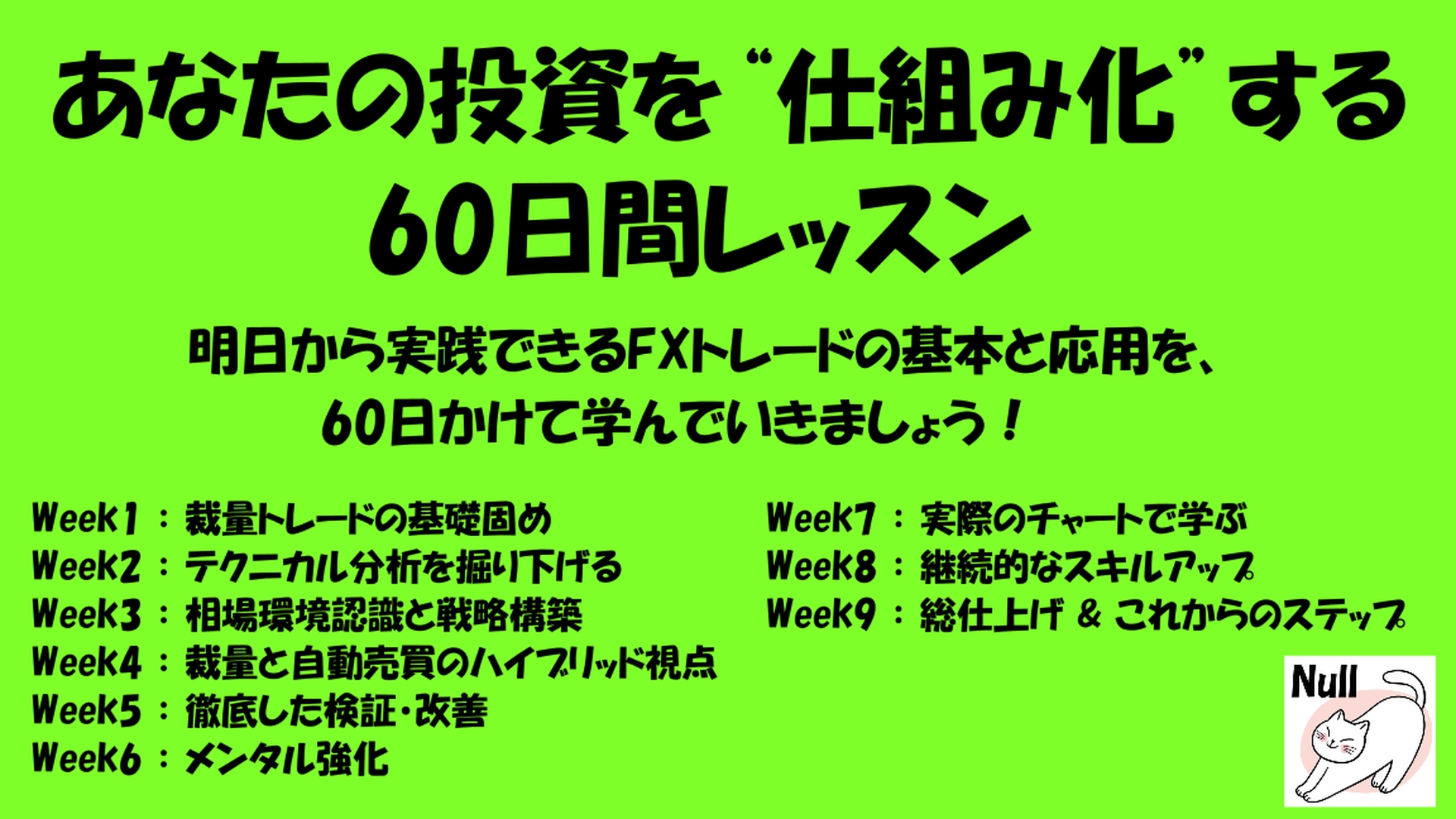

DAY 25: Hybrid Trade 1 – Entry is automated, exit is discretionary
DAY 24 we learned points for manual backtesting by discretionary traders.Key points when a discretionary trader conducts manual backtesting.
From today, we will introduce two practical examples of a hybrid trade that combines discretion and automation, in two parts.Our first approach is to entrust entries to EA (automatic trading) while exits are discretionary and we will examine its merits, cautions, and implementation examples in detail.
1. Basic concept of Hybrid Trade
Automated trading (EA):
- Offers strengths such as “mechanical rule execution,” “24-hour trading capability,” and the elimination of emotions.
- However, it struggles with sudden changes, handling news, and nuanced market judgments.
Discretionary trading:
- Can flexibly judge subtle market changes (pre-indicator movements, long wicks, etc.) and is good at quick, adaptive actions such as closing positions promptly.
- On the other hand, human emotions can creep in, risking missing optimal timing.
Entry by automation, exit by discretion
- Idea:
- EA monitors and executes entry so you don’t miss the timing.
- Once you hold a position, a discretionary trader looks at the chart and responds flexibly, such as “take profit before an indicator event” or “cut losses because news could cause a drop.”
In this arrangement,you significantly reduce missed entriesandemotional hesitation
2. Pros
(1) Preventing missed entries
- With discretion, you might delay and miss the trend as you hesitate like “wait a little longer…”
- Since the EA takes positions as soon as conditions are met,you can reduce timing loss.
(2) Lighter mental load
- Automating entries reduces the inner conflict of “I want to enter soon but I’m scared…”
- If you also auto-set stop-loss levels with the EA, initial risk management is easier.
(3) Human judgment shines in emergencies
- In cases of rapid market changes (economic indicators, remarks by important figures, news), relying solely on the EA may cause unexpected losses.
- However, if you set exits to be discretionary,manual decisions can be made in risky moments.
(4) Balance between strict rules and flexibility
- EA operates strictly according to the logic.Discretion can take flexible actions after entry, such as “hold a little longer, take profits earlier, or widen the stop,”
3. Disadvantages and cautions
(1) You need to monitor the market continuously
- From the moment you enter a position, you manage exits with discretion, so you still need to keep watching the charts to some extent.
- Not completely hands-off; you should stay aware that you must observe the market while holding a position.
(2) Initial risk settings are left to the EA
- If the EA’s stop loss and lot size are inappropriate, sudden volatility could cause large losses in an instant.
- Even if you cannot monitor entry moments, you should at least understand the EA’s default stop loss width and lot settings, and make frequent adjustments.
(3) Exit uncertainty may remain
- As humans decide, you may worry about whether to take profits a bit more or exit earlier and later see it rise.
- If profit-taking criteria are vague, a trade picked up by the EA might end with insufficient profit.
4. Example of operation: Hybrid Trade ①
(1) Simple MA cross EA + discretionary exit
- EA logic example
- Buy when short-term MA and long-term MA have a golden cross; sell when a dead cross occurs.
- Set stop-loss a bit outside the recent low/high or based on ATR.
- Operating method
- Entrances are EA-driven; after holding a position, monitor the chart.
- If you judge that there is an unexpected news event or that price might rebound near recent resistance, stop the EA or exit at market.
- Merits
- You don’t miss crossovers.
- Even with simple logic, discretionary exits can improve overall win rate.
(2) Breakout EA + discretionary trailing
- EA logic example
- Automatically enter when breaking a defined range upper or lower bound.
- Set stop-loss roughly at the middle of the breakout range.
- Operating method
- After entry, discretionary trailing stop (manual trailing in MT4/MT5 or moving the stop based on price).
- If the breakout is a false signal, exit early.
- Merits
- You don’t miss the breakout moment.
- Humans can avoid false breakouts and perform quick settlements to reduce unnecessary losses.
5. Tips for making it successful
Use backtests and forward tests to understand the EA entry logic’s “favorable markets and unfavorable markets.”
- In unfavorable markets, reduce lot size and use discretionary actions around indicator events.
- In unfavorable markets, reduce lot size and use discretionary actions around indicator events.
Define discretionary exit rules to some extent
- Set guidelines like “take profits near recent high/low if a rebound seems likely” or “liquidate before a major indicator,” so you don’t rely on emotion.
- Set guidelines like “take profits near recent high/low if a rebound seems likely” or “liquidate before a major indicator,” so you don’t rely on emotion.
Let the EA mechanically manage stop losses to prevent larger losses in emergencies
- If you cannot tolerate stop losses, delegate them to automated trading.
- Note that in extremely fast markets, the EA may not be able to place orders properly (slippage), so there are no guarantees.
Have a human judge market conditions and toggle EA on/off
- “Turn EA on when a trend seems likely, and turn it off when a range is likely to continue,” so discretionary handles the broader environment.
- This helps prevent losses in ranges or against trends where the EA struggles.
6. Summary & Next Forecast
Summary
- The hybrid style of “entries automated, exits discretionary” can both prevent missed entry opportunities and allow quick stops/targets in emergencies.
- Advantages:Reduces entry hesitation, reduces the need for 24-hour monitoring, and eases mental load.
- Disadvantages:Discretion is still required after holding a position; you must understand the EA’s stop losses and lot settings.
- Keys to success:
- Understand the EA logic and toggle on/off based on market conditions.
- Even for discretionary exits, have minimum rules so you don’t act arbitrarily.
Next time (DAY 26) theme: Hybrid Trade ② – Dividing labor between EA and discretion by currency pair
- As the second part of “Hybrid Trade,” we will introduce a method to use automation and discretion differently for each currency pair.
- For example, let the EA handle high-volatility currencies that are challenging, and use discretion for more stable pairs; there are various patterns, so stay tuned for tomorrow!
If you’re interested in automated trading, please also check the link below.
https://www.gogojungle.co.jp/users/147322/products
If this was helpful, please click “Read more.”
Thank you.