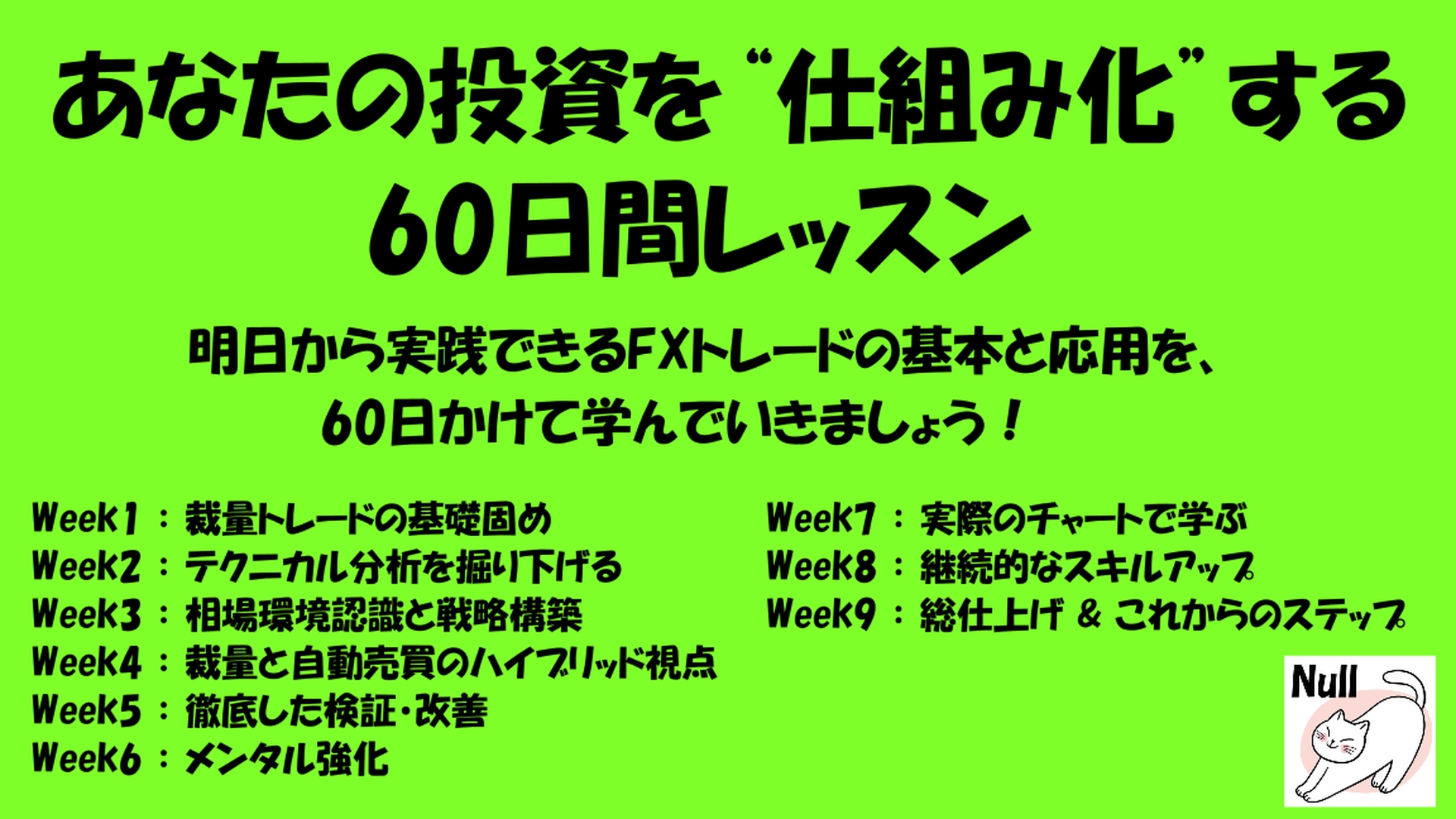

DAY 23: The Essence of Discretion Derived from Automatic Trading
On DAY 22, we looked at the basic concepts of system trading (automatic trading), the differences from discretionary trading, and the potential for hybrid operation.
This time,“the clearly defined rules through automated trading”to learn fromanddiscuss from the perspective of “deeper understanding of the essence of discretionary trading.”
Some readers may wonder, “I’m discretionary, but can automated trading be informative?”, but actuallythe key point for honing discretionary skills is precisely the “rule-making” required for automation.
1. The core of discretion that can be learned from automated trading
(1) The “clear rules” to eliminate emotions
- Automated tradingrequires clear conditions for entry here and exit here.
- In the design phase, concrete triggers such as “buy on a pullback when the moving average is sloping upward and RSI is at or below 30” become essential.
- Even discretionary traderscan reduce emotional entries and stop-loss mistakes by clearly deciding such objective indicators and conditions.
(2) Clarifying winning and losing patterns
- In EA (expert advisor automated trading),backtestsandforward testsare performed, and past performance becomes a number.
- Examples: win rate, average profit, average loss, maximum drawdown, etc.
- If you know win patterns, you can apply indicators like “in such market conditions and under these circumstances, it’s easier to win” to discretionary trading as well.
- By understanding loss patterns (range-bound drawdowns or sharp drops), discretionary traders can implement measures like “don’t enter in such times or reduce position size.”
(3) Mechanisms to prevent over-entry and missed entries
- Automated trading executes according to rules repeatedly, so discretionary traders’ “oversights” or rushing to recover after series of losses are less likely.
- Discretionary traders can also adopt a rule such as “limit trades when consecutive losses occur,” reducing mental load.
2. Conversely, the merits of deriving automated trading from discretionary trading
(1) Mechanizing your strong patterns and systematizing them
- If you can quantify the discretionary experience “this pattern tends to win,” using indicators or candlestick shapes, you can incorporate it into an EA.
- Even if you’re not watching 24 hours, there’s a higher chance of capturing winning patterns.
(2) Verification speed greatly increases
- Discretionary trading requires stepping through past charts manually, but automation allows rapid verification with backtesting.
- Even discretionary traders can benefit from creating a “trial EA” to confirm whether it actually works in a short period.
(3) Clarifying ambiguous discretionary aspects
- If you try to formalize “somehow this seems like a buy…” into an EA, you’ll need to translate it into concrete numbers and criteria.
- Through that process you’ll re-acknowledge gaps in your rules and any unnecessary emotions, thereby increasing your discretionary power.
3. How to train “discretion × automation” together
(1) Manual backtesting vs. EA backtesting comparison
- Manual backtest: progress candle by candle, checking with discretionary feel, “What would happen if I entered here?”
EA backtest: run the program over the same period and conditions to compare win rate and profitability. - If differences appear, analyze “At what point did humans not enter, but the EA did?” and “How did a human respond when the EA stopped out?”
(2) EA settings that allow discretionary interventions
- Some EAs can automatically pause before key announcements or allow a discretionary button to forcibly exit positions.
- Rather than leaving everything to automation, stopping and resuming according to market conditions enables leveraging discretionary experience while still using automation’s strengths.
(3) Use signal EAs to confirm triggers
- Signal EA means it won’t enter, but will alert when certain conditions occur.
- Entry remains the discretionary trader’s final judgment, but it reduces missed opportunities.
- Balancing discretionary trading with automated signals reduces monitoring effort.
4. Failure examples and how to avoid them
(1) Dependency on automated trading leading to no market analysis
- Failure example: Relying entirely on EA, doing nothing during sudden changes or news events, resulting in large drawdown and capital loss.
- Mitigation:
- Include minimal management rules like “pause before indicators release.”
- When market conditions change (range or trend), reduce lot size as discretionary follow-up is needed to accommodate the market that EAs struggle with.
(2) Rules are vague and cannot be EA’d, ending halfway
- Failure: You’re winning with discretionary trading, but trading by “feeling” makes it hard to define conditions for an EA and you give up.
- Mitigation:
- Be deliberate about verbalizing and quantifying the basis of discretion and indicators.
- Start with one or two indicators like simple MA cross or RSI bounce, then gradually add more discretionary nuance.
(3) Optimization bias (overfitting) leads to disastrous real trades
- Failure: Trying to maximize backtest results by over-tuning indicators and parameters works on past data but fails in current markets.
- Mitigation:
- Leave a portion of past data as out-of-sample to test, ensuring it still performs well there.
- Keep optimization parameters to a minimum essential set.
5. Summary & next week teaser
Summary
- The essence of automated tradingis to “execute clearly defined rules mechanically.” It greatly reduces emotional mistakes common in discretionary trading.
- Discretionary traders can also reduce ambiguity by learning the rule-creation process for automation→ discretionary capability effectively improves.
- Hybrid of EA (automatic trading) and discretionoffers various modes, such as signaling only and final judgment by humans, pausing before signals, entering by EA and exiting by discretion, etc.
- To avoid failures, monitor market conditions and perform minimal management, and avoid over-reliance on backtests or optimization.
Next time (DAY 24) theme: How to perform backtesting that benefits discretionary traders
- Automation rules and verification methods have much in common with discretionary traders’ manual backtesting.
- Tomorrow, we will explain the basics of backtesting that you can do manually and the points to check during verification, sharing tips to improve rule accuracy in discretionary trading.
- We will also show concrete methods such as “how to do mental training using past charts,” so please look forward to it!
If you’re interested in automated trading, please also check below.
https://www.gogojungle.co.jp/users/147322/products
If this was helpful, I’d be grateful if you click “Read more.”
Thank you.
× ![]()