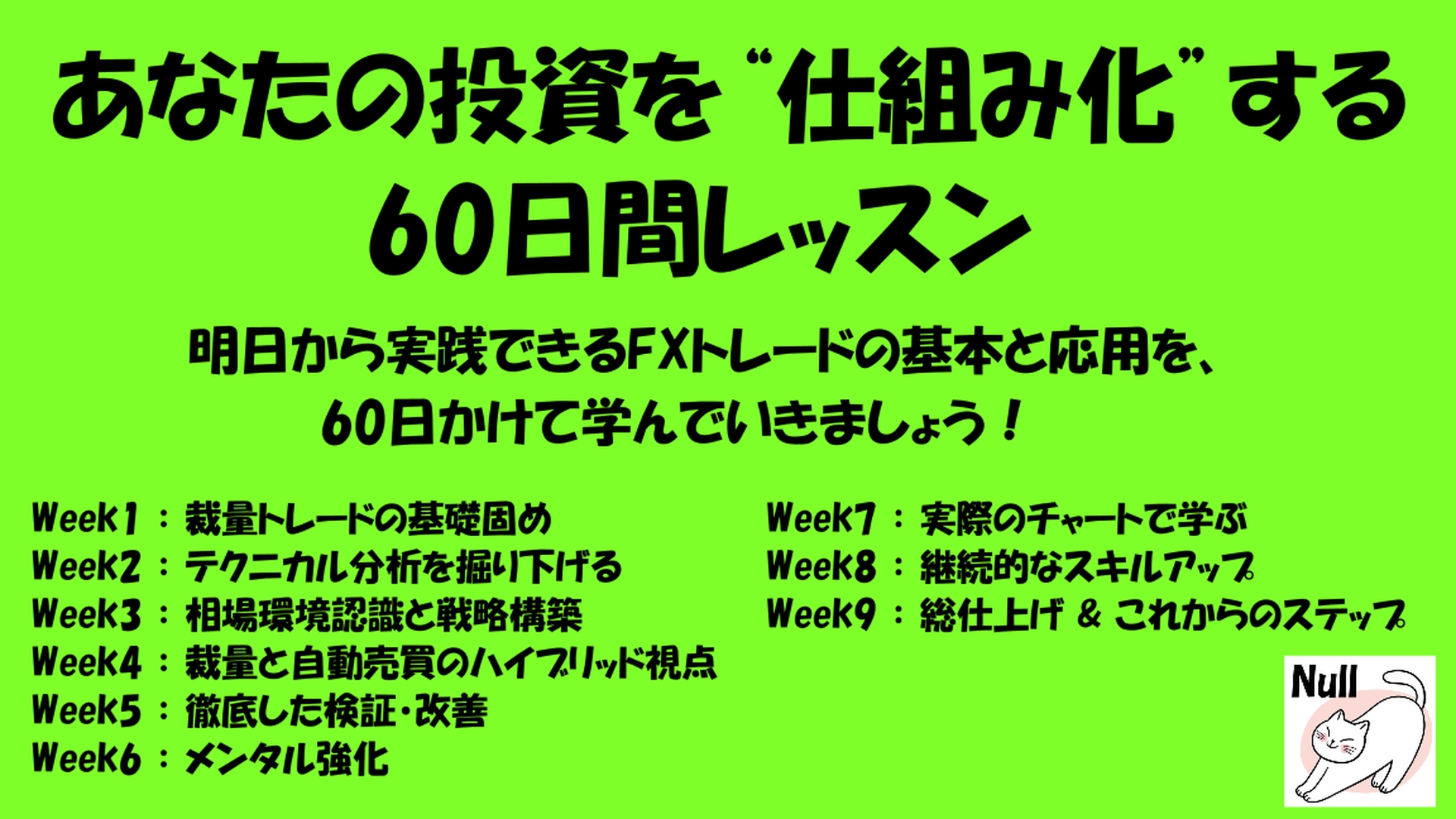

DAY 21: Summary of Strategy Building & Q&A
From DAY 15 to DAY 20, we have learned practical trading strategy elements such as "market environment recognition," "entry & exit strategies," and even "multi-position management."
Today’s DAY 21 is to organize the points for ultimately constructing “your own trading strategy” while comprehensively reflecting on this past week.
1. Quick review of DAY 15–20 learnings
DAY 15: Reading the market environment – Trend vs. Range
- Point: Simply determining whether the market is in a trending or ranging state can significantly change which strategy you should choose.
- Range → contrarian plays using the upper and lower bounds or aiming for a breakout just before it
- Range → contrarian plays using the upper and lower bounds or aiming for a breakout just before it
DAY 16: Using multiple timeframes – Multi-timeframe analysis
- Point: Look at multiple timeframes (higher, middle, lower) to grasp the big picture and precise timing.
- Confirm trend direction on higher timeframes → look for pullback candidates on middle timeframes → measure entry timing on lower timeframes
- Confirm trend direction on higher timeframes → look for pullback candidates on middle timeframes → measure entry timing on lower timeframes
DAY 17: Entry strategy – Breakouts, pullbacks, and rallies
- Breakouts: Capture the moment price breaks through ranges or key lines. You can ride a strong move, but the risk of false breaks is high.
- Pullbacks/Rallies: Core strategy in trending markets. It is difficult to judge the depth of pullbacks or rallies.
DAY 18: Exit strategy – Optimizing stop loss and take profit
- Point: Where you cut losses and take profits significantly affects trade profitability.
- Take profit → Use risk-reward ratio and trailing stops to avoid premature exits.
- Take profit → Use risk-reward ratio and trailing stops to avoid premature exits.
DAY 19: Understanding market quirks – Characteristics by currency pair
- Point: Different currency pairs have varying volatility, indicator sensitivity, and tendency to form trends.
- Major currencies like USD/JPY or EUR/USD → more stability and clearer technical signals; relatively beginner-friendly
- Major currencies like USD/JPY or EUR/USD → more stability and clearer technical signals; relatively beginner-friendly
DAY 20: Managing multiple positions – Portfolio thinking
- Point: Combine multiple pairs to diversify risk and expand opportunities.
- Need to adjust lot sizes considering each currency’s volatility.
- Need to adjust lot sizes considering each currency’s volatility.
2. Steps to build your own trading strategy
Clarify trading goals and timeframes
- First decide how much time you will trade on which time frame.
- Scalping/day trading/swing trading will change entry and exit criteria.
Create rules for judging market environment
- Define criteria to distinguish trend vs. range.
- Use indicators you find easy, such as moving average direction, Dow Theory highs/lows, or Ichimoku cloud breakout.
Decide entry strategies
- In a trending market, use “pullback buying / rally selling” or “breakouts.”
- In a ranging market, use “contrarian plays at support/resistance” or “range breakout attempts.”
- Write down specifically what signals will trigger an entry.
Clarify exit strategies
- How to determine stop loss widths? (technical lines, ATR, risk-reward ratio, etc.)
- Take profit guidelines? (Fibonacci extensions, recent highs, etc.)
- Will you use trailing stops or partial profit-taking?
Currency pair selection & capital management
- Limit yourself to 2–3 currency pairs to trade.
- Decide how much risk per trade and total risk when holding multiple positions.
- In high-volatility currencies, consider lowering position sizes.
Testing & refinement of rules
- Backtest on past charts or demo trades, and record win rate and risk-reward ratios.
- If a losing streak occurs, reduce lot size or revisit conditions and make small adjustments repeatedly.
3. Frequently asked questions & advice
Q1: I keep hesitating on exits and chicken out on taking profits.
- A: Set take-profit targets in advance and do not change the rules until you reach them.
- Partial profit-taking to reduce mental burden and letting the rest ride with a trailing stop can be effective.
- Just try to follow the rules first, then analyze results and improve in a loop.
Q2: I struggle with stop losses and end up with a salt position.
- A: Develop the habit of always setting a stop loss when entering a trade.
- Even if you want to hold, automatic stop-outs prevent further damage.
- Also, keeping risk per trade to about 1–2% of capital means even a stop-out is not catastrophic.
Q3: Monitoring multiple currency pairs is hard and you miss opportunities.
- A: Start with 2–3 pairs.
- Choose pairs that are active during your trading window and focus on them.
- As you gain experience, add one by one and recheck correlations and risk management as you expand.
Q4: I can’t predict when a trend ends, often giving back profits.
- A: Use trailing stops to raise the stop-loss level as price moves (or lower it) to lock in profits while letting profits grow.
- If candlesticks show a reversal on a large bearish or bullish candle, take profits as a clear sign of slowdown.Clear slowdown signal is a good cue to exit.
- If candlesticks show a reversal on a large bearish or bullish candle, take profits as a clear sign of slowdown.Clear slowdown signal is a good cue to exit.
4. Steps for future progression
Continue testing and recording
- Keep a trading journal, screenshots, entry rationale, exit reasons, and review regularly.
- Analyzing both winning and losing trades later helps reveal your patterns and strengths.
Use EA/tools as needed
- If your rules are clear and systemizable, backtest and forward-test with an expert advisor (EA).
- For time-constrained traders, a hybrid of discretionary and automated trading is worth considering.
Be flexible to changing market conditions
- Even the same method may become less effective if the market shifts month to year.
- Regularly analyze results and adjust parameters; this is key to long-term stability.
Mind your mental state
- Don’t aggressively chase losses with more leverage after a losing streak or over-increase lots after a winning streak.
- Engage with trader communities or forums for information exchange, and relieve stress through hobbies; mental calm directly affects performance.
5. Summary & Next steps
Summary
- Through DAY 15–21 learnings, you should have built a foundation for more practical trading strategies.
- The most important is to translate market environment recognition (trend vs. range), timeframe usage, and the entire entry–exit process into your own rules.
- Understanding currency pair characteristics and practicing multi-position management (portfolio thinking) will help you control risk and seize opportunities.
Next steps
- This week you mastered the overall flow of market environment recognition and strategy construction, so next you should focus on “practical chart exercises” and deeper exploration of the mental side to further boost your practical ability.
- Additionally, as a supplement, learning in detail about “how to validate,” “real chart cases,” and “further improvements in capital management” will further raise trading precision.
Lastly
- Learning is not the goal but the starting point. Look at actual charts, practice with small lots or a demo, and accumulate both successes and failures; that’s when your unique strengths will blossom.
- Trading is also a path of personal growth, so proceed steadily without rushing.
From now on, let’s continue to deepen our learning together and build a fulfilling trading life!
If you’re interested in automated trading, please also check out the link below.
https://www.gogojungle.co.jp/users/147322/products
If this was helpful, I would appreciate it if you could click “Read more.”
Thank you.