

Cryptocurrency Market Analysis [February 26]
Bitcoin was in the 96,000-dollar range last week, but since the day before yesterday it has fallen sharply and is now below 90,000, dropping to around 86,000 dollars.
This drop is at the levels of last November to December, and it has fallen below the lower end of the range that emerged in December, which is the 90,000-dollar price.
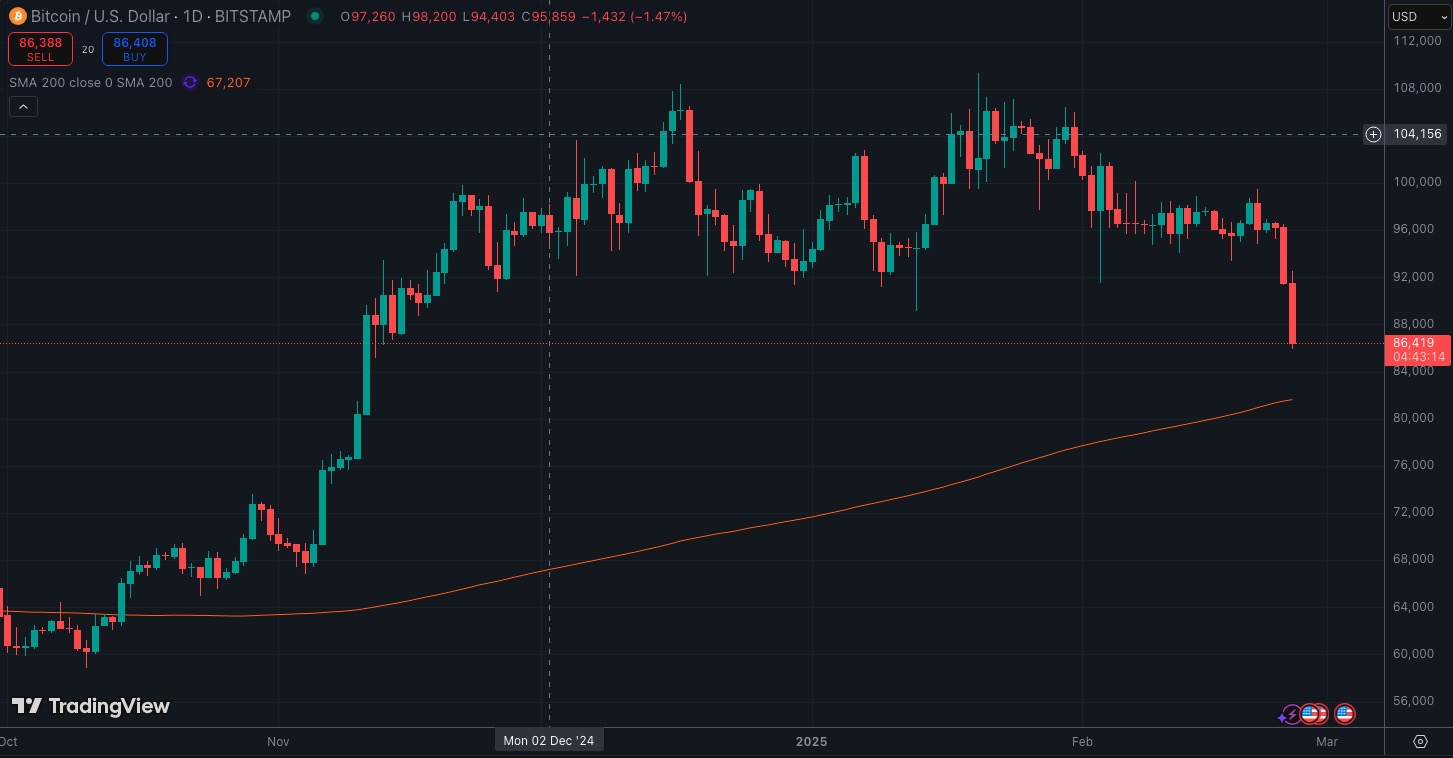
From a chart perspective, around 80,000 dollars is seen as the next resistance line.
The drop is attributed to the U.S. government announcing that tariffs will begin against Canada and Mexico as scheduled, various inflation concern indicators, and the largest-ever hack on the overseas exchange Bybit.
Regarding Bybit, the hack amount of 300 billion yen is said to be the largest in history, and the culprit is suspected to be North Korean hackers.
Among Japanese people using overseas exchanges, Bybit is especially famous, and I think there are quite a lot of Japanese who had funds stored in Bybit.
I have a small amount of funds there, but since I judged that the impact would be within acceptable limits, I left them as is. When trading overseas, you should not keep large funds on exchanges; you need to manage them strictly within domestic wallets or your own wallets.
Also, in this drop
・El Salvador buys Bitcoin
・MicroStrategy buys Bitcoin
・Grayscale applies for a cryptocurrencyADA ETF and the SEC has accepted it.
・SEC ends investigation into Uniswap (decentralized exchange).
There are also such news.
◯ About15 billion dollars worth of Ethereum (ETH) was hacked; large crypto asset exchangesBy*** (Bybit) have seen outflows totaling more than50 Group.”
About15 billion dollars worth of Ethereum (ETH) was hacked; large crypto asset exchangesBy*** (Bybit) have seen outflows totaling more than50 billion dollars. The hacking is believed to be carried out by the North Korean hacker group “Lazarus Group.”
What is notable is that BitMEX co-founder Arthur Hayes has suggested on SNS the “reversal of the Ethereum blockchain,” which, if community consensus were obtained, could be considered— as revealed by its CEO, Yahoo.
Last week’s headline was the hack on the overseas exchange Bybit. A record-high 300 billion yen was hacked.
And Bybit, after the hacking news, saw users urgently requesting withdrawals to other exchanges, and Bybit took appropriate measures.
—————
Ten hours have passed since the hack, and By**: has processed more withdrawals than ever before. A total of 350 thousand withdrawal requests have been received, and currently about 2,100 requests are awaiting processing. Overall, 99.994% of withdrawals have been completed. If you have completed withdrawals, please feel free to leave a comment.
This hack may represent the largest damage across banks, cryptocurrency, and the financial industry in media coverage. However, By***’s all functions and services are operating normally.
By*** will continue to strive for the safety of customers’ assets and platform reliability. If you have any questions, please do not hesitate to ask.
We appreciate your understanding and trust. We will continue to report progress on the investigation as it progresses — Bybit
In general, exchanges stop withdrawals when hacked, but to meet user needs, they process a large volume of withdrawals. In this Bybit hack, customer assets are compensated, so there should be no problem, but I felt that Bybit’s handling of users has improved in a positive way for customer perception.
Whether they take responsibility or prioritize users when problems arise, such handling influences an exchange’s reputation.
Also the CEO said that if it had been 10 or 15 billion dollars, things would have been fine, but if it had been over 100 billion dollars (1.5 trillion yen), there might have been a company sale.
In fact, I learned about this incident when I woke up in the morning; it had already been about eight hours since it happened. In other words, the response time in such cases felt slow. I had a small amount of funds in Bybit for profit-taking, but after checking the news I left the assets as they were.
Because of situations like this, I feel it is important not to keep large amounts of assets on overseas exchanges.
Regarding Bybit, I think there are quite a few Japanese users. Now that Binance, OKX, and FTX can’t be used, the remaining major exchange is Bybit, which is why many Japanese are involved this time.
◯ Bitcoin Fear Index
Bitcoin’s Fear Index has fallen from a neutral 50 to 25 (fear).
This index generally indicates that more people are holding back from buying, and is also used as a gauge for timing purchases.
※In the paid subscription section, we conduct more in-depth stock analysis. Even beyond Bitcoin and Ethereum, we want to go deeper into investments. If you want to understand the future trend of the cryptocurrency market and catch that wave, please consider subscribing. Continuous research is very important.
(This article has been distributed since 2016)