
DAY 15: Reading the Market Environment – Trend vs. Range
By DAY 14, you have learned the main indicators of technical analysis and deepened your understanding.
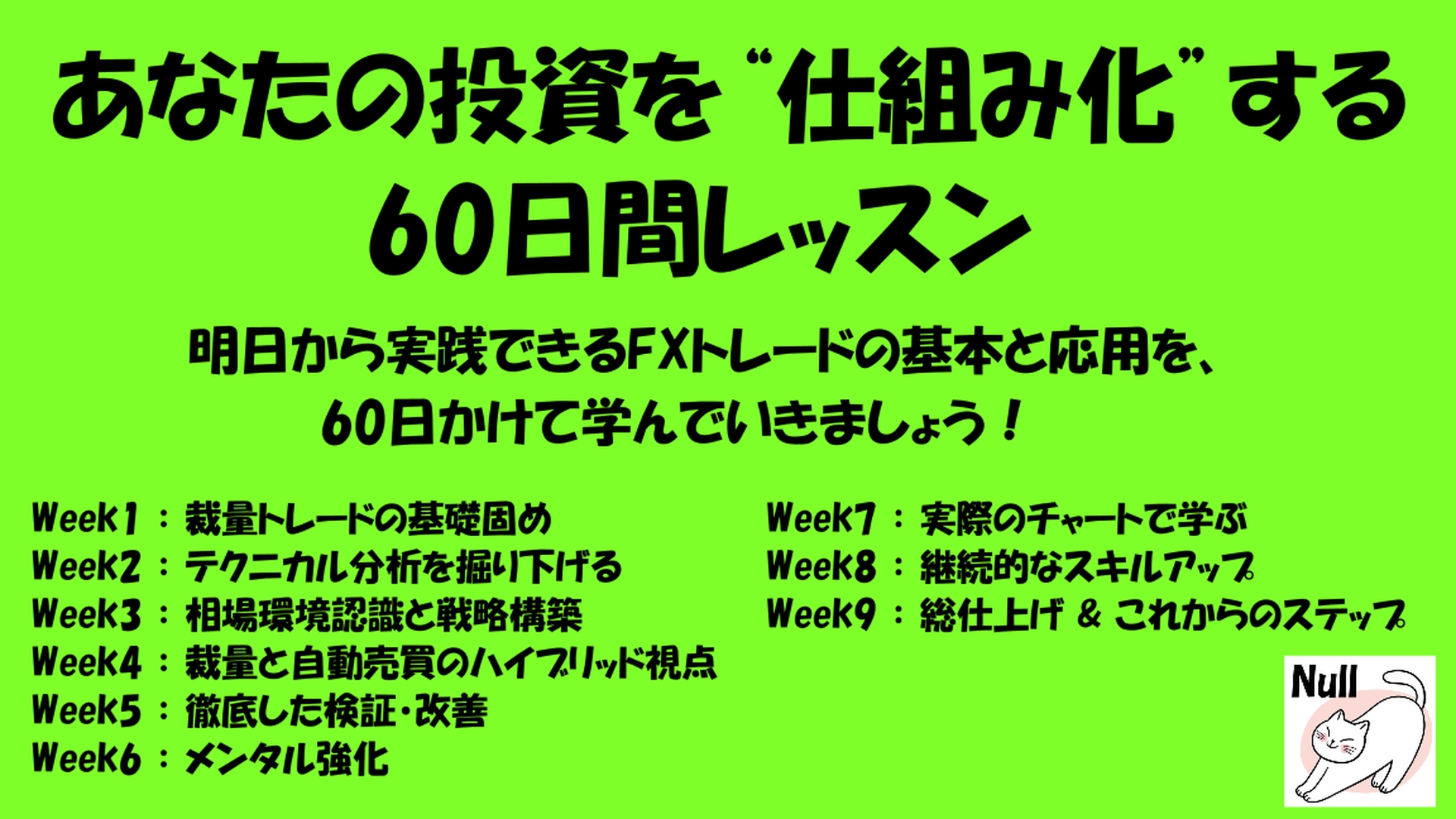
In the coming week (DAY 15–21), we will study from a more practical perspective under the themes of “Market Environment Recognition” and “Strategy Construction”.
First, as DAY 15, let's organize how to determine whether the market is in an uptrend or a ranging (sideways) market, which is the fundamental premise of trading.
If you trade while this is unclear, indicators may not be reliable and losses can increase.
1. Why is understanding the market environment important?
Using trend-following vs. range-bound indicators
- Moving averages and MACD are more powerful in trending markets.
- Oscillators like RSI and Stochastics often work better as contrarian signals in ranging markets.
- If you misjudge which state the market is in, indicator signals become unreliable.
A basis for risk management
- In trending markets, you often set somewhat deeper stops to aim for pullbacks and re-entries.
- In ranging markets, it is more reasonable to repeatedly target quick profits with tighter stops and take-profits.
- By aligning risk-taking with the market environment, you can minimize losses.
Mental preparation matched to that day’s market
- In a trending market, you might think a slight pullback is a buying opportunity, whereas in a ranging market, securing a small profit quickly is often effective.
- Adjusting your mindset to the environment helps reduce mistakes like excessive averaging in and premature profit-taking.
2. Points to determine whether the market is trending or ranging
(1) Check for higher highs / higher lows or lower highs / lower lows
- Uptrend: Recent highs and lows are both rising.
- Downtrend: Recent highs and lows are both falling.
- This basic view aligns with Dow Theory.
(2) Direction of moving averages & price position
- If the MA issloping up and price is above it → likely an uptrend.
- If the MA issloping down and price is below it → likely a downtrend.
- If the MA isflat and price moves sideways → likely a range-bound market.
(3) Clear identification of support & resistance
- If price repeatedly bounces at the same level, that level functions as horizontal support or resistance.
- If price remains unable to break above or below, it indicates a ranging market.
- Conversely, a breakout that pushes to new highs or lows indicates a continuing trend.
(4) Changes in volatility
- If Bollinger Band width contracts and price moves between ±1σ or ±2σ → ranging market.
- If bands widen and price tracks along +2σ or -2σ → strong trending market.
3. Basic strategies for trending markets
(1) Trend following (going with the trend)
- In an uptrend, buy on pullbacks,in a downtrend, sell on rebounds.
- To better time pullbacks or retests, combining moving averages with Fibonacci and RSI is useful.
- The appeal of trend following is the potential for large profits with relatively small losses.
(2) Breakout hunting
- Enter when price breaks clearly through highs, lows, horizontal lines, or the upper/lower edge of the cloud.
- Place stops near the prior swing low (for longs) or swing high (for shorts).
- Be aware that news or major events can cause whipsaws, so set reasonable stop levels.
(3) Multi-timeframe analysis
- Look at weekly and daily trends, but also 1-hour charts to understand temporary pullbacks or corrections.
- By not fighting the big trend and viewing short-term moves as entry opportunities, your win rate tends to improve.
4. Basic strategies for ranging markets
(1) Contrarian using support & resistance
- Buy near the lower end of the range (near support) and sell near the upper end (near resistance).
- However, a breakout is possible, so always place a stop loss.
- As an approach, using RSI or Stochastics to gauge overbought/oversold helps identify entry points.
(2) Capture the initial move of a range breakout
- After a long range, a break of the line may lead to a swift move.
- When approaching a breakout, if volatility (Bollinger Bands) or volume confirms, consider entering.
- Place stops if price returns inside the range (breakout fails).
(3) Wait without rushing
- Trading near the middle of the range tends to be noisy.
- Focus on trading near the range’s edges or aiming for breakouts to reduce unnecessary trades and improve win rate.
5. Summary of market environment recognition
- First, determine whether the current market is trending or ranging
- Assess by MA slope, updated highs/lows, and support/resistance lines.
- Assess by MA slope, updated highs/lows, and support/resistance lines.
- Choose indicators and strategies suited to the market environment
- Trending market → use moving averages, MACD, and Fibonacci for pullbacks and reversals.
- Ranging market → use RSI, Stochastics, and horizontal lines for contrarian plays or breakouts.
- Always keep in mind the possibility of a breakout
- Ranges do not last forever; trends will end eventually.
- If price moves differently from your expectation, exit with a stop and reassess the environment.
6. Summary & Next Time Preview
Summary
- If you apply technical indicators without reading the market environment, you cannot expect highly accurate trades.
- Determining whether the market is trending or ranging at the outset can completely change your strategy..
- Markets are a living thing that constantly move, so it’s important to not miss moments when the trend shifts to range or vice versa.
Next time (DAY 16) topic: Using timeframes – Multi-Time-Frame Analysis
- To understand the market environment, look at multiple timeframes, not just one.Multi-Time-Frame Analysisis effective.
- Even when day trading using 1-hour or 15-minute charts, learn to check the larger direction on daily or 4-hour charts to improve trading accuracy.
If you’re interested in automated trading, please also check the link below.
https://www.gogojungle.co.jp/users/147322/products
If this was helpful, please click "Read more" if you can.
Thank you.