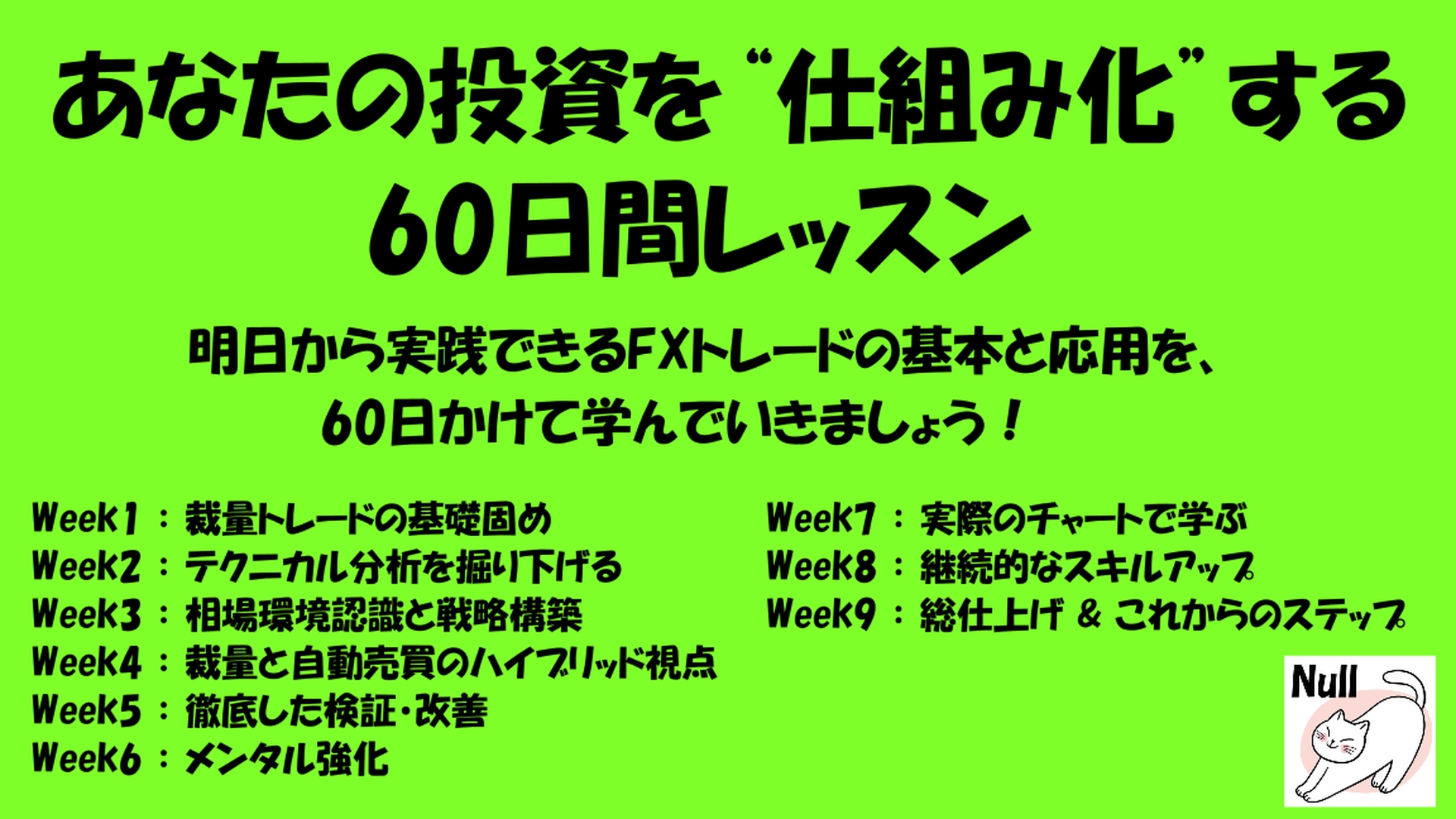

DAY 8: Moving Averages – Simple but powerful tools
By DAY 7, we have built the foundation of basic trading concepts such as money management and mental management.
From today, we will delve deeply intoTechnical Analysis.
First, let's start with the most popular and widely used indicator among professional traders: Moving Average (MA).
1. What is a Moving Average?
(1) Definition and Role
- Moving Averageis a line drawn by continuously averaging the prices (typically closing prices) over a fixed period.
- Purpose: Visually grasp the “average price movement” of the market and help identify trends.
(2) Basic Types
- Simple Moving Average (SMA)
- The most common moving average. It is the average of the closing prices over the period.
- For a 20-day period, it is the value obtained by adding the closing prices of the past 20 days and dividing by 20, plotted as a line.
- Exponential Moving Average (EMA)
- A moving average calculated to give more weight to recent prices.
- Responds to price changes more quickly than SMA.
- Weighted Moving Average (WMA)and others
- Names vary with weighting methods, but the basic idea is similar to EMA, drawing a line that emphasizes recent price action.
For beginners, it is recommended to focus on mastering how to use either SMA or EMA.
2. What the Moving Average Teaches
(1) Market Direction (Trend)
- Uptrend: The moving average itself slopes upward; prices stay above the moving average.
- Downtrend: The moving average itself slopes downward; prices stay below the moving average.
- Range (No clear direction): The moving average flattens, and prices move up and down around the line.
(2) Buy on Dips / Sell on Rallies Guidelines
- During a downtrend, a rally to the moving average is often a good “sell the rally” entry point.
(3) Function as Support/Resistance
- Market participants use the moving average as a guide, so the line can act as support or resistance.
- Periods that many people watch (for example 20MA, 50MA, 200MA) tend to be particularly observed.
3. Common Ways to Use It
(1) Golden Cross & Dead Cross
- Golden Cross (GC): The short-term moving average crosses above the long-term moving average from below.
- Generally considered a “buy signal.”
- Dead Cross (DC): The short-term moving average crosses below the long-term moving average from above.
- Generally considered a “sell signal.”
- Generally considered a “sell signal.”
Caution
- Entering solely on GC or DC signals often leads to false signals.
- In actual markets, it is hard to determine whether the price will move significantly after a cross or reverse sharply after a cross.
- The slope of the moving average, price position, and combination with other indicators are important.
(2) Using Price Deviation
- When price deviates significantly from the moving average,there is a tendency to be pulled back toward the line.
- If a price spike or drop deviates from the moving average, it can be used as a contrarian indicator for a rebound (pullback).
(3) Visualizing Trend Strength with “Three Moving Averages”
- Example:Short-term MA (5 or 10 days), Mid-term MA (20 or 25 days), Long-term MA (50 or 75 days)
- If all three line up in the same direction (upward or downward), it often signals a strong trend.
- Momentum traders aim for this “perfect order” to time buying dips and selling rallies.
4. Concrete Trading Scenario Examples
(1) Targeting an Uptrend with Trend Following
- Both long-term & mid-term MA are rising. Price is also above.
- Enter long when the short-term MA temporarily dips toward the mid-term MA.
- Take-profit targets can be set when the most recent high is updated, or by considering the slope of the moving average further ahead.
(2) Using MA in a Range Market
- If the moving average is flat, the market may be in a range.
- When deviation becomes large, consider contrarian plays and target reversions toward the moving average area…
- However, since it’s difficult to know when a range will break out, a stop-loss setting is essential.
(3) Implementing as Auto-Trading (EA)
- There are many examples of turning MA crossovers, slope, and deviation into system trades.
- Because it is simple, it can be prone to over-optimization, so validation and adjustment are key.
5. Advantages and Disadvantages of Moving Averages
Advantages
- Visually intuitive
- A line drawn on the chart instantly reveals the direction of the market.
- Easy to apply
- Combines well with other indicators or price action for synergistic effects.
- Compatible with automated trading
- Because cross-detection and slope can be quantified, it’s easy to use in EA development.
- Because cross-detection and slope can be quantified, it’s easy to use in EA development.
Disadvantages
- Lagging indicator
- Since it’s based on past data, it tends to lag behind sharp market moves.
- Prone to false signals
- Crosses and rebounds can be mistaken for real signals, leading to large adverse moves.
- Setting the period is tricky
- 20-day may suit some markets, while 50-day or 75-day may suit others.
- Some adjustment or using multiple periods can be helpful.
6. Summary & Next Preview
Summary
- Moving averages are the most fundamental indicators and help clearly identify the market’s trend and direction.
- There are types like SMA and EMA; combining short-, mid-, and long-term can clarify trend strength and pullbacks/retracements.
- Clear signals such as Golden Cross or Perfect Order are popular, but they have false signals, so use them in conjunction with other factors.
- They are frequently used in automated trading, but lag and period setting are key considerations.
Next (DAY 9) Theme: Oscillators – Basics of RSI and Stochastics
- Following trend-type indicators, we will study RSI and Stochastics, representative oscillators.
- They are famous for judging overbought/oversold conditions, but simply reversing positions isn’t always successful.
- Let’s see tomorrow how to effectively combine trend-type and oscillator-type indicators!
If you’re interested in automated trading, please also check the link below.
https://www.gogojungle.co.jp/users/147322/products
If this was helpful, please press “Continue.”
Thank you.
× ![]()