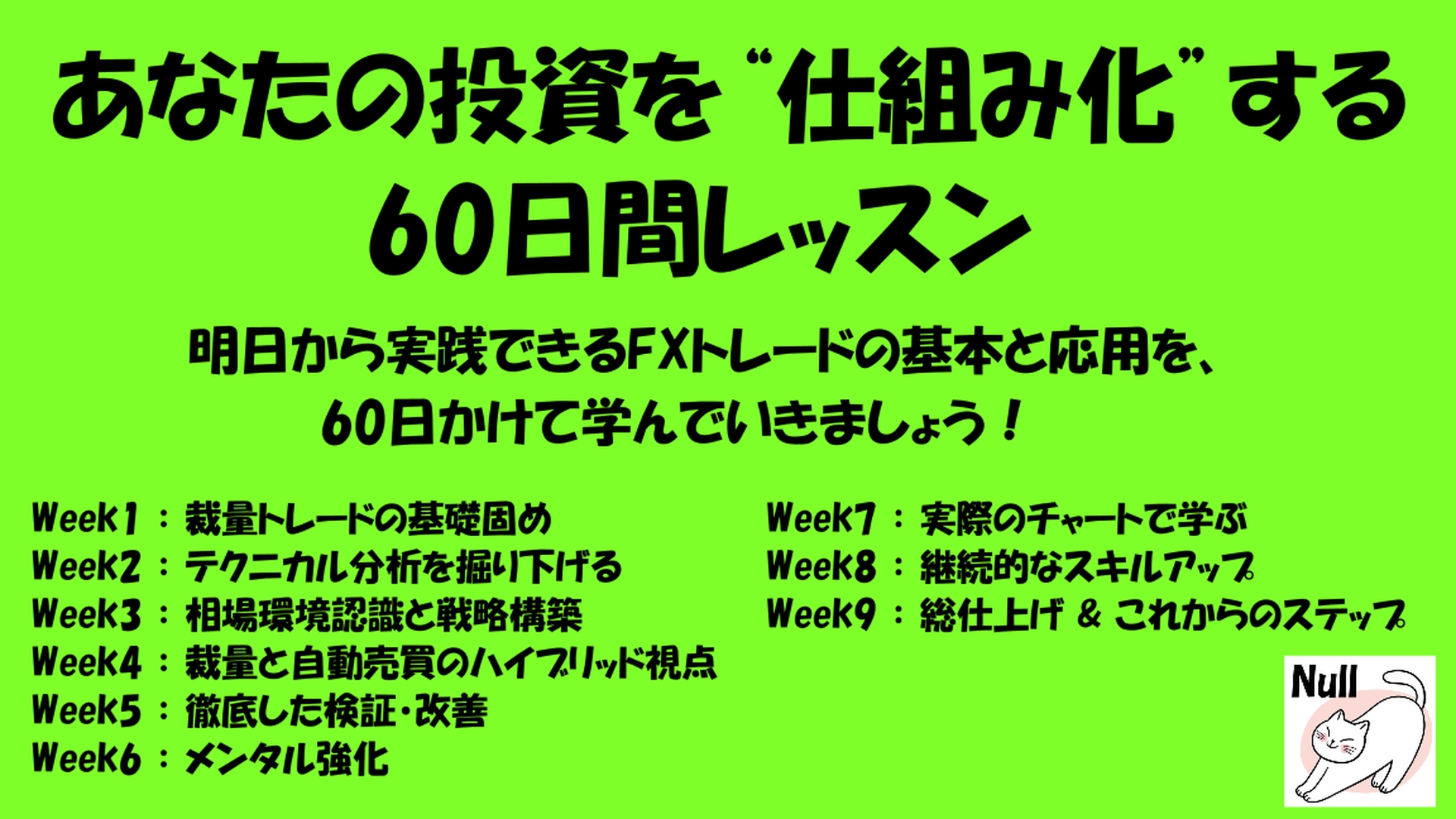

DAY 5: Risk Management – Capital Management and Position Sizing
On DAY 4, we learned the basics of Fundamentals centered on economic indicators. Considering indicators that cause large market moves,risk managementmight have become painfully clear to some of you.
Today, therefore, we will explain the core of risk management in trading: "capital management" and "position sizing." What actually has a big impact on win/loss is not so much the technique itself, but whether the level of risk you take is set appropriately.
1. Basic concepts of risk management
(1) Trading is a game of probability
- There is no method with a 100% win rate.
- Eliminating losses entirely is impossible, so the key is how much loss you are willing to tolerate.
- The idea of “there is a probability of losing, but you ensure it is okay no matter how many times it happens” builds the system for eventual ongoing success.
(2) Loss is a 'cost', profit is 'revenue'
- As mentioned on DAY 1, view losses as “necessary expenses.”
- The issue is whether you are spending money in a way that does not lead to red ink.
- Even if you incur several small losses,as long as you are overall profitable, it’s OK.
2. Why is capital management important?
To survive
- No matter how skilled a trader is, there is a possibility of drawdown (consecutive losses).
- If one big loss wipes out your capital, you won’t be able to seize future opportunities.
- By keeping risk constant, you avoid a fatal hit even during losing streaks.
To maintain mental stability
- When capital management is lax, you constantly worry, “What if I lose next…?”
- It becomes hard to follow trading rules and stay calm for good decisions.
- With proper capital management,you can minimize mental fluctuations.
3. Concrete examples of position sizing
(1) Decide the risk per trade
- Many professional traders fix the amount (or percentage) of capital they are willing to lose per trade relative to total funds.
- Example: For 1,000,000 yen capital, maximum loss per trade is 2% of capital, i.e., up to 20,000 yen.
- Do not take positions that risk more than this 20,000 yen.
- Benefits: Even after a string of losses, capital does not drop sharply. Even 10 consecutive losses would only incur a 200,000 yen loss (20% of capital).
(2) How to calculate actual lot size
- Decide the stop loss width (pips)
- Example: In USD/JPY, set a stop loss of 30 pips.
- Example: In USD/JPY, set a stop loss of 30 pips.
- Decide the allowable loss amount
- With 1,000,000 yen capital, set trade risk to 2% (20,000 yen).
- With 1,000,000 yen capital, set trade risk to 2% (20,000 yen).
- Back-calculate lot size from the loss amount
- Loss for 30 pips should equal 20,000 yen, so adjust position size accordingly.
- In USD/JPY, 1 pip ≈ 100 yen (1 lot = 100,000 currency units), so 30 pips = 3,000 yen × lot size.
- 20,000 yen ÷ 3,000 yen = about 6.66… → roughly0.66 lots.
As a result, if you enter with a 30-pip stop and 0.66 lots, the loss if you lose will be about 20,000 yen (within 2% of your capital).
(3) It is a mistake to decide lot size after deciding stop loss
- The method of “enter with 1 lot first and adjust the stop loss later” carries a high risk of large capital loss.
- Ideal flow: assess the market environment first and set an appropriate stop loss line (support/resistance, etc.) → calculate position size according to your capital rule → enter.
4. Focus on risk-reward rather than win rate
(1) What is the risk-reward ratio
- It quantifies how much loss risk you take and how much profit you aim for.
- Example: stop loss width 1, take profit width 2 → risk-reward ratio is 1:2
- Even with a 50% win rate, a good risk-reward ratio can yield overall profitability.
(2) Relationship between win rate and risk-reward
- High win rate = consistently winning?
- Not necessarily. A method with 90% win rate can still be wiped out by a single large loss.
- Low win rate but high risk-reward can be profitable
- Even with a 40% win rate, if the profit on wins is more than twice the losses, you can be overall profitable.
- Even with a 40% win rate, if the profit on wins is more than twice the losses, you can be overall profitable.
5. Even in automated trading (EA), capital management is crucial
- Should you keep lot size constant in EAs?
- Many EAs use optimized lot settings or martingale, etc.
- However, if the lot size is too large relative to your funds, a few losses can wipe out your margin.
- Setting risk tolerance relative to capital
- Some EAs are designed with a maximum single-trade loss limited to a certain percentage of funds.
- If you can adjust parameters yourself, you shouldset lot size according to your risk tolerance.
6. Summary & Next Episode Preview
Summary
- The essence of capital managementis to keep risk at a level you can tolerate even after several losses.
- Steps for position sizing
- Decide stop loss first → set allowable risk → back-calculate lot size.
- Decide stop loss first → set allowable risk → back-calculate lot size.
- Use of risk-reward ratio
- Don’t chase only win rate; focus on balance between profit and loss.
- Don’t chase only win rate; focus on balance between profit and loss.
- Same applies to automated trading
- Don’t rely entirely on automated trading; understanding lot settings and risk management helps avoid big losses.
- Don’t rely entirely on automated trading; understanding lot settings and risk management helps avoid big losses.
Next time (DAY 6) theme: Mental management – eliminating resistance to cutting losses
- Even when you understand capital management is important, emotional challenges such as “I can’t cut my losses” or “I can’t continue after a losing streak” are common.
- Next time, we will delve into mental management focusing on these human doubts. Since this also applies to automated trading, please look forward to it!
If you are interested in automated trading, please also check the link below.
https://www.gogojungle.co.jp/users/147322/products
If this was helpful, please click "Read more." We would be grateful.
Thank you.