

Examples of buying and selling timing using RSI and Bollinger Bands EA: trend-following and counter-trend strategies
Hello!
This is Satori, researching FX.
Today I bring you an example of trading timing using RSI and Bands for EA long and short positions.
In the previous article “Which is more stable, contrarian or trend-following?” I wrote that contrarian trades more often and makes money, but trend-following has a more stable balance chart.
http://fxmt4indicator.blog.jp/archives/77485740.html
Today I will explain the reason.
The figure below is an example of two consecutive buy wins on EURUSD 5-minute chart.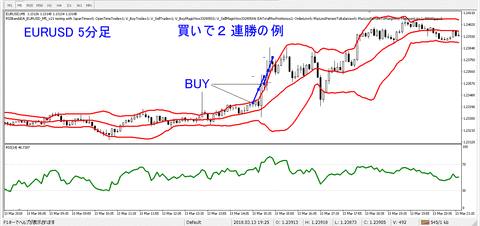
http://livedoor.blogimg.jp/fxmt4indicator/imgs/1/3/132c069a.gif
In the above image, v21 of the RSIBandsEA is used.
The Bollinger Band width narrows, and after the price stabilizes it begins to rise, so a buy is initiated, and by riding the BandWalk flow, it achieves two consecutive wins.
v21 uses a trend-following approach.
Because energy is accumulated in a squeeze and a floor is formed, it is easier to ride the breakout flow.
RSI before entering is above 50, but it is also stable.
In stable market conditions, the price range on a 1-hour chart is estimated to be about 10 pips to 30 pips.
If you tried to enter this manually, typical human psychology would make you wait for the breakout, or jump in after the breakout, and even if the direction is correct, you might not hold the position due to price fluctuations, leading to a higher chance of being shaken out.
Then, with the included v20 contrarian signals, at what timing should you trade? As shown below, it is the timing for entering a sell on GBPJPY 5-minute chart with 3 consecutive wins.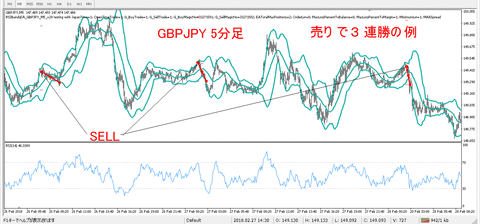
http://livedoor.blogimg.jp/fxmt4indicator/imgs/8/6/861f72a4.gif
In the above image, within a downtrend, Bands and RSI are moving, and the contrarian sellback trades are entered, achieving 3 consecutive wins.
Contrarian aims at market distortions, so this can be considered a successful signal example in that sense.
However, when using EA to continuously trade automatically, how much price range constitutes the fluctuation of contrarian or pullback? In other words, should you enter on a 20-pip pullback? 50 pips? 100 pips? This varies greatly with market volatility.
In short, contrarian trades more often, but statistical data is harder to utilize, and forward performance is less stable.
When performing contrarian manually, if the market is volatile due to sudden news, you can take a break, and you can change the currency or time frame as you see fit, so with market sense you can still pursue volatility trading.
Thus, it depends on the person, but due to human psychology manual contrarian trading tends to be advantageous, whereas for always-on EA, targeting the BandWalk at breakout is advantageous for trend-following.
For this test, I used the current RSI BandsEA contrarian scenario, which supports 8 currencies.
Featuring four logics in v18 (8 currencies supported), contrarian v20 (4 currencies), and trend-following v21 (4 currencies) included, and in the future, all 8 currencies will be supported for v20 and v21 at no charge.
http://fxmt4indicator.abproducts.biz/wp/?page_id=1554
Technical Trade Blog Ranking
※Please register for the free newsletter “FX Research” at the URL below.