

Cryptocurrency Market Analysis [December 3]
Bitcoin rose from a price of92,000 dollars last week and climbed toward the 100,000 mark to98,000 dollars (about 14.6 million yen).
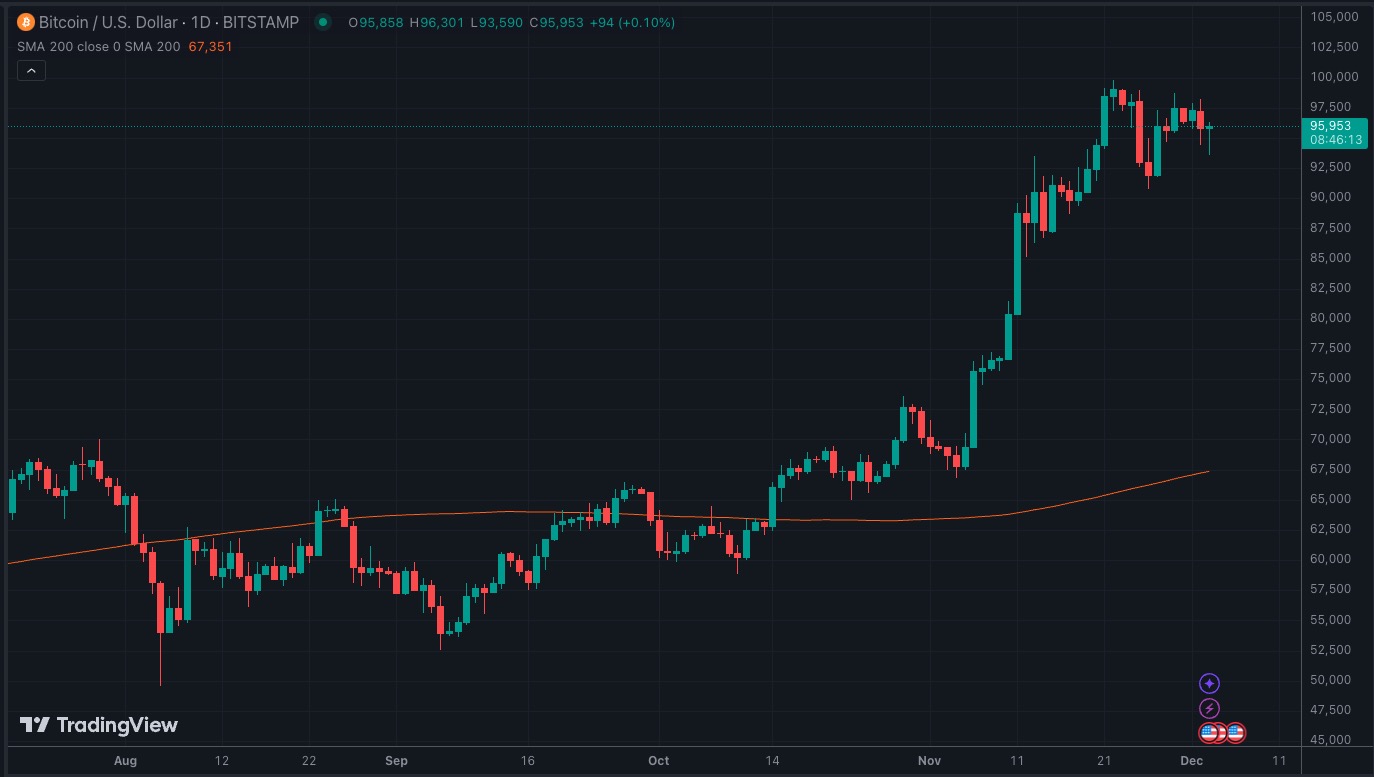
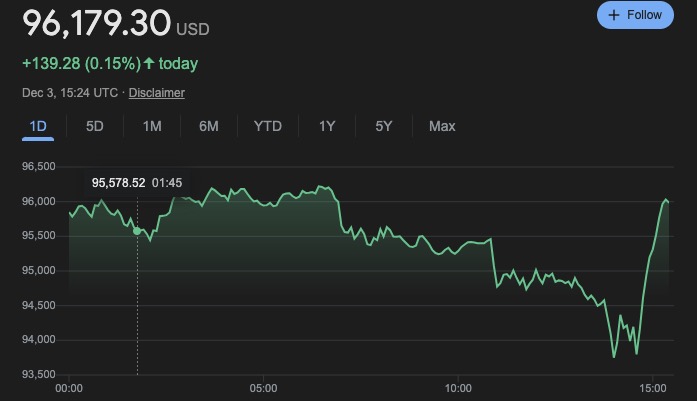
And in the early hours of the most recent4 days, the Korean president issued a "state of emergency," and Bitcoin temporarily fell before rebounding.
Pattern of rebound ↓
ーーーー
Korean President Yoon, on localTV, YTN, said“state of emergency”, causing cryptocurrencies including Bitcoin to crash in won terms. Kimchi shock!
President Yoon said
“Korea will protect its citizens’ freedom and happiness from the threat of North Korea.”
ーーーー
The previous declaration is said to be 44 years ago, and reports indicated that the number of deaths exceeded 100.
Therefore, cryptocurrency trading on Korea’s exchanges on Wednesday appears to be undecided.
This area is thought to have influenced Bitcoin and the cryptocurrency market.
Next, in the movements of this week, Bitcoin ETF and Ethereum ETF saw inflows of funds.
From the following, according to Nikkei
The breadth of institutions holding ETFs that include Bitcoin as part of their assets is widening. Nikkei reported that, compared with three months earlier, the number rose by 20%, exceeding 1200 companies. Investors such as public pension funds, which assume long-term holdings, are investing as an inflation-hedging asset like gold.
ーーーー
Regarding Bitcoin ownership by Japanese companies, Metaplannet is currently well known, but it is expected to increase further.
As for Ethereum ETF, there is a possibility that staking rewards might be allowed during the Trump administration, which has become one of the major factors.
Ethereum has a staking mechanism where you deposit currency and receive interest according to the amount staked. Currently about 3% annual, but with increasing staking, it is said that the interest could rise to 5 to 6%.
This means you could earn interest along with investing in Ethereum, and that expectation is believed to have contributed to the inflow of this ETF.
Bitcoin currently does not have such a mechanism, while Ethereum does.
Another recent surprise is the surge of XRP (Ripple).
Ripple, familiar in Japan for a long time, yesterday surpassed its previous peak price of 400 yen set in 2017.
I never expected it to reach and surpass that high price (in Japanese yen) again.
As for Ripple, Trump’s announcement that profits from virtual currencies issued by US crypto companies would be tax-exempt, and the likelihood that XRP ETF applications would be approved under his administration, along with information that Ripple’s new stablecoin (a virtual currency tied to the dollar) would be traded soon, have been circulating.
These pieces of information are creating strong buying pressure, in our view.
In addition, capital has been flowing into other currencies as Bitcoin’s price surge has cooled.
Also yesterday, former PM Ishiba stated that he does not currently consider separating taxation for cryptocurrency. “Salary taxes can be as high as 55%, so making crypto assets 20% tax may not gain public approval,” Ishiba said.
Japan may still lag behind other countries.
Bitcoin’s performance is very strong, but for some reason it does not become a news story in Japan. This may have resulted in a significant opportunity loss for Japanese people.
The talk in the streets is all about NISA (Nippon Individual Savings Account).
To survive in a Japan with many vested interests, one needs to take proactive steps and look ahead.
By the way, Japan’s cryptocurrency tax rate of 55% is among the world’s highest.
Finally, here is year-end forecast. Arc Investment has been bullish, but it is important to understand the basis.
At the start of the year, Cathie Wood, CEO of Ark Invest, set an optimistic target for Bitcoin to rise from $1 to 1 million dollars per Bitcoin by 2030, and to 1 million 50 thousand dollars to 2 billion 2500 million (approx. 1.5 trillion to 25 trillion yen) with a basic target of $650,000 as the main goal. Phelan (Puell) noted that price could be pushed higher by the advent of the next Trump administration. Who will be selected as the SEC chair and how aggressively the Federal Reserve’s policies align with risk-on assets will influence this. The outlook for strategic Bitcoin reserves goes without saying.
Mr. Puel said, “We should pay attention to monetary policy and the SEC’s stance. But to put it simply, strategic Bitcoin reserves are not just the cherry on the cake, they’re a whole new cake on top of the cake.”
However, this does not mean Bitcoin will rise forever. Seasonalities and cycles suggest Bitcoin could fall from its peak by as much as 70% in a bear market, and the bottom will depend on how far Bitcoin can rise before the music stops, according to Puell.
※In the paid subscription section, we conduct more in-depth stock analysis. For those who want to invest beyond Bitcoin and Ethereum and understand future trends of the cryptocurrency market, please consider subscribing. Continued research is very important.
(This article has been distributed since 2016)