

How to replace EAs according to market conditions (From the perspective of an EA developer)
0
Today, I would like to share with everyone how to switch EAs according to the market environment.
I started developing EAs in 2020, and have developed over 100 EAs to date.
Since I began operating EAs in 2021, my annual net has been positive every year.
Since losers have no credibility, I will publish my real account for EA trading.
REAL TRADE
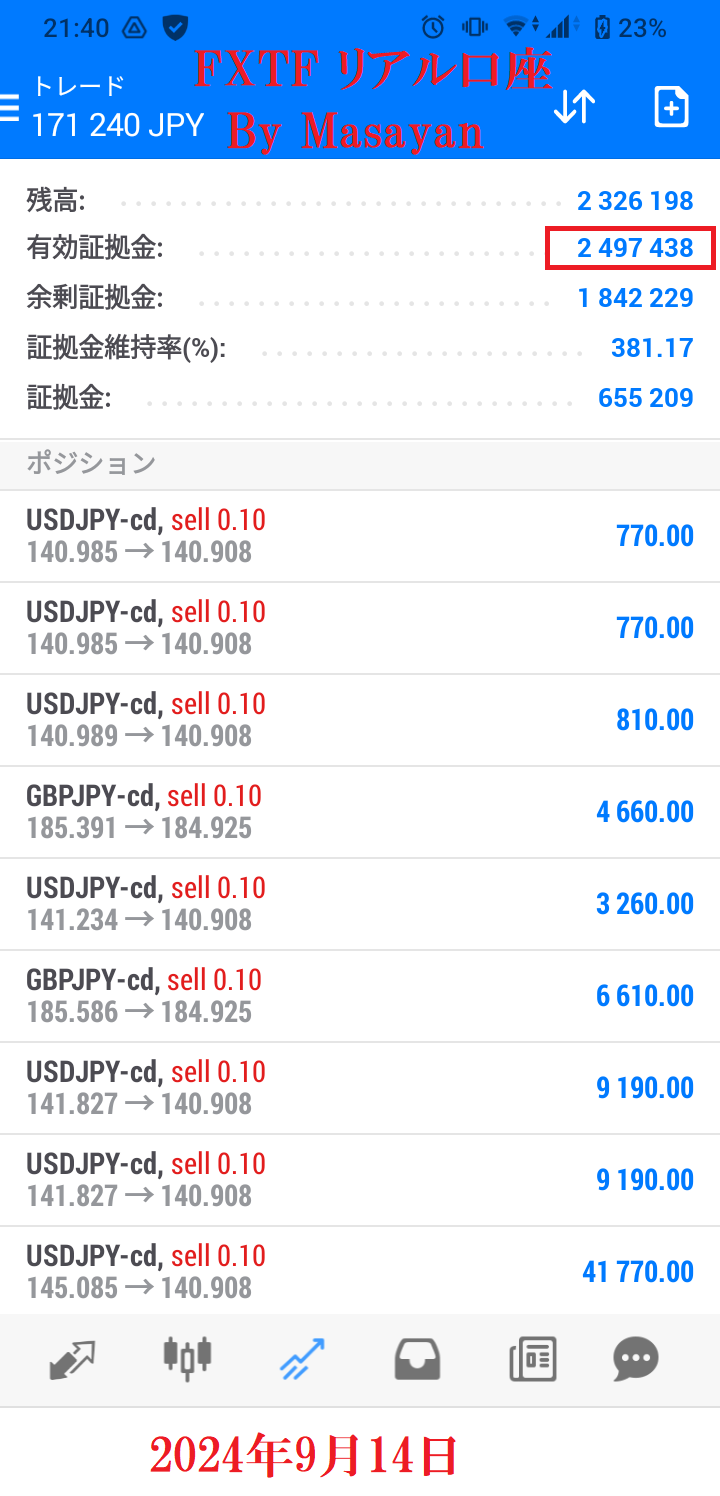
The image above shows my FXTF real account, where I deposited 300,000 yen in June 2022, and the account balance has grown to 2,500,000 yen as of September 2024 through EA operation alone.
While looking at the real-account performance of the EAs I developed and the demo forward results on Gogojungle, I’ve come to understand that different EA types perform well in different market conditions and struggle in others.
I believe this article will be helpful for those who are struggling with EA trading.
The following chart is the weekly chart for USD/JPY.
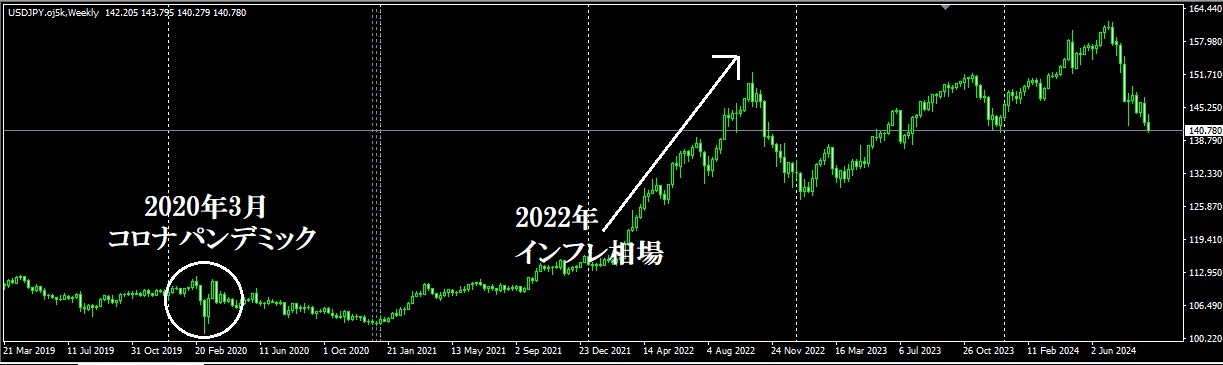
The period is 2019 to September 2024.
Since 2022, inflationary markets have continued with historically high volatility.
In such markets, simply running a high-volatility trend-following EA can generate profits.
So, which EAs dislike highly volatile markets?
The answer is contrarian EAs.
Depending on how the developer tunes parameters, anomaly-type EAs and averaging-down EAs may also fail to keep up with high volatility.
Regarding the EAs I developed, I have a fairly good sense of which market conditions each EA excels in and where it struggles.
Here, I will classify the earlier chart into four types and apply my EAs to see which markets they pair well with.
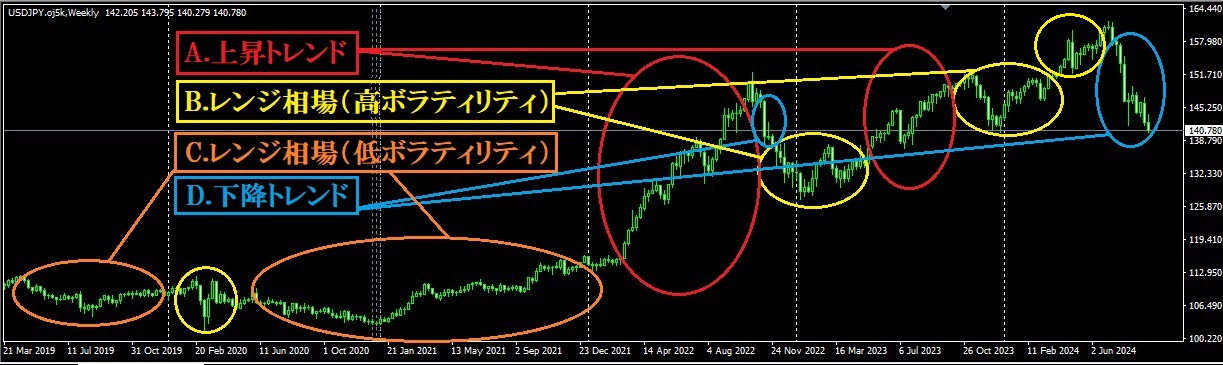
A. Uptrend
D. Downtrend
A and D are trending markets, so I think trend-following EAs tend to win more easily.
C. Range market (low volatility)is also relatively easy to understand.
EAs that pair well with the C market are contrarian EAs, anomaly-type EAs, and averaging-down EAs.
The problem isB. Range market (high volatility).
Volatility is extremely high, so prices move sharply up and down.
Even when there are big moves due to currency interventions or US economic indicators, on a daily bar this market fits.
If you run a trend-following EA in this market, you can get hit with a reverse swing depending on the timing.
Averaging-down EAs or contrarian EAs can, depending on settings, quickly move to the opposite direction while holding a position.
Anomaly-type EAs function in relatively calm markets, I think.
Currently, anomalies are being overwhelmed by high volatility, and anomalies are not functioning well.
Thus, although this is a market range that seems impossible to conquer (high volatility), I believe it can be conquered with the right combination of an EA portfolio.
As of September 2024, the market is in a downtrend, but it’s unclear when it will reverse.
Perhaps it has already shifted into the B market range (high volatility).
Chart shape is retrospective; future markets cannot be predicted.
What can be said is that high-volatility markets will continue for a while.
If so, the current downtrend in D could reverse into an uptrend in A with a V-shaped bounce, or it could become a B-range market (high volatility).
It is unlikely to immediately shift to C’s range market (low volatility), so I think it is desirable to build a portfolio with EAs that respond to both trend markets and high-volatility markets.
The recommended portfolio from my EAs for sale can be verified by the EAs operated in REAL TRADE.
FXTF REAL TRADE
I have picked out a few particularly recommended EAs.
■ EAs suited for trending markets
PerfectOrder_GBPJPY
GoldenCross_USDJPY
Seven Elements
■ EAs suitable for range markets (high volatility)
Hybrid EA Trade USDJPY
In the morning, it uses contrarian logic, and during the day and night, it employs trend-following logic as a hybrid EA.
Bear Mind
A stable grid-time averaging-down EA that cuts losses when the market makes a sudden move.
Reversal Seven Sensitivity MAX25 (needs parameter tuning)
Not only in ranges but also in trending markets, it can aim for profits. By increasing sensitivity, you can time faster price movements.
[Summary]
When building a portfolio, when a strong trend appears, you should maximize profits with EAs that suit trending markets.
When the trend does not continue and the market swings up and down significantly, you should aim for counter-trend with range-market (high volatility) EAs to stabilize income.
Even with only trend-market EAs in the portfolio, you can quickly fall into a pattern of trend reversals and stop-losses.
Even then, by incorporating range-market EAs into your portfolio, you can stabilize earnings using counter-trend methods (investing in the opposite direction of the trend).
Note: even counter-trend is not simply a reverse-contrarian EA.
Also, a simple averaging-down EA that never cuts losses is not good.
Let's use contrarian EAs and averaging-down EAs that are suited to the current high-volatility market.
× ![]()