
Three Essential Steps for Beginners to Master to Succeed in FX Trading
Interested in FX trading and thinking of starting, are you unsure what to tackle first? FX can offer high returns, but starting without proper preparation carries the risk of significant losses. To succeed, you need correct knowledge and a planned, step-by-step approach.
In this article, we detail the three essential steps beginners should take before starting trading, and the points to watch for during the process. After reading this, you should have a clear idea of what to prepare before you begin trading.

Step 1: Acquire basic knowledge
First, acquiring fundamental knowledge of FX trading is the initial step. Starting to trade without understanding how FX trading works is like diving into rough seas without preparation. Make sure you thoroughly understand the following points.
■ How currency pairs work
FX is a trading of currency pairs. For example, in USD/JPY, you trade the pair of the US dollar and the Japanese yen. Understanding how to choose this currency pair and its characteristics helps you grasp the risks involved. Beginners should start with major currency pairs. For example, USD/JPY or EUR/USD, which have high liquidity and relatively stable behavior, making them easier to forecast.
■ Leverage and margin
One of FX’s attractions is the ability to make large trades with a small margin through leverage. However, leverage is a double-edged sword: higher leverage can yield large profits with small market moves, but also increases the potential for substantial losses. Set appropriate leverage and trade according to your risk tolerance.
■ Moving averages and Bollinger Bands
To understand market trends, it’s important to learn how to use indicators like moving averages and Bollinger Bands. Moving averages show the average price over a period and help confirm the trend direction. Bollinger Bands visualize price volatility and help judge whether the market is overheated. Using these basic indicators can improve trading accuracy.
■ Understanding trading hours
FX markets are open on weekdays, and the market is closed on weekends. Understand this and plan your trades accordingly. The market doesn’t move over the weekend, so you cannot practice on a demo account. Manage your trading schedule efficiently to learn effectively.
Step 2: Practice on a demo account
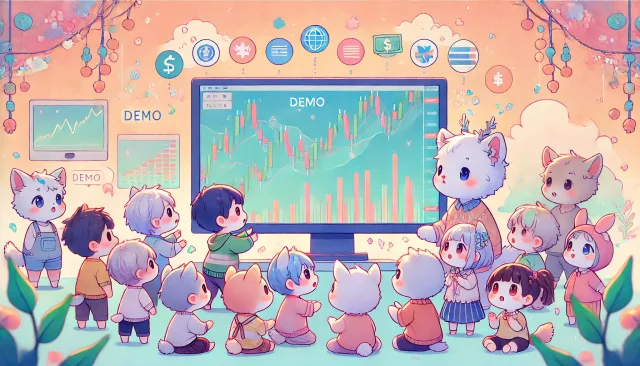
After acquiring basic knowledge, your next step is to practice on a demo account. A demo account is a highly effective tool to learn trading feel without using real money. It’s a great opportunity for beginners to learn the basics without taking on risk.
■ Benefits of a demo account
The biggest advantage of a demo account is that it’s free and easy to use. Since you practice in a simulated real trading environment, you can experience the flow of real trading. There is no risk of losing funds, so beginners can start trading with peace of mind.
■ Limitations and risks of a demo account
However, you should also understand that demo accounts have several limitations. Success on a demo does not necessarily translate to real trading. Demo accounts often provide ample capital, allowing large lots, which can lead to reckless trading and overconfidence. It can be very dangerous to immediately put real money in just because you had a win on a demo.
Also, since funds can be reset easily on a demo account, even if you lose big, that experience may not transfer to real trading. Moreover,human memory tends to be biased: you may remember winning excitement but forget the losses and the resets.FX is a simple game of guessing whether prices will go up or down, so you can win with a casual order, but continuing that approach will almost surely lead to large losses.
Warning: if you feel “this looks easy to win,” that is a complete misconception.Do not overhype a short-term demo success before investing real money; think carefully. Many beginners suffer large losses due to this overconfidence. Real-money trading adds emotional pressure, often producing results different from demo trading.
Furthermore, trades based on unfounded predictions or wishful thinking can lead to bankruptcy. When losses grow, clinging to hopes like “it will come back soon” or “it will recover” without evidence often widens losses. In such cases, you may suffer margin calls and be forced to add funds. Ultimately, you could face losses so severe you cannot discuss them with your family.
■ Do not misinterpret FX as a game
Some people tend to view FX as a game, but that is a significant mistake. Just as in sports, study, love, or games, success in any field requires practice and effort. Investment is no exception. To succeed in FX, continuous learning and accumulation of experience are essential. Don’t assume you can win just by following arrows or placing orders mechanically as if it were a game. In reality, winning that way is extremely difficult and likely to cause losses.
Investment skills last a lifetime. With proper practice and experience,you can acquire enduring skills that will benefit you for life.
Step 3: Practical training using a trading simulator
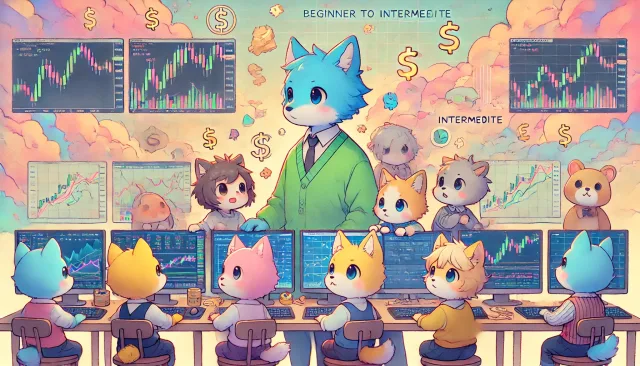
After learning the basics with a demo account, the next step is practical training using a trading simulator.
Demo practice covers the basics, but there are limits to practicing in a market-like environment. In particular, demo accounts progress at the same pace as real time, which is not ideal for efficient learning. Using a trading simulator lets you gain experience more effectively.
■ What a trading simulator should offer
A good trading simulator should have the following capabilities.
- High realism: Some simulators differ from real charts and move in chunky one-candle steps, which is not conducive to practice. It is essential that price movements resemble real market behavior.
- Speed control: Being able to freely adjust playback speed lets you observe market moves in detail and learn from them. Use fast-forward to study many trade patterns efficiently.
- Pause: Pause the flow of trades when needed to think through your strategy. This feature is indispensable for developing judgment in critical moments.
- Retry/rewind anytime: Replaying the same trading scenario multiple times with different strategies helps you find the optimal approach and establish a trading style that fits you.
- Clear P/L display: A function that clearly shows the profit and loss of each trade makes analysis easier and helps improve risk management. Real-time P/L helps you craft more accurate strategies.
Using a simulator with these features allows beginners to practice in a market-like environment and effectively improve their skills. A trading simulator not only increases time efficiency but also enables trying and refining various strategies.
Demo account testing is often slow to yield results and not very efficient.With a trading simulator, you can analyze many charts without wasting time and quickly improve your skills as a trader.
FX is not about luck. It’s important to find a strategic, reliable way to win and steadily grow your capital. Do not do this with real money; instead, use a simulator to win with zero risk.
Prepare thoroughly by using a trading simulator
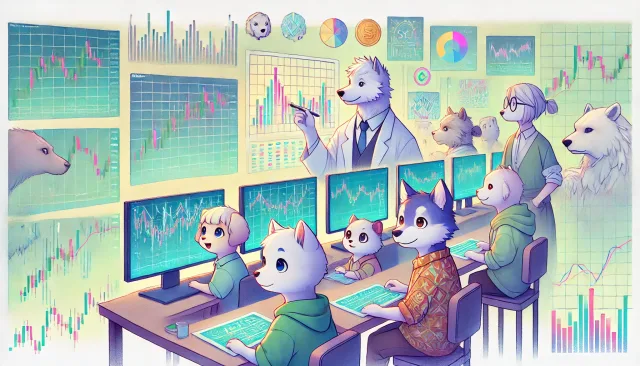
Before starting FX trading, solid foundational practice on a demo account and practical training with a trading simulator are the keys to success. Don’t overbelieve short-term demo successes—establish winning strategies with the simulator before proceeding to real trading.
■ What is a trading simulator?
Trading simulators range from inexpensive, low-feature models to expensive, high-feature models; some expensive ones may still be quite limited. The balance between required features and price is crucial. If you’re paying tens of thousands for a tool, you might be better off allocating that money to your trading capital.
For example,One-Click FX Training offers a low-cost yet high-functioning simulator. This simulator uses real market data and can replay past trades multiple times, enabling traders of all levels to refine strategies. It particularly excels in speed control, pause, and redo functions, and displays real-time P/L, allowing practice in an environment close to real trading.
Using One-Click FX Training helps you gain confidence and skills for actual market trading. By mastering risk-managed, reliable strategies, even beginners can confidently attempt practical trading.
▼ Details of One-Click FX Training MAX are here