
【FX】The Basics
This is Geko.
Before writing about FX automated trading software (EA)
I’ll cover the basics of FX first.
What is FX in the first place?
FX stands for Foreign Exchange, referring to “foreign exchange margin trading.”
What’s that all about?
That’s what it feels like, but…
Foreign exchange refers to the major currencies that are in circulation.
United States Dollar【USD】
Euro【EUR】
British Pound【GBP】
Australian Dollar【AUD】
Japanese Yen【JPY】
and many other currencies.
Trading these currencies against each other is what we call “trading (= trading).”
For example, let’s trade the USD/JPY pair.
When the exchange rate is 150 yen per dollar and you buy 10,000 dollars, you place a “buy entry.”
Since you buy 10,000 dollars at 150 yen, you purchase 1,500,000 yen worth and hold a long position of 10,000 dollars.
When the rate becomes 151 yen per dollar, you close the 10,000-dollar long position.
At 151 yen per dollar, you settle 10,000 dollars worth 1,510,000 yen.
From entry to closure, the trade yielded a profit of 10,000 yen.
The FX rate is a moving target, so of course the opposite case can happen as well.
If you hold a 10,000-dollar position when USD/JPY is 150 yen and close it when it’s 149 yen, you incur a loss of 10,000 yen.
By the way, if you need 1.5 million yen just to hold a 10,000-dollar position, you wouldn’t trade so easily, right?
That’s where the “margin” system comes in.
This is one of the great attractions of FX.
The margin system, in simple terms, lets you hold large positions with a small amount of money (margin).
There’s also the term leverage.
In domestic FX brokers, the maximum leverage is set at 25x, so,
With a margin of 10,000 yen, you can hold a foreign exchange position worth 250,000 yen.
For example, at a certain broker, at a certain time (varies by day),
the minimum margin required to hold a 10,000 currency position in USD/JPY is announced to be about 60,000 yen.
Basics of trading
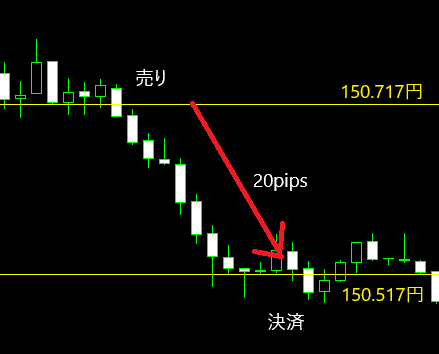
There are two patterns to make a profit in FX.
Buy at a low rate and close at a high rate
Sell at a high rate and close at a low rate
*Refer to the image
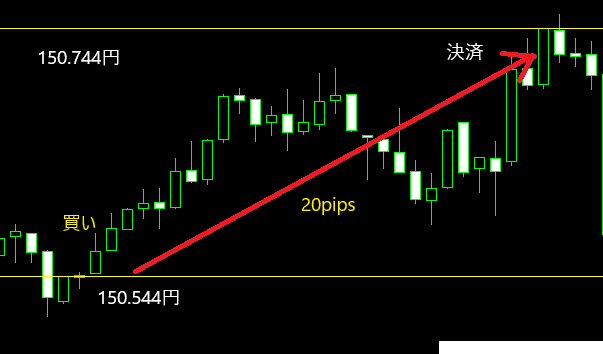
In the image, you can see a display of 【20 pips】, right?
This pip/pips is a unit that represents the price movement of the rate.
In cross pairs like JPY pairs, 1 pip = 0.01 yen
In dollar-based pairs, 1 pip = 0.0001 dollars
If the USD/JPY moves from 150 to 151, that’s a movement of 100 pips.