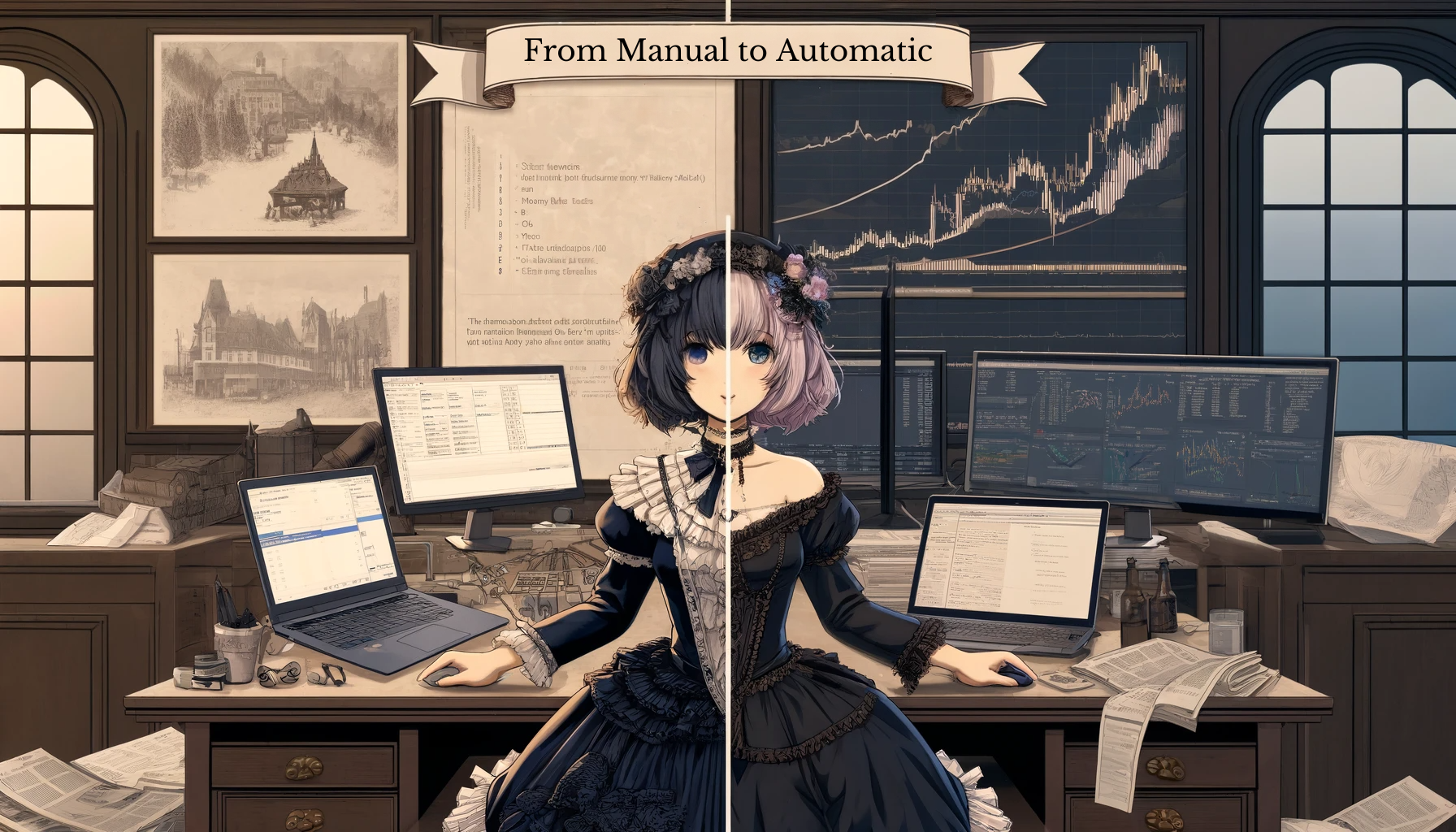

From manual to automated - discretionary traders turning into EA developers
Introduction
There are many approaches to trading in the foreign exchange market, but they are mainly divided into two: "discretionary trading" and "automatic trading." Discretionary trading is a method where the trader uses market information to make judgments and places trades manually. On the other hand, automatic trading is where a program executes trades automatically based on predefined rules. These two methods have markedly different participant roles and trading styles.
There are many advantages for discretionary traders becoming EA (Expert Advisor) developers. First, they can leverage market experience to build more accurate trading strategies. Also, in automated trading, decisions are not swayed by emotions, enabling consistent trading, which is a major benefit. Furthermore, it becomes possible to cover all market hours, eliminating the need for constant human supervision and enabling efficient trading. As a result, discretionary traders can apply their trading skills to a wider range of market environments, potentially achieving more consistent profits.
How discretionary trading experience influences EA development
Discretionary trading sharpens a wide range of skills, including market reading, trade timing, and risk management. These skills help traders sense subtle market fluctuations and make quick judgments accordingly. In discretionary trading, reading market psychology is also important, providing insights that cannot be captured by numerical data alone.
These experiences are highly valuable in EA development. The market analysis skills cultivated in discretionary trading play a crucial role when designing EA strategies. For example, by programming successful trade patterns observed under specific market conditions, you can automate that strategy and expect more consistent results. Additionally, risk management techniques directly aid in setting loss limits and take-profit rules in EAs.
In summary, the intuitive sense and analytical skills honed through discretionary trading enrich the logic ideas in EA development and contribute to building more effective trading systems.
Step-by-step guide to EA development
Developing an Expert Advisor starts with precise market analysis. First, understand market behavior and identify which financial indicators influence price movements. Next, form the trading logic based on this analysis. In forming the logic, this includes defining entry and exit points, selecting the technical indicators to use, and establishing risk management strategies.
Once the logic is determined, move to the backtesting stage. Backtesting applies the EA to historical market data to evaluate its performance and verify whether the strategy could theoretically be profitable. Through this testing, the strengths and weaknesses of the trading logic become clear, revealing under which market conditions it is effective or less effective.
Finally, optimize the EA. In this stage, based on the data obtained from backtesting, adjust parameters to improve performance. For example, fine-tuning stop-loss and take-profit settings can improve the balance of risk and return. Through this process, the EA provides more consistent results in real trading environments.
Success stories
Many discretionary traders have found success transitioning to automated trading, but a particularly notable case is a Tokyo-based trader who made a leap as an EA developer. This trader leveraged years of discretionary trading experience to embed his own trading strategy into an EA. His EA excels in high-volatility markets and achieved high returns in a short period.
The key to this success was his deep market understanding and his ability to translate it into concrete trading logic. He understood from past trades which market signals were important and incorporated them into the EA's algorithm. He also spent extensive time on backtesting, thoroughly analyzing the EA's performance under various market conditions.
The lesson from this case is that successful EA development requires more than just programming skills. Deep market understanding and the ability to automate it efficiently are essential. Also, repeatedly testing and optimizing without fear of failure leads to eventual success.
Summary
When starting EA development, there are several important cautions. First, without a solid trading strategy, you cannot develop an effective EA. Before starting, it is important to deeply understand market analysis and your own trading style, and to set具体 trading rules. Also, basic programming knowledge is necessary, but if you lack specialized skills, collaborating with a professional developer is one option.
Tips to apply discretionary trading experience to EA development include carefully recording patterns from successful trades and incorporating those conditions into the EA's logic. Also, to ensure the EA behaves as intended, thorough backtesting and forward testing are necessary. Finally, since the market is always changing, it is important to regularly review and adjust the EA as needed.
Through this process, discretionary traders will be able to build new successes in the world of automated trading.
To everyone
Thank you for reading the article.
If you would like more detailed information or are interested in my background, please visit my profile page via the links below.
As one of Japan's oldest MetaTrader FX automated trading developers, I have over 15 years of experience and a long track record.
I ranked first among 6,000 systems at the Trendsing Tournament '15 and was the runner-up in the 3rd EA-1 Grand Prix, and I have appeared in various media with my techniques and insights.
My profile page is here:Bear-chan @ Tokyo System Trading Profile
× ![]()