

The Secret to Cutting Losses II ~ A Method That Starts with Cutting Losses ~
Thank you for your hard work.
This is Nobushi.
In the previous article, I talked about how to think when placing stop losses.
To summarize,
・Do not set stop loss width based on personal convenience
→This is your limit financially... (If you lose a certain percentage of total assets...)
→ Psychologically, this is your limit... (Because a sudden large adverse move happened, you’re scared...)
We discussed that stop losses must be placed based on the chart, not personal preference.
Now, let's actually decide the stop-loss point.
By the way, I haven’t touched on entry points at all yet, but since the theme this time is stop-loss first, the method proceeds in this order.

Well, for example, let's talk about the current USD/JPY 1-hour chart.
Leaving aside the entry rationale, suppose we enter here by selling.
In this case, before entering, we should first decide the stop-loss point, right?
Let’s not decide the stop-loss after entering and retroactively.
So, where should we place the stop-loss point?
As I mentioned last time, there are various ways to place a stop-loss.
However, at minimum, it must be chosen based on the chart’s conditions.
Suppose we set this recent high line as the stop-loss line.
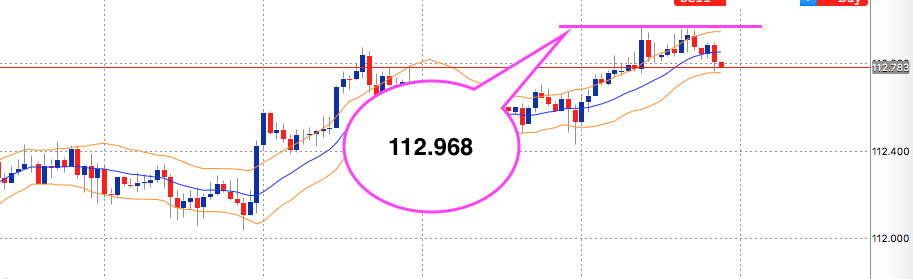
In that case, it is about 20 pips from the current price, so the stop-loss width is −20 pips.
If this width can be endured with the current assets, then entry is possible.
Now that we are risking 20 pips, we must seek a reward that matches that risk.
What is the profit target in pips that matches this risk?
A commonly advocated principle isthe 1.5x rule, right?
It is the principle to aim for a profit width 1.5 times the stop-loss width.
Then the target would be 30 pips, so place the take-profit around 112.480.
To be honest, I haven’t even considered entry rationale or take-profit points at all.
If you enter from the stop-loss line, everything will be decided, and after entry you just follow that rule.
Of course, there are times when things don’t move as expected, and you may enter a range and get anxious and retreat.
In such cases, discretion is needed, but having the stop-loss point decided versus not having it decided makes a world of difference.
This time I entered without any rationale, but if your usual method can predict the price direction with at least over 50% probability, you will likely be able to stay profitable.
To be honest, I think reading price movement with 100% accuracy is impossible.
The market is a living thing, so it’s natural that it doesn’t move as you wish.
In such situations, you will scramble to find a slightly higher-probability point and attempt an entry.
That effort isn’t wasted, but I would also like you to dedicate that passion to your stop-loss line.
“I can’t win like this anymore…”
If you feel that way, before giving up, please try a stop-loss-first approach as if you were deceived.
Your stop-loss may increase from now, but your entries will also increase, and in the end your profits will likely increase as well.
It will also help you control your mindset considerably.
In the next installments, I will introduce myactual method.
However, from the next article onward, there will be paid content for those who have already purchased access.
Therefore, if you wanted to deepen your understanding of stop-loss, you may stop reading here.
I have completed about 90% of what I intended to convey this time.
If anyone is interested, please continue to check in the next installments.
Thank you for reading this series.