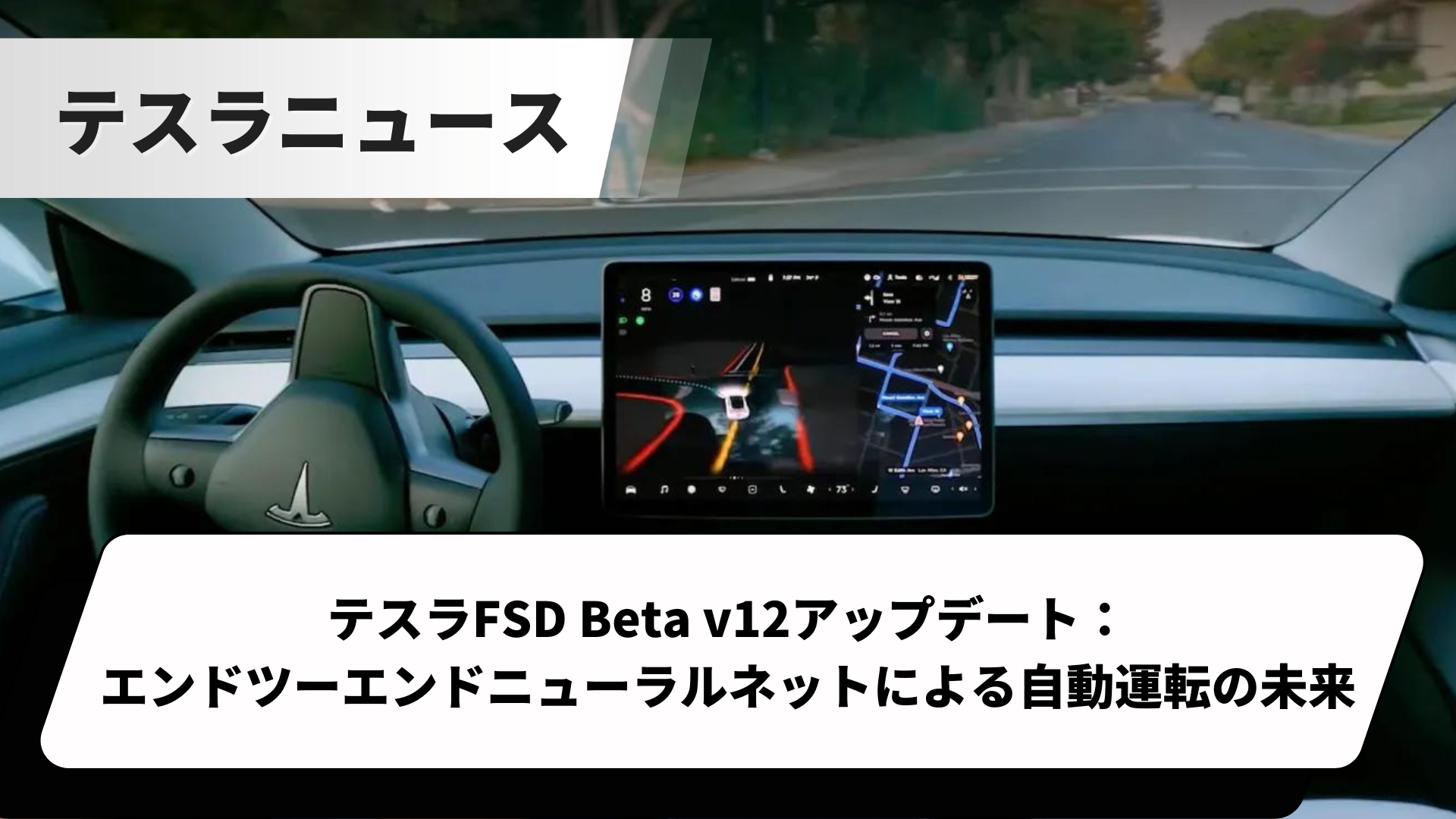

Tesla FSD Beta v12 Update: The Future of Autonomous Driving with End-to-End Neural Networks
Introduction
Tesla has released its latest technology, Full Self-Driving (FSD) Beta v12. This latest update can be considered a significant step toward the future of autonomous driving. In particular, by adopting an end-to-end neural network, the vehicle’s control has undergone a major shift away from traditional programming methods. This innovative technology enables the vehicle to understand more complex environments and make human-like intuitive driving judgments.
This article delves into the main features and significance of the FSD Beta v12 release, as well as the impact of Tesla’s autonomous driving technology on society. It also analyzes the concrete safety implications of introducing the technology and the prospects for future autonomous vehicles.
The target audience for this article is broad, ranging from Tesla owners and potential buyers to technology enthusiasts, automotive industry professionals and analysts, investors, and general consumers interested in the safety and ethics of autonomous driving technology. It provides detailed and expert insights into the significance and future of FSD Beta v12 for a wide readership.
With the rollout of this latest technology, we feel that the future of autonomous driving is drawing even closer. However, it is crucial to prioritize safety in this evolution and to introduce the technology in the best possible way for society. Through this article, we aim to give readers a deep understanding of Tesla’s FSD Beta v12.
Key Features of FSD Beta v12
Introduction of End-to-End Neural Network
Tesla’s FSD Beta v12 update opens new horizons for autonomous driving by adopting an end-to-end neural network. This evolved system processes the vast amount of data collected from the vehicle’s sensors directly and converts it into real-time driving actions. With this technology, Tesla has significantly advanced beyond the traditional program-based approach, enabling the vehicle to mimic driving decisions in a more human-like manner.