

Do you know the definition of EMA?
Issue regarding the name of EMA
"Why is EMA (Exponential Moving Average) called 'exponential smoothing'? Explain from the definition of EMA."
In the first place, readers are probably thinking, "If you don't know the definition of EMA, you can't explain the reasons!"
Foreign traders often use EMA, but many Japanese people may not understand it and choose to use SMA instead, right?
In books and online, explanations emphasize "a moving average that gives more weight to the latest prices," but the calculation formula is not written, which is very unhelpful.
However, unless you understand EMA, you cannot understand the MACD, which is built upon it.
Know the drawbacks of SMA, understand EMA, and learn to use MACD correctly.
So please read this content to the end and understand it.
If we briefly state the answer to the question,
Answer
"The weight of the price decreases exponentially, and it moves more smoothly than SMA."
In the previous article, I wrote about the drawbacks of SMA.
This time, I will explain how EMA compensates for those drawbacks.
Explanation
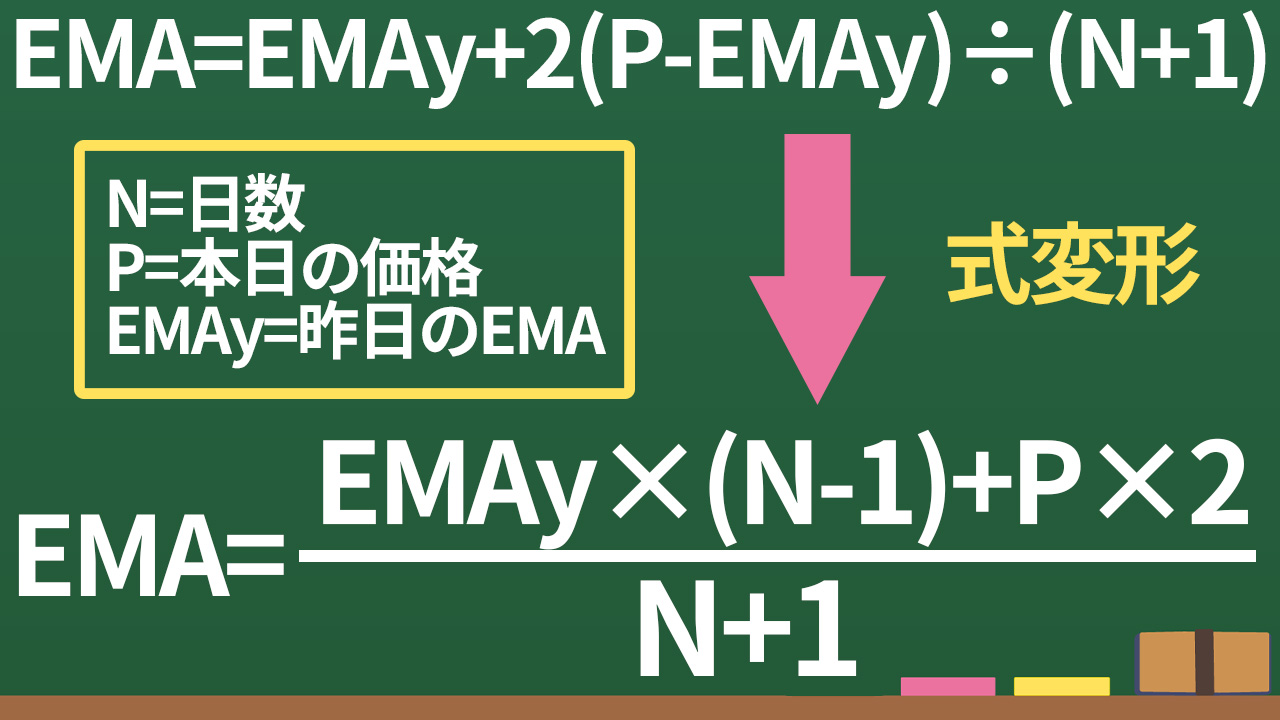
The definition of EMA is,
Today's EMA = Yesterday's EMA + (Today's price − Yesterday's EMA) × 2 ÷ (N + 1)
If you rearrange this formula, you get this.
Today's EMA = {Yesterday's EMA × (N − 1) + Today's price × 2} ÷ (N + 1)
The initial EMA is substituted with SMA.
To make this easier to understand, let's consider a concrete example with a 9-day EMA.
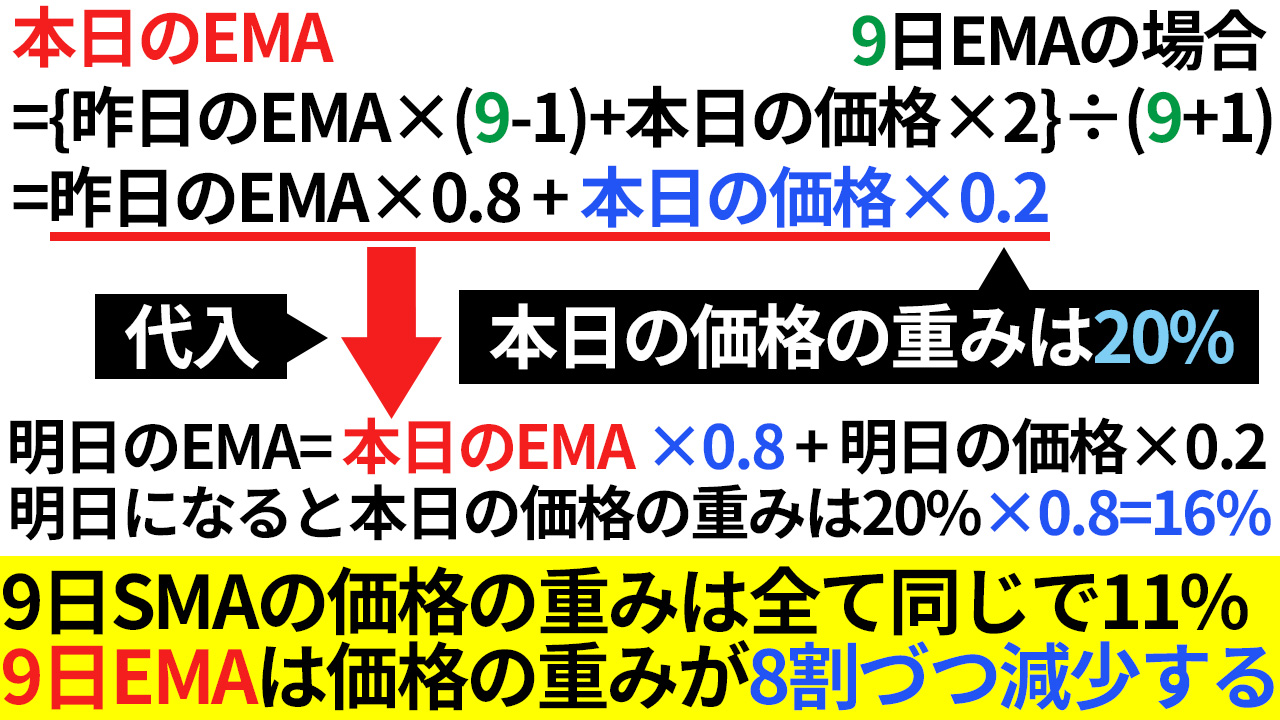
Today's EMA = {Yesterday's EMA × (9 − 1) + Today's price × 2) ÷ (9 + 1)
= Yesterday's EMA × 0.8 + Today's price × 0.2
The weight of Today's price is20%.
What happens tomorrow? how will it change?
Tomorrow's EMA =Today's EMA × 0.8+ Tomorrow's price × 0.2
Since Today's price is included in Today's EMA with a 20% weight, tomorrow's weight becomes 20% × 0.8 = 16%
In other words, the weight of Today's price for tomorrow is 16%.
While the 9-day SMA gives equal weights to all past prices (about 11.1% each),
9-day EMA has prices weights decreasing as 0.8, meaning decreasing by 80% step by step.
This is why EMA is called Exponential.
In general, when expressed as N,
N-day SMA price weights are all equal to 1/N.
N-day EMA price weights decrease by (N − 1) ÷ (N + 1) step by step.
In the previous article, there are two drawbacks of SMA.
・It treats past N days' prices with the same weight
・It does not reflect the influence of prices before the past N days
・Decrease the price weight as time passes
Also, EMA reacts more quickly to price changes than SMA, so it moves more smoothly.
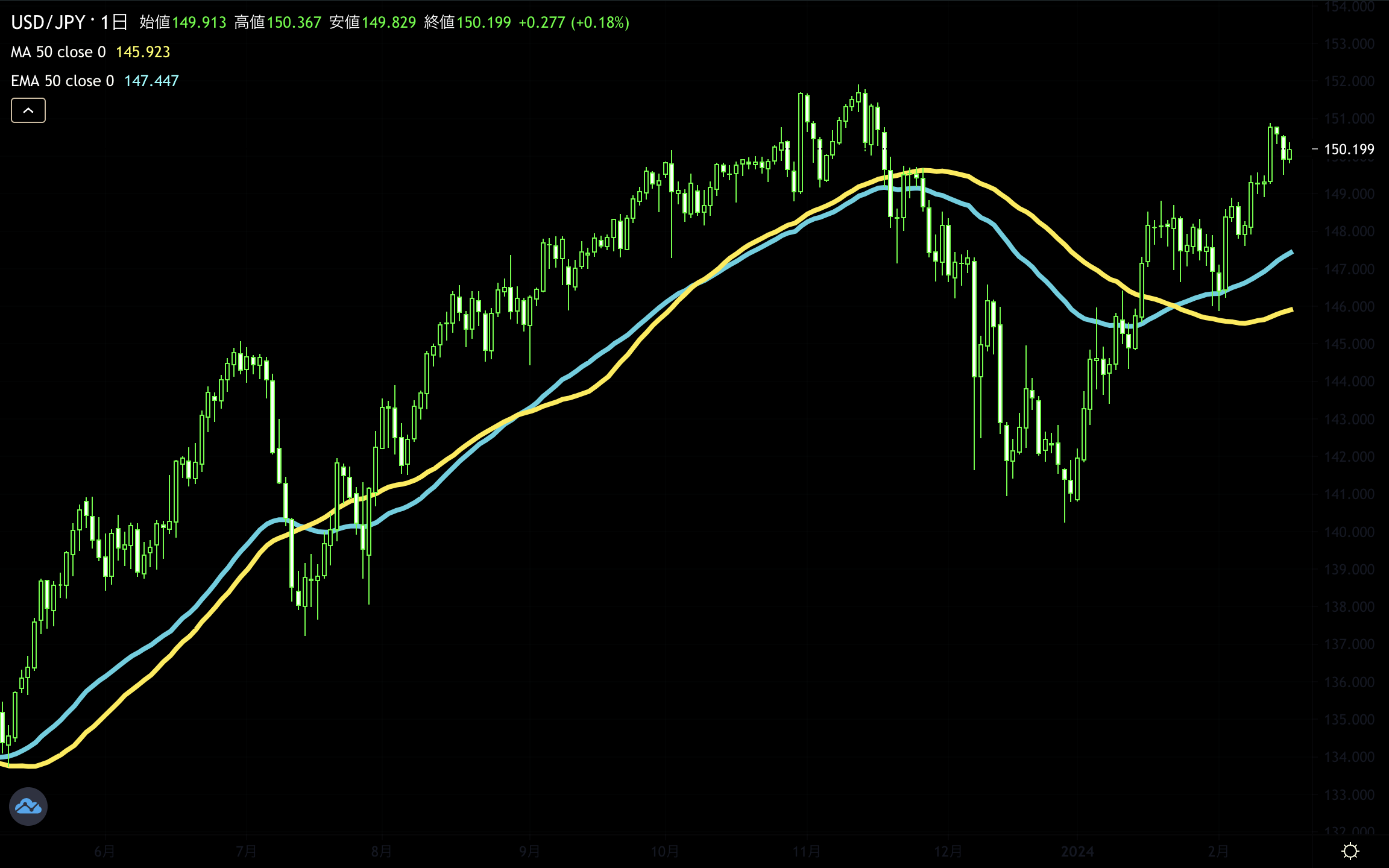
The yellow line is 50SMA
The light blue line is 50EMA
You can see that it stays closer to the price.
To generally explain why EMA is called "Exponential Smoothing,"
Answer
"From the definition, the weight of the price in the N-day EMA decreases by(N − 1) ÷ (N + 1), i.e., decreases exponentially, reacts to price changes faster than SMA, and moves smoothly."
Also, EMA overcomes the confusion where, in the previous article's problem, prices rose while the moving average fell, i.e., the trend direction was unclear.
EMA Definition
Today's EMA = Yesterday's EMA + (Today's price − Yesterday's EMA) × 2 ÷ (N + 1)
If you focus on the part "Today’s price − Yesterday's EMA" in this formula, you can understand the following:
If today's price is higher than yesterday's EMA, EMA will rise.
If today's price is lower than yesterday's EMA, EMA will fall.
Why is the Golden Cross a Buy Signal?