

January 6 (Fri): Nikkei 225 (Free viewing item: when in doubt, look at the larger chart bar)
Good morning☀
Today as well, my son has a game starting from the morning, so I’m posting early?
(Please finish the winter vacation soon? (lol) Weekday morning practices are tough in various ways lol)
First, a introduction of questions
「In 'A New Introduction to the Bollinger Bands', it says to look at the weekly to 4-hour charts, but in the explanation it looks from the monthly chart. Why?」
Honestly, right now the waveforms of any stock on the weekly chart are a bit iffy?
So I look up to the monthly chart for reference.
Normally you would only look occasionally, but when there are turning points, you look carefully.
Many amateurs tend to squint and narrow their view just because they don't understand…
As a result, they tend to end up looking at smaller timeframes more and more.
Especiallythey think, “If I look at the smaller timeframes, I can catch the reversal?”
and end up with that misunderstanding.
As a result, they get whipped by small waves and end up in a flurry of stop-outs…?
If you want to keep earning, it’s the opposite!!!
If you don’t understand, just watch the bigger timeframes and take your time.
And you should also carefully observe the usual timeframes you look at, and trade once the overall market conditions become clear.
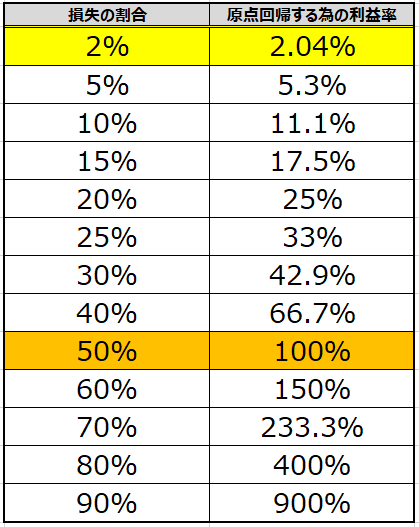
This isthe profit rate needed to return to the origin after incurring losses.
With about a 2% loss, you can roughly recover with a 2% gain.
However, once it exceeds 10%, you cannot recover with the same percentage gain.
It becomes gradually more difficult.
Usually, I talk about setting stop losses based on this table, but this time it’s about not getting whipped by small waves and always stopping losses!
If you accumulate losses, your stop-outs can quickly reach 10% or more.
It will not always be high-probability that you can make profits.
There are times when the probability seems low.
In such cases, skip it.
Rather than regretting opportunity losses, it is far more meaningful to limit poor losses.
If you reduce losses, your assets will keep increasing.
If you’re unsure, cultivate a habit of looking at the larger timeframes, okay?
(※The following environment understanding is limited to members only.)