

Cryptocurrency Market Analysis [September 6]
Practical Investment in Cryptocurrency Article September 6
Dear subscribers
If you have topics you’d like us to cover or questions, please contact us.
Q&A
We will introduce parts of it in the column.
【Awarded 5th place in MagMag Magazines Award】
At MagMag, a major newsletter site in 2020,
the MagMag Magazine Award was announced
and we were able to win a prize.
※Currently MagMag’s distribution has ended
and this article has transitioned to this.
【Cryptocurrency Market Analysis】
The price changes of cryptocurrencies since last week
are summarized as follows (one week)
Display: current price (change from one week ago)
Bitcoin282万 yen(-%)
Ethereum237000円(10%)
Binance Coin40000円(-%)
Ripple47円(-3%)
Solana4700円(5%)
Cardano70円(13%)
Polkadot1000円(7%)
Avalanche 2850円(6%)
Uniswap922円(4.6%)
ICP 976円(5%)
Bitcoin is slightly up from the 270万 yen level from last week.
Bitcoin daily chart (USD)
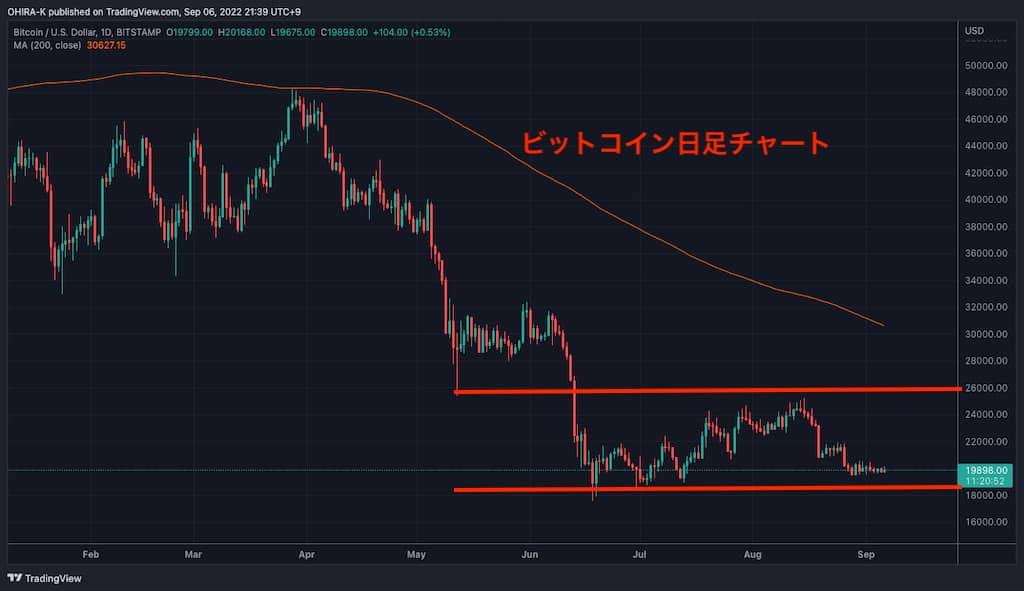
In the daily chart6month, the price steadily rose from a short-term low,8month19to20days, but a large downward adjustment occurred, leading to the current price.
Two weeks ago Bitcoin dropped sharply, so there was attention whether it would break below the notable price range of 20,000 USD, but so far it has managed to hold.
As last week, the current price appears to be within the range of 26,000 USD on the upside and 18,000 USD on the downside.
Last week the price movement was particularly calm and stable.
Next, let’s look at the weekly chart (USD).
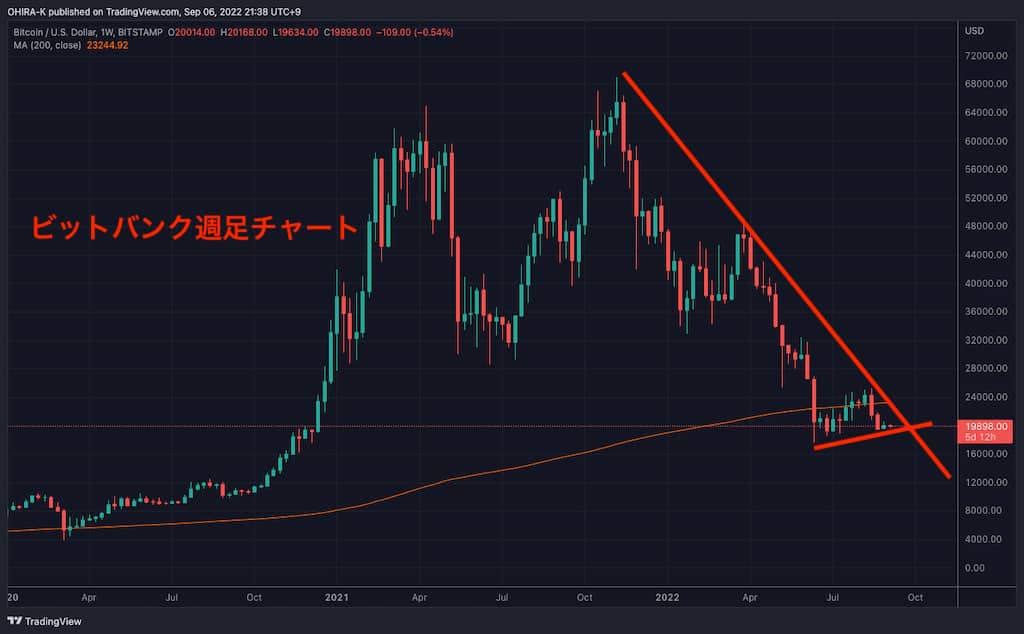
We have been analyzing as follows.
- From the late 2017 bubble peak, there has been a rebound and a short-term upturn, but it fell to the June low levels
- It is below the 200-day moving average (orange line)
This is the situation.
On the chart, the red line drawn from the end of 2021’s high is neatly drawn.
And since the June-end low the line tilts upward, so some might view it as a barely rising trend.
【Ethereum’s Major Upgrade Merge Approaching】
The Ethereum merge is scheduled around September 15 (could happen sooner).
After the merge, it is said that the new Ethereum and the original Ethereum will likely fork.
At that time, if you hold Ethereum, exchanges may distribute one for each original Ethereum (ETHPoW as) currently under consideration by various exchanges.
Within the domestic market, many are undecided,FTXJP appears to be considering distributing, and exchanges that entered from overseas tend to be flexible.
Personally, since ETH itself may not be the main focus going forward, its original price cannot be maintained and may fall, but I would like to receive what can be received.
ETH commemorative items perhaps. It might live on as a meme in the future.
ETHPoWIf generated, overseas exchanges may likely support it. If there is a domestic exchange that does not, I would not want to hold assets therew
Reference articles
The International Bank for Settlement (BIS)(BIS) references cryptocurrency technology
ーーー
The International Monetary Fund (IMF) on the 3rd published in its flagship journal “Finance & Development” (Financing and Development) a discussion titled “Foundations of Trust” about the future of the monetary system.
This article also notes that there are “structural defects” in cryptocurrencies. On the other hand, it evaluates the technology used in cryptocurrencies as having “the potential for innovation.”
Central Bank Digital Currencies (CBDCs) could be “the foundation for a rich and diverse currency ecosystem that supports innovation that benefits the public.”
ーーー
BIS has long criticized cryptocurrencies,BIS but explains that its authority would be enhanced by central banks utilizing cryptocurrency technology, not Bitcoin itself.
CBDC refers to a digital currency that represents the digital form of a country's existing money for transactions.
ーー
Reliance on stablecoins that maintain certain value relative to fiat currencies like the US dollarStablecoins is explained. However, stablecoins are “something that relies on real money issued by central banks,” and cannot exist without the presence of central bank money.
ーー
Stablecoins are well-known for being dollar-linked cryptocurrencies, but many hold them for profit-taking or for stable price movement, making them highly convenient.
Since central bank money must exist for them to function, perhaps that is not a problem. After all, everyone lives in some country and uses that country’s currency to live.
ーーー
It is argued that cryptocurrencies induce fragmentation. The reason is that the decentralized nature of cryptocurrency relies on incentives such as fees to anonymous validators, which can congest the network and hinder scalability. As a result, many Ethereum users move to other blockchains, making decentralized finance increasingly fragmented.
ーー
I don’t think there’s a need to concentrate solely on Ethereum.
From Ethereum network congestion, the development of Layer 2 (L2) technology to improve fees has gained attention, and other blockchains (Polygon, Solana, Avalanche, etc.) each have advantages, so it might be best for users to choose the chain they want to use. This may be good from the perspective of decentralization as well.
After all, existing payment services likeVISA, MasterCard, PayPal,PayPal, and others exist, and it might be similar to that.
There is no reason everyone must useVISA.
Nevertheless, Ethereum remains the major pillar of cryptocurrency as a whole today, andL2 and other chains also emphasize interoperability with Ethereum. This is an important point as well.
(Interoperability between Ethereum and other chains to enhance convenience)
ーーー
The authors emphasize that central banks play a crucial role in the monetary system as issuers of fiat currency and as supervisors ensuring smooth payment systems.
ーーー
That’s fine, but perhaps the reason Bitcoin attracts attention is precisely because existing state reliability is shaky, with no borders and no centralized administrators.
When a country experiences a financial crisis, it is well known from history that Bitcoin is bought for that reason.
Cryptocurrency technology, not belonging to any country. Bitcoin, often called digital gold, will play what role in the world going forward?
BIS discusses government-backed trust, but there are not that many trustworthy countries. If the Japanese yen moves to 140 yen or stronger, other Southeast Asian countries may view it as lower in rank. When national trust falters, simply enduring poorer conditions would be absurd.
Reference article