

Zhongyuan Jun's "What do you think is recommended" Part 5 Updated July 25
HCA Healthcare (HCA NYSE)
Target price 221 dollars
HCA Healthcare (formerly Hospital Corporation of America) is a U.S. hospital operating holding company. Through its subsidiaries, it operates general and emergency hospitals, psychiatric hospitals, rehabilitation facilities, and independent surgical centers, as well as other medical facilities in Florida, Texas, Tennessee, Virginia, Georgia and across 20 U.S. states and the United Kingdom. It provides medical services including internal medicine, outpatient surgery, cardiovascular disease, oncology, neurology and orthopedics, respiratory therapy, and emergency care. Headquarters: Nashville, Tennessee.
Market capitalization: $59,696,713 thousand (7/22); outstanding shares: 295,484,400 (7/22)
P/E (trailing) 9.39x (19:00) P/B (trailing) ---x (19:00)
EPS (trailing) 21.52 (2021/12) BPS (trailing) -3.05 (2021/12)
HCA Healthcare (HCA 11.43%) stock jumped 14.4% as of 10:56 a.m. (ET) on July 22. HCA reported second-quarter revenue of $14.8 billion, up from $14.4 billion a year earlier, and net income of about $1.2 billion (adjusted earnings per diluted share $3.90). This fell short of the $1.45 billion (EPS $4.36) a year earlier in Q2 2021, but HCA exceeded both Wall Street expectations on the top and bottom lines. Analysts' average estimate was $14.7 billion in revenue and $3.70 per share in earnings.
HCA faced several challenges in Q2. Labor demand remained tight. Rising inflation increased the company's costs. HCA also incurred temporary costs weighing on earnings, including a $32 million loss from facility dispositions and $78 million in debt repayments. Patient volumes declined 1.2% year over year in Q2. Procedures at facilities declined by 2.3% for inpatient surgeries and 1.4% for outpatient surgeries. However, emergency department visits rose 7.3%, and facility revenue increased 3.5%. COVID-19 continues to be a key factor affecting HCA's results over the next several quarters. If hospitals become overwhelmed with COVID-19 patients, elective procedures may be postponed, risking substantial revenue and earnings declines.
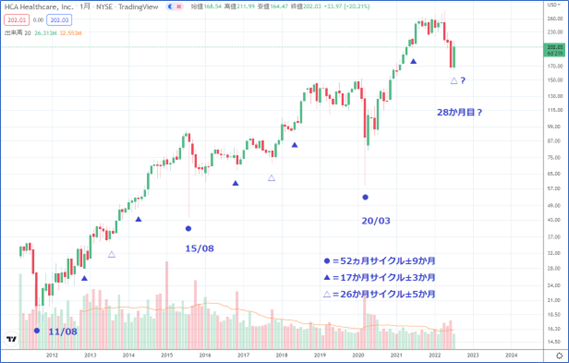
(● = 52-month cycle, ▲ = 17-month cycle, △ = 26-month cycle)
Although the history is short and long-term analysis is limited, the 52-month cycle, the 17-month cycle as a three-part division, and the 26-month cycle as a two-part division appear to be valid. All of these cycles are close to the basic values of stock cycles.
The 52-month cycle bottomed in August 2011, August 2015, and March 2020. In the past two cycles, they appear as a combination pattern of the 17-month and 26-month cycles. However, unlike the past two which clearly featured a three-phase 17-month cycle, the current 52-month cycle shows the 17-month cycle less clear and the 26-month cycle more dominant. The July 14 low of 164.47 was the 28th month, an ideal time to align with a 26-month cycle.
If this July 14 low holds, the second 26-month cycle’s advance should continue. In the near term, the rally appears overheated, so it is important to carefully pick up dips. Ideally, target around the $190 range to enter.
Targets are ① $208 ② $221 ③ $235.