

Zhongyuan Jun's "What Do You Recommend?" Part 1 Updated July 11
NVIDIA (NVDA Nasdaq)
Target price 200 dollars
NVIDIA boasts overwhelming share and high performance in visual computing technologies such as graphics processing units (GPUs). In addition to selling flagship consumer graphics processors “GeForce” and memory products, the company also offers workstations “Quadro,” high-performance computing offerings “Tesla” and “3DVision,” and mobile communications processors “Tegra.” Headquarters: Santa Clara, California.
Market cap 395,950,000 thousand USD (as of 7/8); diluted shares outstanding 2,500,000,000 (as of 7/8)
PER (trailing) 40.51x (20:00); PBR (trailing) 14.91x (20:00)
EPS (trailing) 3.91 (as of 2022/01); BPS (trailing) 10.62 (as of 2022/01)
The chaos in the cryptocurrency industry is forcing investors to rebalance portfolios and is also hitting NVIDIA’s graphics cards, which had benefited from the crypto boom. Graphics cards long loved by gamers saw demand surge as essential components for crypto mining, and NVIDIA product prices surged in secondary markets such as eBay. Now, the situation has changed: crypto values have plummeted, reducing demand for expensive GPUs. Ethereum’s blockchain network has moved to a new method called “Proof of Stake,” reducing the need for high computational power; GPU demand could fall further. The consumer graphics card market is projected to shrink to about one-third. NVIDIA cards have fallen up to 50% on the secondary market over the past several months. Many analysts have materially cut the 2022 earnings-per-share forecasts from about $4.6 to around $4.2.
However, Meta’s Zuckerberg revealed plans to quintuple its data center GPUs within the year. This large investment could be favorable for NVIDIA, the leading supplier of data center GPUs. The quarter’s weakness will be revealed in the August 24 earnings release, but since pessimistic figures are already reflected, results could still trigger upside.
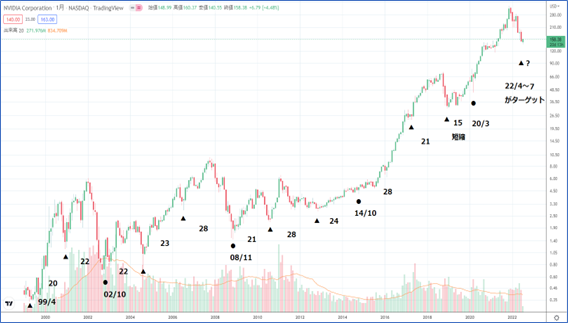
〈NVIDIA Monthly Chart〉The 24±4 month cycle is valid and marks the time of the first 24-month cycle bottom
Since the analysis on June 2, 2021. Price before the 4-for-1 split was 672 (theoretical post-split value 168), with a target of 822; the high reached 1,384 (theoretical post-split 346) on November 22. It doubled sharply in six months, but subsequent decline was steep, dropping to 140 (theoretical pre-split 560) by July 5.
The dominant long-term cycle is 24 months, with a range of 20–28 months. With three 24-month cycles forming a six-year cycle, this is highly plausible.
From the October 2002 bottom, three 24-month cycles led to a bottom-out in November 2008; similarly, a bottom-out occurred in October 2014. The six-year cycle target from October 2014 was October 2020 ±1 year, so the six-year cycle bottom would be around March 2020. Due to the six-year cycle, the third 24-month cycle is considered shortened to 15 months.
Now, the new six-year cycle with the first 24-month cycle’s strong rise topped in November 2021, implying a 21-month rise. The subsequent decline is steep, but the central time window for the 24-month cycle bottom is March–July 2020, so July 5’s 140.55 could have been a 24-month cycle bottom. Regardless, cyclically this represents a buying opportunity roughly every two years. Although this stock does not show clear seasonality, it generally tends to strengthen toward the end of the year.
Target prices are ①180 ②200 ③280.
Shun Nakahara Profile
“Weekly Shun Nakahara Report” is written every Monday.
Grandfather amassed wealth in Sony, mother in Pioneer, from a family of speculators.
With over 20 years in the market, a true trader known to enthusiasts, expert in the strategies of Larry Williams and Tom DeMark, whose techniques are widely recognized. The “Gann theory” includes many seminars in the U.S. that cost hundreds of thousands of yen in tuition, and Nakahara is one of the few in Japan who studies Gann theory in depth. He is also famous for rarely appearing in the public eye.