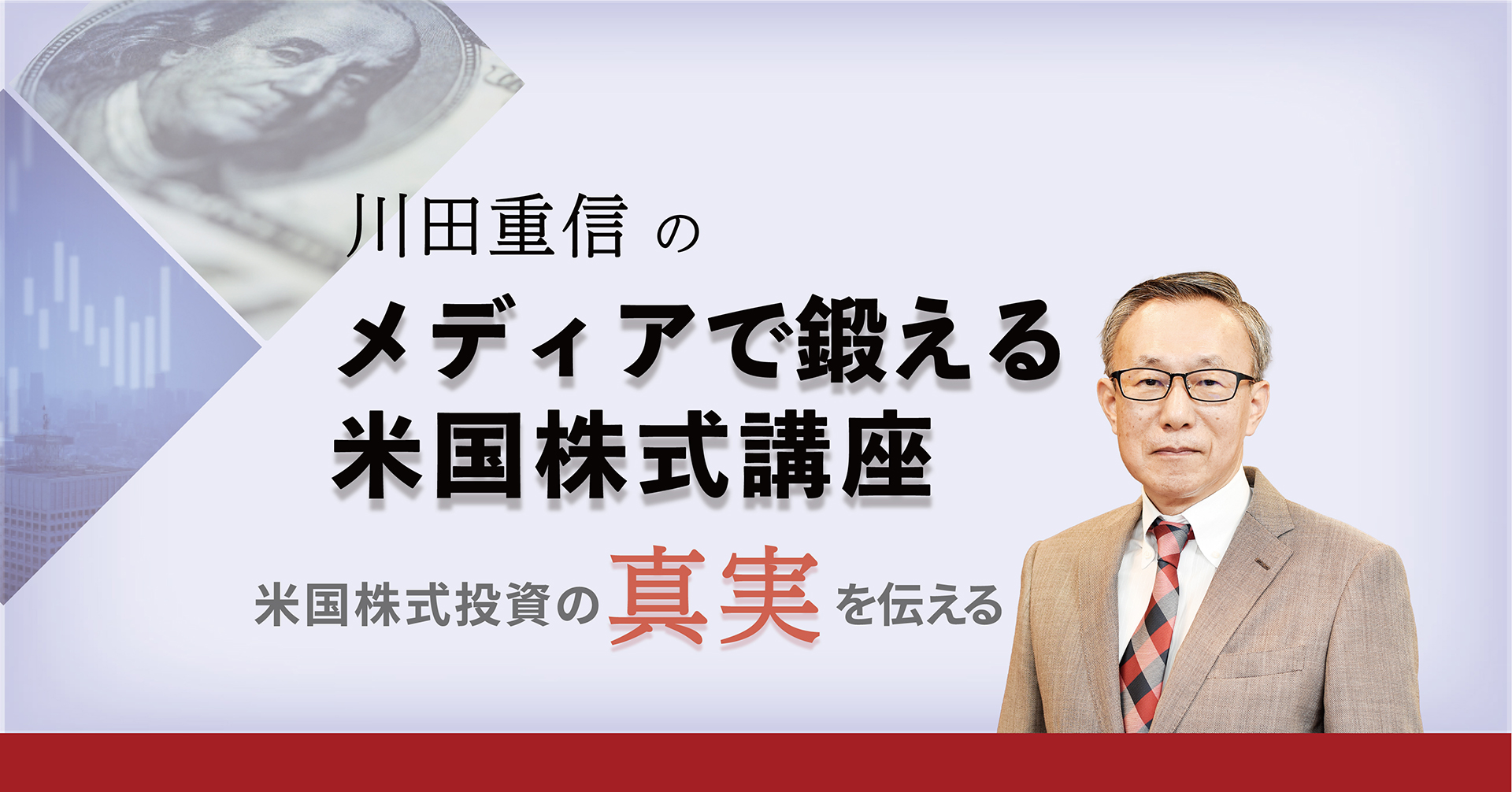
The Truth About U.S. Stock Investment[Vol.50]Distributed June 13, 2022

|||||||||||||||
The Truth About U.S. Stock Investments
[Vol.50] June 13, 2022
|||||||||||||||||
Shigenobu Kawada’s “Training in U.S. Stocks Through the Media”
***Table of Contents***
Market Review
This Week’s Featured Articles
Kawada’s Interesting Stocks
Investment Tips
Walks
What the Ultra-Wealthy Practice: “Private Investment Strategies”
Activity Information
【How to Read Nikkei to Enrich Your Life】
A project that picks up and comments on articles from Nikkei News that I have been reading for over 40 years since turning professional. It is held every Saturday from 9:00 to 9:45 a.m. via Zoom.
Participation is free, so if you’re interested please apply onPeatix.
Below are a few article titles covered last Saturday

Online Salon “Dream Realization: Asset Building School”

An online salon where everyone learns together to succeed in asset formation and encourages one another. It offers member seminars that convey content the popular newsletter “Training in U.S. Stocks Through the Media” cannot fully cover, and allows you to experience the魅力 of U.S. stock investing.
■□■□■□■□■□■□■□■□■□■□■□■□■□■□■□■□■□■
1. Market Review (June 6–June 10)
Major Indices
• Dow Jones -4.6%
• S&P 500 -5.1%
• Nasdaq Composite -5.6%
= Quick Version =
The stock market reacted to moves in long-term interest rates. When long-term rates fell below 3%, there was buying on dips, but when CPI released at week’s end exceeded expectations, long-term rates surged and growth stocks were sold off.
= A Bit More Detail =
Last week’s stock market began with a rebound after Friday’s decline, but ahead of the CPI release over the weekend, the market faced a challenging upper level.
When long-term rates fell below the psychological 3% level, buying appeared, but when auctions for 3-year and 10-year Treasuries underperformed, yields rose and selling followed quickly.
On Thursday, when the European Central Bank announced it would stop quantitative easing in July and begin raising interest rates, European government bond yields surged, and U.S. rates rose as well.
On Friday, the CPI exceeded expectations, recording the highest year-on-year growth since December 1981.
With expectations of stronger monetary tightening, long-term rates remained at their highest since May 9, and growth stocks were heavily sold off.

S&P 500 Five-Year Chart

■□■□■□■□■□■□■□■□■□■□■□■□■□■□■□■□■□■
2. This Week’s Picked Articles
This column selects information I find interesting from what I have gathered and ranks it, commenting in a very personal view. Starting this week, it also includes the picks and comments by Mr. Kumakura Tsuneyoshi, who has been introducing books in the Walk section.
【1】Wall Street Journal 【Opinion : Kissinger vs. Soros: Different Views on Russia; Two Octogenarians at Davos Present Contrasting Worldviews
Author Walter Russell Mead is a columnist for the Global View section
Henry Kissinger

【Davos (Switzerland)】Two men who survived Nazi rule as immigrants to the U.S. became central figures in the discussions at the World Economic Forum annual meeting.
Henry KissingerDo not defeat or exclude Russia; Ukraine should accept the loss of territory from 2014.
George Soros
Victory by Putin’s Russia is necessary to "save civilization." Provide whatever Western nations must to ensure Ukraine’s victory.

Both men offer very different prescriptions, but share many views in common: both believe that defending European peace based on U.S. values and interests is a primary objective of U.S. foreign policy.
In the end, Russia is a secondary issue for U.S. policy; many agree that, in the long run, the importance of the U.S.-China relationship far outweighs it.
Differences: The nature of the order or civilization they want to preserve
Soros, like the Biden administration, sees the main global issue as the struggle between democracy and totalitarianism. In democratic countries, rights of citizens are legally protected domestically, and actions abroad are constrained by international law. Totalitarian leaders refuse such constraints both domestically and internationally.Kissinger’s stance
There have always been various forms of government in the world and will continue to be so. We do not have the task of transforming Russia and China into democracies, and we must recognize that rival great powers have rights and interests worthy of respect.Looking back at history, there is one thing that seems certain. The French and British leaders who tried to appease Hitler in the 1930s argued for respecting Germany’s national interests, similar to Kissinger’s view. Meanwhile, neo-conservatives who urged President George W. Bush to invade Iraq argued about the totalitarian nature of Saddam Hussein’s regime, echoing Soros’ perspective.
Both Kissinger and Soros would likely agree, but no historical theory should be mechanically applied to the messy reality of international society.
【Kawada’s Comment】
Representatives of global intellects hold common ground with Russia and President Putin yet offer differing views.

Dr. Kissinger says, “Do not defeat or exclude Russia; Ukraine should accept the loss of territory from 2014.” Soros argues, “Victory for Putin’s Russia is necessary to ‘save civilization.’”
This image is a screenshot from BS-TBS’s “News 19:30.” Just as these two intellectual giants differ, so do the opinions of France’s President Macron and Estonia’s Prime Minister Kallas on Russia. Macron advocates seeking a long-term path to coexisting with Russia, while Prime Minister Kallas argues that making concessions to Putin would be far more dangerous.
Which opinion would you find convincing? I lean toward Kissinger and Macron. We tend to judge through media filtered by British and American perspectives. In other words, biases from those countries at the moment influence our view. And there is no absolute truth in human actions; acting on “righteous” principles does not always lead to the intended outcomes.

While pondering this issue, I saw an advertisement in Nikkei Weekend (6/12) for Akiko Ikeda’s “14-year-olds’ Philosophy: A Textbook for Thinking” (2003/3/20). She passed away in 2007, but she was a highly noted writer at the time.
The excerpt below from the newspaper ad captures my thoughts well, so I quote it here.

“Yet, determining which country in a war is right may not be meaningful to you. After all, human beings have two sides to every argument. If Japan were to go to war, what you should know is not which side is right, but how you should live righteously within it.”
In other words, what does “right” really mean? Are there any other things humans should know in life?
Information is information. It can be true or false. It can be factual or not. The truth or facts are not something handed to you from outside; they are something you must think for yourself.” From “Philosophy for 14-Year-Olds,” Chapter 2.
Akiko Ikeda
Born August 21, 1960, in Tokyo. In March 1983, she graduated from Keio University, Faculty of Letters, Department of Ethics. A writer who styled herself as a philosopher. Widely read; died February 23, 2007.
【2】Nikkei Newspaper Large-Scale Renewable Energy Storage Network: NTT Group, Kyushu Electric Power, and Mitsubishi Corp. collaborate to store surplus energy and ensure stable supply6/10
NTT Group, Kyushu Electric Power, and Mitsubishi Corporation will build a large-storage battery network to efficiently use electricity generated from renewable energy.
NTT Energy's subsidiaryNTT Anode Energy(Tokyo, Chiyoda), Kyuden, and Mitsubishi Corporation will collaborate on reducing output fluctuations from solar power using storage batteries, and by February 2023 will install a system-connected battery on a vacant site in Fukuoka Prefecture to be used like a power plant connected to the grid.
The charged energy amount is 4,200 kWh, equivalent to about 350 households’ daily electricity consumption. On sunny days, electricity generated from solar power will be charged.
In Europe, Australia, and parts of the United States, storage batteries are integrated into the power grid to effectively utilize renewable energy.
Challenges of storage batteries are costs. According to the energy basic plan, the cost of electricity from industrial storage batteries in 2019 was about 240,000 yen per kWh, well above the government’s target of around 60,000 yen by 2030.
【Kumakura Comment】
For stable supply of natural energy sources such as solar, wind, tidal, and geothermal power, whose output cannot be controlled by humans, technologies such as large-capacity batteries and generation output adjustment are required.
According to the website of NTT Atone Energy Co., Ltd., the company defines the “Storage Plant Business” as follows.
In the NTT Group, there are telecommunications buildings nationwide used to maintain telecommunications infrastructure, and batteries are kept to ensure communications during power outages. By utilizing these telecommunications buildings as “storage plants,” NTT Atone Energy contributes to the spread and expansion of renewable energy power plants that promote local production for local consumption, and aims to reduce social costs (such as transmission losses).

It seems like an impression of a complement to the conventional power generation and transmission business, but the goal appears to be to accumulate demonstration in a narrow region and then connect to a larger regional business in the future, including industrial power supplies.
On the other hand, I do not have precise knowledge about the current status of large-scale storage battery production, but competition in this field seems to be a major factor in the competition for natural energy utilization.
Japanese companies have anticipated the development of electric vehicles (EVs) and have engaged in the development and production of batteries for vehicles from relatively early on.
However, the current top player in this field is Chinese, and Korean companies are rapidly catching up.
Contemporary Amperex Technology Co., Limited (CATL)
Although the large storage batteries used for vehicles and those used in natural energy utilization cycles may be different, if they lie on the same line of technological development, the outcome of hegemonies in this field is something to watch.
■□■□■□■□■□■□■□■□■□■□■□■□■□■□■□■□■□■
3. Brands Kawada is Watching
This is a corner that introduces brands Kawada holds and other U.S. stock information that caught my attention.
This Week’s Brand
Snowflake Snowflake Inc.
Overview
A company that provides software to process vast amounts of data stored by enterprises on public clouds such as Amazon Web Services (AWS) and Microsoft Azure, helping to manage and analyze that data more easily.
What Makes It Appealing
Growing data cloud market
(Figure 1: Snowflake Platform)

Currently, enterprises store large amounts of data, but considering maintenance costs, storage locations have shifted from on-premise servers to public clouds such as AWS. They are migrating to public clouds.
Sources of stored data include enterprise software for HR and payroll, third-party databases, data from the Internet of Things (IoT), and many others. On the other hand, data usage includes selling the data itself, business analytics for management, and real-time analysis for operations.
Snowflake’s service enables use of various data stored across multiple public clouds without worrying about sources or storage locations. For example, weather data stored in one cloud and footfall data in another can be combined to analyze the impact of weather on customer attendance. Moreover, the same data can be used simultaneously by multiple parties, and data input can be executed concurrently.
As the data cloud market grows and the types of stored data increase, analytic needs intensify. As digital transformation (DX) becomes global mainstream, Snowflake’s service is expected to become increasingly necessary.
High Growth Leader in Share
Snowflake had 63,22 customers as of the end of April 2022, and 206 customers with revenues over $1 million.
(Figure 2: Snowflake’s Customer Base Expansion)

Also, according to a website called Datanyze, Snowflake leads the data warehousing field (which Snowflake defines as a part of data cloud) with a market share of a little over 20%.
(Figure 3: Data Warehousing Share)

Reflecting this, the total revenue for 2022 was up 106% year-on-year, and for the first quarter of 2023 (year ended April) was up 85% year-on-year.
(Figure 4: Snowflake Total Revenue (annual and quarterly))

Moreover, free cash flow turned positive from Q3 2022 onward (non-GAAP basis).
(Figure 5: Free Cash Flow Trend (Non-GAAP))

In the results briefing on May 25, it was formally announced that product revenue would grow at an annual rate of 30% in the future and reach $10 billion by fiscal 2029.
Long-term outlook raised for other metrics as well: product gross margin to 78% (previously 75%), operating margin to 20% (previously 10%), and adjusted free cash flow margin to 25% (previously 15%).
(Figure 6: 2023 Results and Long-Term Outlook)

Risks
The stock price remains near the IPO price, but as a typical growth stock, higher interest rates would be a headwind for the stock.
Also, although market share is gaining in the industry, depending on economic conditions, corporate usage could shrink and the overall market could contract.
While investor enthusiasm has cooled and valuations have stabilized, this is a stock with high growth expectations, so if actual results and outlook fail to meet expectations, there could be short-term selling pressure.
(Sources: Figures 1, 2, 4, 5, 6 are from company materials; Figure 3 from the URL below, Datanyze)https://www.datanyze.com/market-share/data-warehousing--240
SNOW Basic Data (Sources: company data, Yahoo! Finance)
(As of June 10)
Stock price $122.42
Market capitalization $38.9 billion
Total revenue $1.41 billion
P/E ratio (forecast) N/A
Dividend yield (forecast) N/A
Headquarters: Bozeman, Montana
Listed: September 2020

Stock price chart since listing
Chart powered by TradingView.com
(This corner is provided for general information only and does not solicit the purchase or sale of any securities)
■□■□■□■□■□■□■□■□■□■□■□■□■□■□■□■□■□■
4. Investment Tips
This corner covers not only “investment methods” and “stock picks,” but also “interesting indicators and statements” and “societal and political movements.”
This time, it is an article by Shigenobu Okura, familiar from our company's YouTube channel series “40 Years of American Stock Investment.”
Presidential Cycle and Stock Returns
Sell in May and go away.
Many long-time American stock investors are somewhat aware of the stock market “anomalies.” An anomaly is a market adage or rule of thumb that may be true despite lacking a solid theory or evidence. One famous example is the seasonality of the stock market known as “Sell in May and go away.”
As previously covered in this newsletter, there is a continuation to this adage: “Sell in May and go away, and don’t come back until St Leger day.” St Leger day is the day of the British horse racing major race, which falls on the second Saturday in September. Interpreting this in market terms suggests that the market tends to be strong from year-start to April, then loses momentum from May to September, and regains momentum toward the new year.
Figure 1 shows the average monthly returns of the S&P 500 from 1971 to 2020 and the year-long trend (cumulative returns) based on those monthly returns. Looking at each month’s average return, it tends to be large from January to April, lower from May to September, with September often negative on average, and then increases again from October to December.
Figure 1: Average movement of the S&P 500 over a year

However, over the past 50 years, the index has risen about 0.7% per month on average, so seasonality may be hard to discern. To remove the 0.7% monthly upward trend from each month’s return, see Figure 2. Viewing this way makes the market momentum changes over the year easier to understand.
Figure 2: Average movement of the S&P 500 across the year after removing the trend

Not every year follows this pattern, but generally the stock market tends to pull back in autumn (with more declines). It’s worth knowing.
[Presidential Cycle]
So far we’ve discussed a yearly rhythm, but next we examine the four-year cycle of the U.S. presidential election. This cycle comprises 1) the Presidential Year, 2) the Year after the Election, 3) the Midterm Year, and 4) the Year before the Presidential Election. The average returns for each year are shown in Figure 3.
Figure 3: S&P 500 average returns by Presidential Cycle

Over 50 years from 1971 to 2020, the annualized return is 8.8%. The average returns for the Election Year and the Year after are 7.2% and 9.0% respectively, so these two years are relatively close to the long-term average. In contrast, Midterm Years return 2.3%, lagging behind others. Election Year is as high as 16.8%, significantly above others.
Why does this happen? The reason the incumbent president tends to boost the economy before the election is understandable. But the reason for lower returns in Midterm Years is not clear (perhaps it’s the anomaly).
[Buying stocks in September of Midterm Years]
Next, for each of the four years that constitute the Presidential Cycle, Figure 4 shows the average movement across the year. Election Years and the Year after generally resemble each other and align with the 50-year average. Midterm Years, however, resemble the election year and the Year after up to April, but then trend downward toward autumn, with September declines being particularly large. Then they rebound from October through year-end.Election Year and
Putting this together, the takeaway is: “(On average) in Midterm Year’s September you should buy to enjoy a major rally into the following year.”
Figure 4: Average movement of the S&P 500 by year in the Presidential Cycle

[Outlook and Mindset]
Against the backdrop of the Fed’s policy stance, supply chain bottlenecks, and Russia’s invasion of Ukraine, the U.S. stock market has continued to be weak at the start of the year. This year is a Midterm Year, and performance through May of this year has also been lackluster.
In particular, on May 20 intraday, the price fell more than 20% from the high, and many labeled it a bear market. What will happen next? Will the market rebound from the May bottom as a rally, or will the rebound be only temporary (a bear market rally) and by autumn there could be another significant drop?
Since a large drop has already occurred in the first half of the year, I don’t know whether it will fall further. However, if there is a significant drop around September, it could present a good buying opportunity for the next year’s rally. Regardless of whether it falls or not, at least adopt a mindset that you should not be surprised by declines.
[Shigenobu Okura]
From Ehime Prefecture. Graduated from Osaka University Faculty of Economics in 1984. 2005: Doctor of Economics from Saitama University Graduate School of Economics. Worked at Citibank, NationsBank (NDB), Cititrust Trust Bank, and Societe Generale Trust Bank (now SMBC Trust Bank). Worked with pension funds and other institutional investors, and private banking for high-net-worth individuals. In 2017, established Eagle Capital Co., Ltd. in Kyoto’s Higashiyama. CFA charterholder. Certified member of the Japan Society of Securities Analysts and Financial Analysts Association.

■□■□■□■□■□■□■□■□■□■□■□■□■□■□■□■□■□■
5. Walking Corner
◇◇Recent shops,movies, museums, books◇◇
~ The Kawakura N cool edition ~
A contribution from a former securities man and avid reader, Mr. Kawakura Kaneki.

Extraterrestrial Life – Origin and Future of Life Explored by Astrobiology / Kenmasa Kobayashi (author)
When meeting foreigners at parties, I often use a little anecdote as an icebreaker.
“Americans appear to be the nation most frequently witnessing unidentified flying objects (UFOs) in the world.”
“That is because they cannot bear the terrifying reality that intelligent life besides humans may not exist in this vast universe, so they see UFO-like phantoms.”
If asked what about the Japanese, I explain that Japan is protected by countless gods and myriad phenomena.
It’s just a humorous anecdote, but I have long doubted that intelligent life exists elsewhere in the universe.
Over countless billions of years, humans evolved by a miraculous probability, and I could hardly imagine similar processes occurring somewhere else.
However, recent studies suggest that the origin of life may lie in organic compounds formed in space, and the field of astro-biology is taking shape from accumulated evidence.
One example of supporting evidence described in 2022-06-07 issue of Nihon Keizai Shimbun is on the front page: “Hayabusa2 brings back from asteroid Ryugu amino acids—the building blocks of proteins.”
Hayabusa2, launched in 2014, landed twice on Ryugu in 2019 and collected samples, returning to Earth in December 2020.
The amino acids essential for life, along with water, were found in the dust brought back by JAXA’s asteroid explorer Hayabusa2 from Ryugu.
Hayabusa2 was launched in 2014, landed on Ryugu twice in 2019 to collect samples, and returned to Earth in December 2020.
Amino acids are essential materials for life alongside water; theories about their origin include formation on Earth or delivery from space via meteorites.
Reading this book after receiving such information greatly stimulates intellectual curiosity.
This book is by a chemist who ponders how life began and whether life exists beyond Earth, drawing on Hollywood films and science fiction novels, and considering ETI (Extraterrestrial Intelligence) and comparative planetology within astrobiology—a beginner’s guide to the past, present, and future of astrobiology.
The author also reflects on encounters with ETI (truly an encounter with the unknown) and concludes, “What we can do is pray that we may encounter them in the future, and to prevent our civilization from destroying itself until then.”
To achieve that, the author emphasizes that astrobiology should contribute to sustainable development goals (SDGs) and serve as a warning against a self-centered, divided world.
Although a new pocket edition priced at 900 yen plus tax, its content is deeply impressive.
【Kaneki Kawakura】
Joined Daiwa Securities in 1980. Holds an MBA from the University of Chicago Booth School of Business, earned through corporate-sponsored study. Experienced in Asia-Pacific business through postings in Singapore and Hong Kong.

■□■□■□■□■□■□■□■□■□■□■□■□■□■□■□■□■□■
6. Private Investment Strategies Used by the Ultra-Wealthy
Hiroshi Ichikawa, who provides sales support focused on IFA, presents in simple terms the investment strategies used by the ultra-wealthy for readers like you.
This time, we share common mistakes in private investment strategies that should never be made.
These are especially tempting when markets are highly volatile or falling. Investing requires constant calm, so beware of these two points.
Understanding the psychological cycle of investing to stay calm
The financial markets are strongly affected by investors’ psychology. In particular, individual investors tend to move in the same direction, so caution is needed.
Understanding this psychological cycle helps you invest calmly. From what I have seen, ultra-wealthy individual investors are not swayed by these cycles. Rather, they leverage psychology effectively for investment success.

The number of individual investors in the U.S. has risen sharply in the last decade. In 2010, individuals accounted for only 10% of U.S. stock trading volume, but by 2020, that figure approached 20%.
One reason is the COVID-19 pandemic, which kept people at home and increased the number of people investing.
This trend is not limited to the U.S.; Japan has seen a similar rise in novice investors due to influencers and other factors. This is favorable for the financial industry, but many people still follow the typical investment psychology cycle, which is regrettable.
In recent years, the stock market has been rising, so many new investors experienced profits right away and felt the market would continue to rise, perhaps thinking the same as the chart shows.
When the market started to fall in 2022, positive feelings were followed by anxiety and panic as the market dropped.
Mistake 1: Buy high, sell low
One of the mistakes ultra-wealthy people never make is to “buy high and sell low.”
For example, when news breaks that a company is partnering with another or releasing a new product, influencers may promote the investment. Individual investors may be swayed by optimism or excitement and invest accordingly.
Then, if the stock price declines and unrealized losses appear, they succumb to anxiety or panic and cut losses.
As a result, they end up buying high and selling low, making the investment a failure.
Key is not to follow the crowd just because others are investing; instead, think carefully yourself or consult a trusted adviser before investing at all.
If you decide to invest in a company, take one of the following actions:
- Take profits when you have gains in the short term.
- Hold through unrealized losses without panic.
If you plan ahead, you can maintain a steady mindset even when losses occur. Investing should be long-term.
Mistake 2: Overconcentrating in one investment
Another common mistake is concentrating investments in a single company or sector.
Investing carries risk. Risk can be mitigated by your investment approach, but concentration can increase risk rather than reduce it.
For example, just because a certain IT stock is rising does not mean all similar stocks will rise long-term. Investing in things you don’t need will carry unnecessary risk.
This mistake reflects not understanding your own investment strategy; the way to avoid it is not to figure it out alone.
The Inevitable Anxiety
In the investor psychology cycle, anxiety is inevitable. You may feel anxious and suffer pessimistic emotions for a while.
But that also signals an ensuing period of hope. That is the nature of the market.
Pause, observe, and choose calmly. Understanding the investor psychology cycle is essential. Then find a trusted adviser. This helps you avoid the two mistakes described above and respond calmly.
【Hiroshi Ichikawa】
Investment Techniques to Become Ultra-Wealthy
CEO of Winviser Co., Ltd. After serving as a wealth management consultant at SMBC Nikko Securities at branches in Ibaraki, Fukuoka, and Tokyo, he engaged in marketing financial products for the ultra-wealthy.
Transferring to an Independent Financial Advisor (IFA) company, he provided wealth management advice to the ultra-wealthy and later established a support firm focused on IFAs to contribute to the development of Japan’s financial industry. Currently, in addition to supporting IFAs, he provides a third opinion on asset management for individual investors based on his experience.

■□■□■□■□■□■□■□■□■□■□■□■□■□■□■□■□■□■
7. Upcoming Activities
◇ Stock Voice: June 15 (Wed) 11:00
◇ Nikkei CNBC: June 29 (Wed) Telephone Interview (Mr. Aono)
June 30 (Thu) Mr. Okura’s telephone interview (Mr. Aono)
───────────────────────────
★ For questions, please read the 【Question Rules】 below and email
info@kawata-magazine.com
【Question Rules】
◆We may not answer all questions. Please understand in advance.
◆Questions you submit may be published on our site, YouTube videos, other SNS, or in books in a form that does not identify individuals.
◆We will not respond to questions from people who are not subscribers.
◆Sections considered clearly advertisements or promotions may be omitted.
◆We may take appropriate measures against those who submit malicious questions without subscribing.
───────────────────────────────────
★Disclaimer
◆Our newsletter does not provide buy or sell recommendations for securities such as stocks, bonds, funds, ETFs, or sectors. Investment decisions are the responsibility of the newsletter subscribers, and we provide no guarantees.
◆We do not guarantee any damages incurred by members who use the newsletter.
◆We are not responsible for any disputes between members or between members and third parties arising from information in our service (proposals that are illegal or violate public morals, defamation, insults, invasion of privacy, threats, slander, harassment, etc.).
◆We do not take any responsibility for damages arising from interruptions or cessation of this service or changes to its content.
───────────────────────────────────
■ Publisher: Hibiya Technology & Finance Co., Ltd.
■ Kawada Shigenobu’s Thank You, American Stocks
https://www.kawataamekabu.com/
■ Twitter:https://twitter.com/ShigenobuKawata
■ For opinions, requests, or to unsubscribe, click here
【Email】info@kawata-magazine.com
■ If you do not receive emails, they may be classified as spam; please check in advance.
───────────────────────────────────