

Cryptocurrency market analysis [June 5]
Practical Investment Article on Cryptocurrency - June 5
Dear Subscribers
*Paid subscribers can also view the article at the private link below.
Please take a look at the articles behind the private link.
*If there are topics you want covered in the newsletter or questions, please contact us.
Please contact us with any topics or questions you’d like to be addressed in the newsletter.
In the Newsletter’sQ&Asection, we will introduce some of them.
My selected Rankings of Domestic and Overseas Exchanges
are here ↓↓
https://bitcoin-newstart.com/bitcoin-account
【Ranked 5th in Mag magazine’s Newsletter Grand Prize】
In 2020, on Mag magazine, a major newsletter site,
the newsletter Grand Prize was announced
and I was able to win.
(Reference)2020 Mag magazine cryptocurrency newsletter asset management division 5th place!!
※Currently Mag has ended its distribution
and this article has been transitioned to this page.
https://bitcoin-newstart.com/2020magmag
【Cryptocurrency Market Analysis】
The price changes of cryptocurrencies since last week
over the past week are summarized as follows
Display: Current price (change from one week ago)
Bitcoin3,930,000yen(-3%)
Ethereum230,000yen(-8%)
Binance Coin37,500yen(-8%)
Ripple52yen(-%)
Solana5,200yen(-13%)
Cardano78yen(7%)
Polkadot1,200 yen(yen(-9%)
Avalanche 3100yen(-10%)
Uniswap677yen(-6%)
ICP 921yen(-11%)
Bitcoin has fallen from last week’s 4.1 million yen to around 3.9 million yen.
Bitcoin Chart
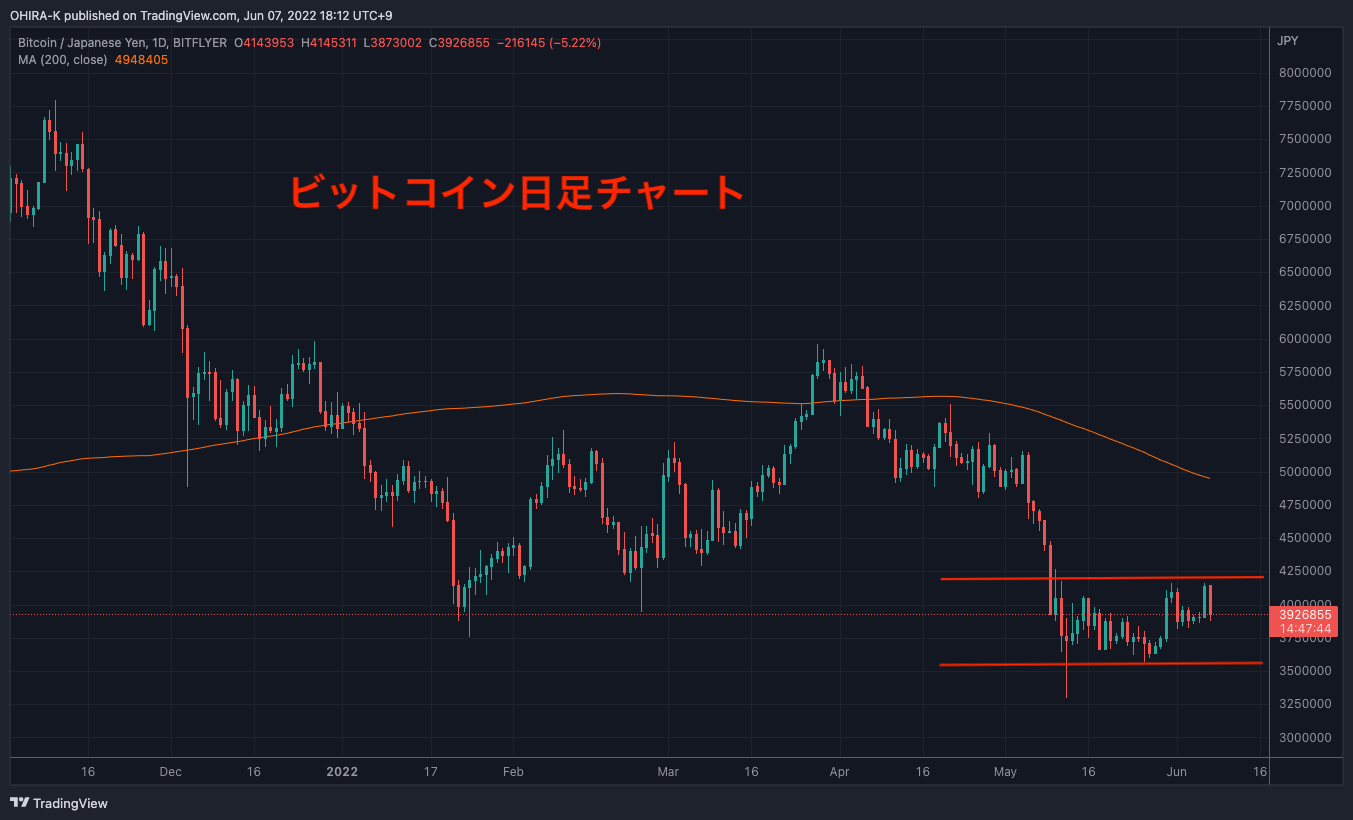
Bitcoin remains in a range between approximately4,100,000yen and3,600,000yen, moving back and forth.
With current market volume being low and funds flowing out, will this range continue for a while, or will it drop to the next level around 3,300,000 yen?
Previously, cryptocurrency declines began around late January 2018, and from around May 2020 a large uptrend formed, with the market remaining subdued for about two years.
This time, since prices started to fall from January 2022, only about half a year has passed.
【Bitcoin that interest emerging markets】
Bitcoin has a fixed issuance and is outside government control, so emerging economies are considering economic independence and are trying to adopt Bitcoin.
El Salvador first adopted Bitcoin as legal tender.
Several articles like the following appeared.
ーーーーーー
“El Salvador, which made Bitcoin legal tender last year, does not intend to change its policy even as Bitcoin’s value has plummeted. With electronic wallets enabling many citizens to use financial services and the ability to receive remittances at low cost from abroad, there are advantages.”
El Salvador’s populist president Nayib Bukele announced about1 years ago that he would adopt Bitcoin as legal tender alongside the dollar. Officials at the IMF and Western central banks publicly criticized the idea as something a president with little economic understanding would propose.”
(Nikkei Business)https://business.nikkei.com/atcl/NBD/19/world/00489/
ーーーーー
Bitcoin is not only a means of remittance but also a potential future asset, and El Salvador continues to hold Bitcoin when its price falls.
Whether El Salvador can sustain holding Bitcoin in the medium to long term without default remains a point of focus, but as IMF has said, turning to the dollar as legal tender and relying on credit would likely not fundamentally change anything, I think.
Because it is not government-controlled, I personally think Bitcoin could significantly advance as a hedge against inflation in the future for legal tender.
Holding Bitcoin and facing unrealized losses is, in fact, a natural consequence.
Of course, if you had bought Bitcoin when it was around 100,000 yen and held it, you would still have substantial gains today with no issue. However, buying at the right time and experiencing unrealized losses at certain periods is normal.
This stance of El Salvador makes me feel that professional investors may be involved behind the scenes (not in a bad sense).
Such emerging economies achieving significant economic independence with assets not controlled by the government is a highly interesting and fascinating topic.
【MicroStrategy in the U.S. continues to hold Bitcoin】
Michael Saylor CEO of MicroStrategy said at the end of May that the price decline of Bitcoin (BTC) and its impact on the company’s Bitcoin investment posture were discussed.
Saylor told cryptocurrency mediaThe Block that “once you understand the fundamentals of major cryptocurrencies and the difficulty of building something better than them, thinking about short-term fluctuations in Bitcoin is largely meaningless.”
He further stated, “Bitcoin is the most reliable thing in an extremely uncertain world, more reliable than any other19,000 coins, any stock, or any real estate anywhere in the world.”
He also added, “If now is a bear market, then in the past two years there have been three similar declines.”
Saylor noted that if you do not plan to hold for at least4 years, you are more of a speculator (trader) than an investor and recommended long-term holding.
4
(CoinPost)https://coinpost.jp/?p=356449
No objections from me....
In 2020, MicroStrategy drew significant attention as a Nasdaq-listed company that massively holds Bitcoin.
Since then it has generated substantial profits, but the current P/L is roughly breakeven.
Bitcoin should be viewed not only by price but by its underlying structure.
The environment to trade Bitcoin already exists, and unless there is a fundamental flaw in its structure, many investors who hold it will continue to hold.
Of course, I do the same.
【Rising Yen Depreciation】
I found information about the yen depreciation and I’m sharing it here.
ーーーーーーー
Who is selling the yen the most? It’s Japanese corporations and Japanese investors.
3 trillion dollars of overseas assets, and investments in foreign bonds, foreign stocks, and foreign real estate that must be included in portfolios managed by the United States and other widely invested foreign assets are small/ speculative actions accumulate real yen shorts.1/
Business/The basics of investment are
“Borrow money at low interest and invest at high interest”
Actions by Japanese people for their own利益 protections and hedging by those who understand them are effectively selling the yen.2/
As long as interest rates are forcibly suppressed, there will be a bias toward a weaker yen.
The currency is shaped by Japanese companies and Japanese people themselves.
GPIF and life insurers, non-life insurers, companies, and individual investors collectively drive yen shorts, which is something to understand, and this trend will continue with the Bank of Japan’s policy to suppress rates, which the government also understands and allows.
4/4
https://twitter.com/7shou7kin/status/1534068727624323072
ーーーーー
In short, they cannot raise rates as easily as the United States.
ーーーーーー
1.When rates rise, mortgage payments and corporate interest becomes a problem, and rates have started to rise.
2.The Bank of Japan announces measures to keep rates low.But there is a side effect: the value of the yen declines.
3.Following the announcement, the yen’s value plunges.
4.When the value of the yen falls, price hikes accelerate.
https://twitter.com/cryptocoinchef/status/1508348761793130501