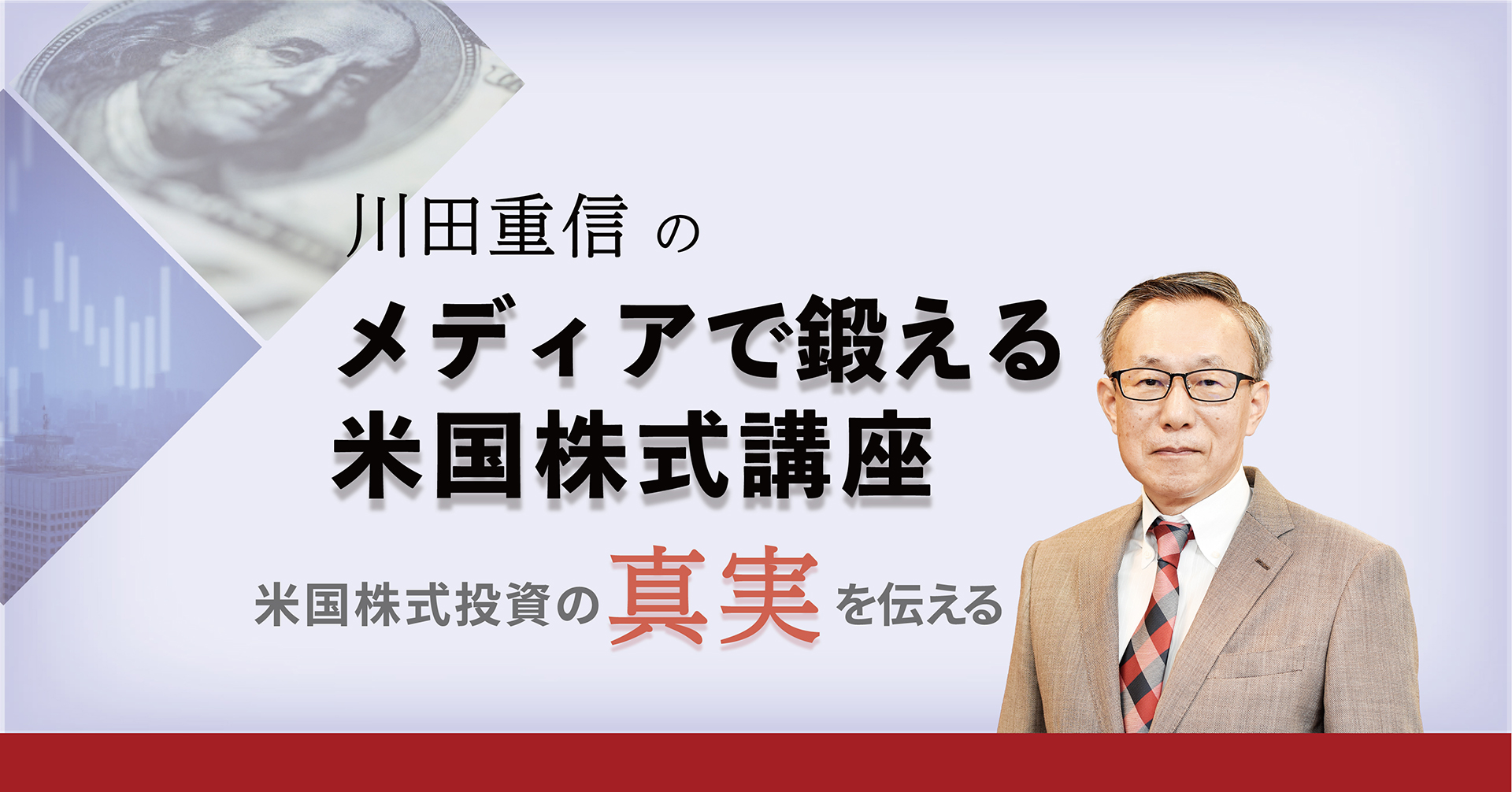
The Truth About U.S. Stock Investments [Vol.46] May 9, 2022

????????????????
Translating the Truth of U.S. Stock Investment
[Vol.46] May 9, 2022 edition
????????????????
Shigenobu Kawada's “Learning U.S. Stocks through the Media”
***Table of Contents***
Market Review
This Week's Picked Articles
Kawada's Notable Stocks
Investment Tips
Walk
What the Ultra-Wealthy Practice: “Private Investment Strategies”
Activity Information
Closing day: May 30
New Series【How to Read Nikkei to Enrich Your Life】
A project that picks up articles from Nikkei Newspaper that I've found interesting in over 40 years of reading as a working adult and comments on them. We hold Zoom participation every Saturday from 9:00 to 9:45 a.m.
Participation is free, so if you are interested, please apply onPeatix.
Online Salon “Asset Formation School Where Dreams Come True”

Aimed at helping everyone succeed in asset formation, this online salon offers seminars for members that cannot be fully conveyed by the popular newsletter “Learning U.S. Stocks through the Media” and lets you experience the魅力 of U.S. stock investing.
Achieving 20 million yen pace-setter

Source: Financial Services Agency – Asset Management Simulation prepared by ExeTrust Co., Ltd.
*The figures above are simulations and do not guarantee future investment results. Fees and taxes are not considered.
Reading method: assumed yield and target time frame
3–4% for 30+ years: wrap funds or balanced funds can achieve this
5–7% for 25 years: maybe with non-U.S. stock funds
8–10% for about 20 years: considering the more modest rise of the S&P 500
S&P 500 Performance (dividends reinvested 1970-2021)

Reach 20 million yen early with proper risk-taking
Kawada's message is extremely simple. To achieve 20 million yen, let as much of your surplus capital work efficiently as possible. For that, it is important that participants understand the meaning of risk and reward. Before reading the weekly newsletter, glance at this table and confirm the correct investing posture.
Now, start the countdown to reaching 20 million yen right away!
■□■□■□■□■□■□■□■□■□■□■□■□■□■□■□■□■□
1. Market Review (May 2–May 6)
<Major Indices>
• Dow Jones Industrial Average -0.2%
• S&P 500 -0.2%
• Nasdaq Composite -1.5%
= Quick Version =
The stock market, which had adopted a cautious stance, rose sharply after a 0.5% rate hike was decided, as uncertainty eased. However, concerns about monetary tightening resurfaced, and after the April employment data was released, growth stocks were sold off again.
= A little more detail =
In the early part of the week, global recession fears capped gains, but ahead of the Federal Open Market Committee (FOMC) meeting, the market held its ground with a cautious stance.
The FOMC delivered a 0.5% rate hike and announced quantitative tightening starting June 1. Although some feared a 0.75% hike, Fed Chair Powell signaled a cautious stance, easing the market's policy uncertainty and driving a sharp rise after the meeting.
However, questions emerged that financial tightening might be lagging, and concerns about tightening led to renewed selling especially in growth stocks.
The April payroll report released on Friday showed continued labor-market tightness, leading to a fall on fears of rapid tightening.


■□■□■□■□■□■□■□■□■□■□■□■□■□■□
2. This Week's Picked Articles
A section where I select information useful for asset formation from what I have found, rank it, and comment with my personal views.
【1】Nikkei Newspaper Education Rock: The Labor Market of a Nation (4) “Competition Based on Grades” Reproducing Inequality: The Difficulty of Breaking Through5/5

On February 1, at the entry examination site for Kaisei, Tokyo’s most difficult junior high, a fourth-grade boy and his parents looked on as a family was visiting for a “tour” in preparation for the actual test two years later. A mother (41) who spends 100,000 yen per month on cram school since grade 1 says, “It’s not too expensive if it helps my child get into Tokyo University.”
Many Tokyo University graduates come from private junior/senior high schools, and 54% of students come from households with annual incomes over 9.5 million yen. Kenmei Ezuka, professor of Educational Sociology at Aoyama Gakuin University, notes, “Education is what one can obtain through effort, but inequality based on parental background is large.”

Harvard University professor Michael Sandel argues that in the U.S., an elite who grew up in favorable circumstances and entered top universities look down on those who fail, causing anger among the underserved and deepening social divisions.
Elites raised in similar environments alone cannot steer society’s complex course. Kenji Hashimoto, professor at Waseda University, says, “We must cultivate talent who can think from the perspective of the weak.” Can we fulfill the role of providing equal opportunities and nurturing capable individuals? Schools are being tested.
【Kawada's Comment】

Education issues are a constant theme in Nikkei, and this time it is the “Education Rock” series. The starting point of the problem is that the current system does not respond to the demands of the times, due to a mixture of long-standing customs and vested interests.
Academic credentials are valued in many countries, including Japan and Korea and China. In the U.S., though, the college selection criteria differ slightly. The biggest difference is that U.S. universities are explicitly positioned as institutions that cultivate leaders for society. Therefore, entrance tests evaluate qualities needed for future leadership.
Below are the evaluation items for U.S. college admissions
① High school grades (GPA, Grade Point Average, average of all subjects)
② External assessments such as SAT, ACT, PSAT
③ Achievements in activities outside school (sports, arts, community service, etc.)
④ Recommendations
⑤ Essays
Beyond grades, universities seek evidence of leadership potential and personal qualities. This can be proven through sports or group activities, communication skills, and community contributions. Equally important are letters of recommendation and personal essays. In short, the selection criteria assess the individual’s entire set of abilities, values, upbringing, and relationships.
Thus, simply excelling in tutoring and test scores is not enough. Meeting items ③ and ④ alongside other criteria while leading a normal life is challenging. Many parents prepare these elements meticulously for their children, investing time and money. Long-term planning and strategy are required, which naturally narrows the group that can compete from the start.
Education systems in any country aim to cultivate talents that meet national needs. Yet, in reality, there is unfairness, harshness, and at times cruelty.

Nevertheless, compared to communities where birth or religion or race already limits competition, it is still more tolerable.
As Michael Sandel discusses in “What Power, But Also Luck,” even in the relatively freer and fair U.S., educational inequality has recently been openly reproduced, becoming a serious social issue.
Compared to that, Japan may seem fairer and more equal, but is my view correct?
Now, there can be no perfectly fair system in these educational structures. The point is that individuals must establish their own values and work toward them, gaining social recognition and personal satisfaction in the process. It may be unlikely that such a society exists, but striving in that direction is meaningful.
【2】Nikkei Newspaper
Barons’ Digest, May 1 issue“Root causes of the Great Retirement Era”
What workers want from the workplace after the pandemic
Health is the most important:The pandemic prompted many workers to leave their jobs. The impact on the labor market is immeasurable, but a longer-lasting, significant change is about to take place.
Mental health:Workers are under unprecedented stress. When workers were interviewed, they said health, not job security or salary, was most important.
Flexibility in workplace and working hours:The era when job security and salary mattered most has ended; flexibility is now essential in the workplace. Work is part of life, and the mindset of aiming only higher is being reconsidered.
Remote work:Following the demand for flexible hours, 28% said they would accept a lower salary to work where they prefer. About two-thirds said they would consider changing jobs if forced to commute full-time.
Integration of work and life:In the past two years, workers around the world have experienced the blurring of boundaries between work and home. The distinction between a worker and a family person has disappeared; one person is both, and employers must recognize and accept this. Surveys show a desire to stay connected to life even during work. Flexibility is not about location; it is about time, which is more valuable.
The breadwinner of a family no longer moves a child to a new school, sells the house, packs belongings into a car, and moves to a new town for a new job. Life comes first, and work comes to you.
【Kawada's Comment】
I found this article in Baron's Digest, which highlights changes in employers and workers’ attitudes toward employment, including the workers’ career mindset through surveys.

In Japan too, similar efforts to embrace flexible work styles that do not hinge on time or location are being actively pursued. However, even for something as simple as paternity leave for men, achieving it is not straightforward and requires finding a balance.
Yet, I often feel it is odd to overly sympathize with the worries of Japanese salarymen. The underlying problem is the persistent “employee mindset.”
If you treat yourself as the owner and manager of the organization you belong to, many problems will be resolved.
Impressed by a 92-year-old active worker
During Golden Week, I returned home briefly and visited a cousin who runs a business in our hometown. My cousin is around my age, so he would be at retirement age if he were a regular employee, but he continues to work diligently.
He goes to bed around 6:30 p.m. and wakes at 1:30 a.m. When I asked in a condescending way if the unusual hours were difficult, he replied, “You get used to it.” A salaryman would complain about such working conditions, but not a single complaint comes out of him.

And surprisingly, in the home office, his father (my uncle, over 90) speaks with a lively voice, joking around. He even asks for my opinion on the recent yen depreciation issue.
The work ethic of my cousin and uncle provides hints and answers for addressing aging and the challenges faced by city salarymen.
*Realize quickly that lifetime employment no longer exists.
*Protect your own health and your family’s health yourself. It is unacceptable to have your health or mental state harmed by being pushed around by the company or transferred.
*Personnel transfers should be issued by yourself and retirement age should be decided by yourself.
*If you work as if you are the owner or manager and you start a business or work as if you started a business, you will naturally find answers to issues such as commuting near work, taking childcare leave, and work-life balance (hopefully).
However, it’s easy to say. When you actually try it, unexpected difficult problems come up. Yet by tackling those challenges you gain wisdom and ingenuity. I want to believe that there is growth as a person there.
Also, from my imperfect experience, people who continue to work with the same tension and sense of being the partier as in self-employment can succeed even as ordinary employees. In short, no matter what job or environment, in the end it can be traced back to the individual. I tell myself this.
■□■□■□■□■□■□■□■□■□■□■□■□■□■□■□■□■□■
3. Kawada’s Stocks of Interest
This is a corner where, starting with Kawada’s holdings and while looking at information on U.S. stocks, I introduce stocks that have caught my eye.
This week’s stock
Micron<Ticker: MU> Micron Technology, Inc.
Overview
A semiconductor manufacturer that mainly supplies two types of memory semiconductors: volatile memory DRAM, which loses data when power is off, and non-volatile memory NAND, which retains data when power is off, as well as optical sensors such as CMOS sensors, etc.
The company’s appeal
Stability of the competitive landscape and long-term demand growth
Memory semiconductors are often seen as “general-purpose products,” and are not particularly popular among investors in high-tech stocks. However, the image of “general-use” = “inexpensive products” = “many competitors” = “low profit margins” has changed from the past.
One reason is a decrease in competitors. DRAM memory is about 95% of the market held by the three major companies, including Micron. NAND, because Intel has exited, is a five-company market, and the five companies together hold almost all of it. Reduced competition leads to less price competition and less aggressive capital expenditure competition, strengthening the earnings base.
Another reason is long-term demand growth. Although influenced by economic cycles, increases in semiconductor use in automobiles and the higher performance of mobile devices suggest memory demand will continue to grow. Also, the share of memory in total semiconductor revenue has been rising steadily.
(Figure 1: Forecast for memory semiconductor demand, expanding 1.5x over four years)

(Figure 2: Examples of semiconductor usage in automobiles)


(Figure 3: Long-term increase in the share of memory within the entire semiconductor market)

Financial stability and dividend restart
Stability in this industry and Micron’s broad product lineup have led to stronger earnings power, higher cash flow, reduced debt, and increased net asset value.
(Figure 4: Long-term margin expansion = EBITDA margin as a share of sales (4-year moving average))

(Figure 5: Operating cash flow trend, 4-year moving average)

(Figure 6: Cash position and debt reduction = net cash turns positive and debt ratio falls)

(Figure 7: Increase in net assets)

With this background, the company has continued its share buybacks, and in October 2021 resumed dividend payments for the first time in about 25 years.
Undervaluation
Despite this earnings stability, investors’ perception of Micron remains the same (low profitability, highly cyclical, financially unstable), keeping it undervalued. Compared to major semiconductor makers, the discount is pronounced. Being labeled a semiconductor stock, it’s sold off, but if the P/E ratio matches the market average (about 18x), the stock could potentially triple. In a macro environment of rising interest rates, there could be renewed buying by investors.
(Table 1: Comparison of semiconductor stocks)

Risks
Long-term demand growth is expected, but there are short-term cyclical risks. The recent drop in stock prices likely reflects such factors. Additionally, unexpected acquisitions or broad investor sentiment toward semiconductor stocks could pose risks.
(Figures 1–7 are from company materials; Table 1 is from Yahoo! Finance data)
MU basic data (sources: company data, Yahoo! Finance)
(as of May 6)
Stock price $70.35
Market capitalization $78.56 billion
Total revenue $31.2 billion
Estimated P/E 6.0x
Estimated yield 0.6%
Head office: Boise, Idaho
Listed: May 1984

Stock price chart: 5 years
Chart provided by TradingView.com
(This column is intended for general information purposes only and does not constitute an invitation to buy or sell any specific securities)
■□■□■□■□■□■□■□■□■□■□■□■□■□■□■□■□■□■
4. Investment tips
This corner covers not only “investment methods” and “stock picks,” but also “interesting indicators or remarks” and “societal and political movements.”
Part 1: Recent market overview
The stock market has been falling since the start of the year, with high volatility. The reason is inflationary pressure forcing tighter monetary policy, and the market has priced this in. At the same time, Russia’s invasion of Ukraine became a concrete reality on February 24, highlighting geopolitical risks.
Recently, the Federal Reserve has raised rates twice. At the May 3–4 FOMC meeting, a 0.50 percentage point hike was decided. Although Chair Powell denies it, markets expect a 0.75 percentage point hike at the June FOMC.
In this environment, investors have turned notably bearish. The Nasdaq Composite, with many tech stocks, hit its lowest since 2020 and fell for five weeks in a row, the longest since Q4 2012. The S&P 500 also declined for five weeks in a row—the longest since 2011.
Next, check the latest market checkpoints.
S&P 500 five-year chart
From the high on January 3 of this year, at Friday’s close, it is down 14.0%.

Nasdaq 100 five-year chart
From the all-time high on November 19 last year, it is down 23.4% and in a so-called bear market.

Performance of major indices since March 23 this year
The deeper the orange (green) color, the larger the drop (rise). Recently, the Nasdaq has been highly volatile.

Nasdaq 100: past sharp declines
This decline of 23.4% exceeds the 22.9% decline from autumn 2018 to year-end.

Among the Nasdaq Composite (about 3,500 stocks), half of the components have fallen to below half their price.

AAII weekly survey
In the investor poll, the share of bulls versus bears for the next six months indicates extreme bearishness. However, as of May 4, the bulls have increased slightly and bears have decreased since April 27.
This kind of sentiment typically peaks bearish at market bottoms. Following last week’s drop in bearishness, what will the May 11 survey show?

Valuation (P/E) has fallen quite a bit.
P/E depends on interest rates, but with recent declines, stocks have become relatively cheaper.

Are “bubble stocks” already bursting?
An ETF that might symbolize this overheated wave is the ARK Innovation ETF (ARKK), which invests in genome revolution, Web 3.0, and related names. These have been vastly overhyped and sold off since around February last year.
This reminds me of Nasdaq Composite in the year 2000. The IT boom began around 1995, soared without end, peaked in March 2000, and then collapsed into 2002.
ARKK’s chart resembles the Nasdaq Composite from the IT bubble. Comparing them, it seems ARKK’s wide price swings may be largely over.

Conclusion
The S&P 500 had a yearly decline in 2018 (-6.4%). It tripped into a dramatic fall during the COVID-19 crash in 2020 (down ~34%), but recovered with monetary easing and digital transformation, especially lifting tech stocks to unprecedented highs.
Hype stocks peaked last February, and the S&P 500 hasn’t stopped falling since the start of this year.
U.S. stocks have fallen on an annual basis roughly every 4–5 years, and midterm election years tend to be weak for stocks in memory.
However, during these declines, P/E ratios have fallen too. For now, stock prices are in flux as they weigh interest rates against corporate earnings.
Nevertheless, signs of inflation peaking are still elusive, and confidence in the Fed’s ability to tame inflation is shaky, dampening investor sentiment.
In the current uncertainty, some investors may prefer to lower their positions and wait for safety. Yet such volatility is part of stock investing and a mindset necessary for long-term investment.
Long term, U.S. equity investments have delivered excellent returns and will continue to do so. I remain patient and keep my approach unchanged.


Part 2: “I have around $200,000 on hand. Should I invest it all in the S&P 500 index in one go or use time diversification?”
Question
I currently have about $200,000 in an MRF (money reserve fund) that I plan to invest in an S&P 500 index fund. When is best to invest—should I put everything in at once now, or invest gradually over time? If gradual, over what period should I spread it?
Background
* 67-year-old man; former employee, currently unemployed.
* Have been with a face-to-face brokerage for about 10 years, but have mostly bought monthly-distribution type funds on instruction. Currently hold AllianceBernstein C-class fund (monthly distribution) about 22 million yen since Dec 2017. This fund has delivered about 11 million yen in ordinary distributions so far.
* After listening to Kawata’s video, started a monthly S&P 500 index fund via online brokerage at 130,000 yen per month.
Assets held
➀ MRF: $200,000 (25 million yen)
➁ Investment trust: AllianceBernstein: 22 million yen (monthly distribution)
③ Other 8 active funds: 23 million yen (all U.S. stocks)
④ No individual stocks
Future plan
➀ Use MRF to invest in the S&P 500 index.
➁ Sell AllianceBernstein over 1–2 years (currently at a negative base price) and invest in eMAXIS or high-dividend stocks.
③ Also switch other active funds to index funds.
I’m considering accumulating the $2 million (the $2 million equivalent) in a S&P 500 index fund or ETF. In that context, I read the following investment book.
Comprehensive Revision, 3rd Edition Practical Investing by Yamazaki and Kenichi Mizusue (co-author)
Published March 30, 2022

Q
“Investors with a lump sum of money rationally invest all at once. If funds are invested in installments, there will be a period of inadequate investment, resulting in opportunity costs.”
With about $200,000 in a face-to-face brokerage MRF, it’s physically possible to set monthly contributions of $8,000 (about 1 million yen) or $25,000 (about 3 million yen). But at a monthly $1,500 (about 200,000 yen), isn’t that an “opportunity loss”? Of course, this is a long-term investment stance.
Kawata’s advice
As Yamazaki says, if markets rise steadily, buying everything at once yields much better long-term performance.
However, if you want to stay in the market for a long period to grow your investment assets even through crashes like in 2000 or 2009, time diversification to maintain mental health is effective.
Regarding how long time diversification should take, if your current assets are only about 70 million yen (items 1–3), this 25 million yen should be invested with a bit more risk tolerance.
Some say long-term investment in U.S. stocks requires you not to try to time the market.
But the current U.S. stock environment is as follows:
① This year, the S&P 500 is down about 13.5% from the start of the year. It’s rare for the index to fall for a year, but this year it has fallen significantly.
② The second year of a presidential term and midterm election years tend to be soft for markets.
③ Russia’s invasion of Ukraine triggered a market drop, but historically geopolitical risks have not had long-term negative effects on stock prices.
Considering the above, what about spreading the 25 million yen over about 3 years? Plan: this year (2022) is expected to be a soft year, invest about half (10–12.5 million), by year-end, then next year (2023) invest the remaining two-thirds, and by 2024 invest the rest.
For reference
I found the following sites related to this topic:
Is lump-sum investing really dangerous? The curse of dollar-cost averaging | Trading Company’s Game
As is well known, there are two main investment timings: lump-sum investing and dollar-cost averaging.
Lump-sum investing: deploy all funds at a single point in time.
Dollar-cost averaging: deploy funds gradually over time. Buy mechanically at certain prices to increase purchases when prices are low and reduce purchases when prices are high.
This helps smooth purchases regardless of short-term price movements.
Lump-sum investing carries higher risk if a crash comes soon after. Dollar-cost averaging lowers risk by lowering the average cost when prices fall.


Maintain a constant mix of risky assets and risk-free assets
What is the first thing you must do when investing? First, understand your own risk tolerance, and second, decide on asset allocation. Asset allocation is the balance between risky assets and risk-free assets.

■□■□■□■□■□■□■□■□■□■□■□■□■□■□■□■□■□■5. Walking Corner
◇◇Recent shops,movies, museums, book edition◇◇
~Kumakura Tsuneki’s Volume~
A contribution from Kumakura Tsuneki, a former securities man and a book lover.

Kanda Tsuruhachi Sushi Tales/Yukio Morooka
If you borrow the old wisdom “Eyes one life, ears two, tongue three,” today’s self-styled gourmets seem nothing but half-baked know-it-alls.
Moreover, in television and publishing, people who display only half-formed knowledge and their own unseemly background and profit off it evoke little sympathy.
Also, when a foreign tire shop publishes an “A-to-Z” book and competes to visit many listed shops, it resembles Red Guards clutching Mao’s Quotations in red book.
Speaking of the West, Christianity admonishes gluttony, one of the seven deadly sins made famous by the 1995 American film Se7en starring Brad Pitt.
In the East, Buddhist teaching discourages desire for food as leading the starving dead to hungry ghost realms.
In the Islamic world too, fasting and abstinence from alcohol are used to discipline life in this world.
Thus, is it inherently shameful to claim “this is tasty, that is delicious”?
Yet taboos are jumping boards to pleasure, and the desire for “delicious foods” can be like karma that captures people.
Or, looking at Russia’s invasion of Ukraine, eating out may symbolize peace.
As the great Ikegawa Shōtarō once said, “for a few years after the war, you couldn’t go out without a lunchbox,” recalling Tokyo’s postwar desolation; dining out was a symbol of peace and recovery.
In today’s era of abundance, dining out remains a valuable component of a portfolio in the investment world as well.
There are several upper-scale, mass-market conveyor belt sushi operators that come to mind.
Now, as for the book discussed this time, the first edition was published by Sōshisha, according to the company’s website, in February Showa 61 (1986). Perhaps the editor carefully wrote down the author’s narration before the bubble economy destroyed many things.
The author trained at a sushi shop in Yanagibashi, Tokyo, one of the city’s leading entertainment districts after the war, and later became independent, running his own shop in Kanda Jinbocho for many years.
Part I records the fine details of the sushi work the author trained in, especially Edo-style sushi, revealing how much work goes on behind the counter.
Part II is a memoir of training days (this portion served as the basis for NHK’s drama “Iki no ii Yatsu”); the demanding apprentice system that produced a master craftsman is somewhat excessive by today’s standards but is packed full.
Part III consists of miscellaneous tales about sushi, reflecting work and social climate of Showa-era craftsmen.
I have loved this book for many years.
That is because reading it reminds me of the hierarchy in sales fields when I first entered the securities world, and personally, the author’s voice seems to come through the pages.
Earlier I described the book as “edited into careful prose by the editor,” but why do I say that?
Because as you read, the author’s words come alive as sound, and the local dialect of Tokyo’s downtown streets reappears in the writing.
For example, terms like “geisha-shu” and “wakai-shu” appear, but in certain places they are pronounced as “geishashi” and “wakai shi.”
Conversely, there are passages where the dialect for “walking” is cleverly written as “aruitetta.”
As someone who was a downtown primitive myself, I can imagine the editor’s effort when my father’s conversations from that era are occasionally unclear to me.
It is a rare book in which you can read or listen to stories of old Tokyo’s downtown townspeople.
【Kumakura Tsuneki】
Joined Daiwa Securities in 1980. Obtained an MBA at the University of Chicago Booth School of Business as part of a corporate-sponsored study abroad. Through postings in Singapore and Hong Kong, involved in Asia business.

■□■□■□■□■□■□■□■□■□■□■□■□■□■□■□■□■□■
6. What the ultra-wealthy actually do: “Private investment strategies”
Hiroshi Ichikawa, who provides sales support specializing in IFA, explains in a simple way the investment strategies used by the ultra-wealthy.
Choosing active funds that consistently beat the index: four tips
This time, I’ll share hints for selecting fund (mutual fund) holdings. For beginners or those who do not want to risk making poor fund choices, purchasing index funds is generally safe.
However, many people still want to find active funds that consistently beat the index. Here are simple tips for finding active funds.
1. At least 3 years of performance
When you look at fund performance, what numbers do you examine? Most people look at “how much it has risen.” But there is a pitfall here.
On brokerage or fund company websites you’ll see performance rankings for the recent 6 months or 1 year, and some show only the last month.
Fund performance cannot be judged by 1 month or 1 year. It’s like judging a baseball player after only a few games. Even Ichiro had periods where he couldn’t hit, and some players can have a few big games.
When evaluating performance, look at at least 3 years.
2. Net returns vs. fees
Recently, there is a trend that low-fee funds are better. While it’s good that firms reduce fees to maximize client returns, the idea that “low fees = good fund” is simplistic and dangerous. The value investors expect first and foremost is “to grow assets.”
The most important thing for a fund is net returns after fees, i.e., the actual profit left for the investor.
Honestly, the Japanese asset management industry isn’t a high-margin business. If fee competition continues, funds’ profitability will worsen, talented staff will leave for higher-paying foreign firms, and service quality may decline.
3. Sharpe ratio
Professional investors place more emphasis on the Sharpe ratio than on returns. The Financial Services Agency’s annual Progress Report on Asset Management uses the Sharpe ratio to evaluate funds.
So, what is the Sharpe ratio? Simply put, it measures how consistently a fund delivers returns.

In rough terms, it is “Return divided by Risk.” Higher risk lowers the ratio; higher return with the same risk increases it.
Use: when comparing funds with the same return, the one with the higher Sharpe ratio is more efficiently managed.
Let’s look at an example.
If two funds have the same annual return, fund B with a higher Sharpe ratio is superior.
A fund: annual return +10%, Sharpe ratio 0.5
B fund: annual return +10%, Sharpe ratio 1.5
Plotting the actual performance shows that the final return is the same, but A has more volatility and risk.

So, what level of Sharpe ratio is considered good?
Generally, a Sharpe ratio above 1.0 is regarded as excellent. Market averages like TOPIX or the S&P 500 have Sharpe ratios around 0.2–0.4, depending on the measurement period.
4. Balancing return and Sharpe ratio
Even funds with a high Sharpe ratio may have low returns. For example, with government bonds in developed countries, price moves are calm and Sharpe ratios tend to be higher.
Nevertheless, if returns are only around 1–2% per year, it may feel unsatisfying for personal asset management.
A: +1% return with Sharpe 2.0
B: +15% return with Sharpe 1.0
Sharpe ratio favors A, but for personal asset management, B may be more appropriate.
A 15% annual return with Sharpe 1.0 would be a solid performance for an individual investor.
As for average returns of indices, TOPIX in Japan is about 3–5% per year, and the S&P 500 is about 5–7% per year.
【Hiroshi Ikikawa】
Investment techniques to become ultra-rich
Winviser Co., Ltd. President. Worked in asset management consulting at SMBC Nikko Securities at branches in Ibaraki, Fukuoka, and Tokyo, then marketed financial products for ultra-high-net-worth individuals.
After transitioning to an independent financial advisor (IFA) and providing asset management advice to ultra-rich clients, founded a support company for IFAs to contribute to the development of Japan’s financial industry. Now, while supporting IFAs, shares third-opinion asset management advice with individual investors based on personal experience.

■□■□■□■□■□■□■□■□■□■□■□■□■□■□■□■□■□■
7. Upcoming activities
◇ Stock Voice: May 11, May 18 (Wed) 11:00
◇ Nikkei CNBC: May 19 (Thu) telephone interview (Mr. Hora no)
May 24 (Tue) Studio appearance (Mr. Tsuguchi)
───────────────────────────
★ For questions, please read the following 【Question Rules】 and then contact
info@kawata-magazine.com
【Question Rules】
◆We cannot answer all questions. Please understand in advance.
◆Questions may be published on our site, YouTube, SNS, books, etc., in a form that does not identify individuals.
◆We will not respond to questions from those whose subscriptions cannot be verified.
◆Sections that are clearly advertisements or promotional in nature will be omitted.
◆If you post malicious questions while not subscribed, we will take appropriate measures.
───────────────────────────────────
★ Disclaimers
◆We do not provide recommendations to buy or sell stocks, bonds, funds, ETFs, or sectors in this newsletter. Investment decisions are the subscriber’s responsibility, and we provide no guarantees.
◆We do not guarantee damages incurred by subscribers using our newsletter.
◆We are not responsible for disputes between members or between members and third parties arising from information provided in this service (illegal acts, defamation, privacy invasion, threats, harassment, etc.).
◆We do not assume any responsibility for damages arising from the stoppage, suspension, or changes to this service.
───────────────────────────────────
■ Publisher: Hibiya Technology & Finance Co., Ltd.
■ Kawata Shigenobu’s Thank You, America Stocks
https://www.kawataamekabu.com/
■ Twitter:https://twitter.com/ShigenobuKawata
■ For opinions, requests, or to unsubscribe, click here
【Email】info@kawata-magazine.com
■ If you do not receive an email, it may be classified as junk mail, please check in advance.
───────────────────────────────────