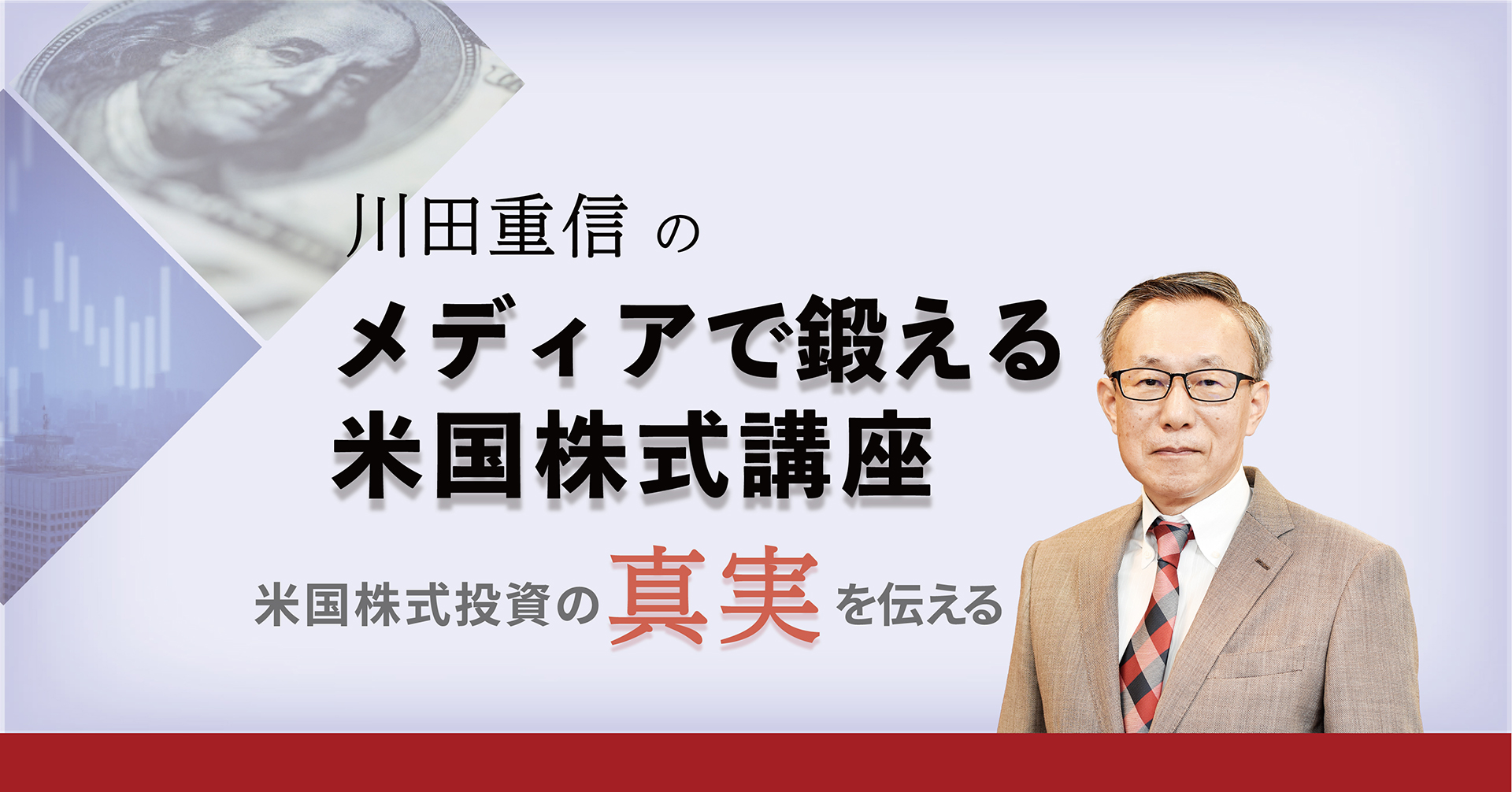
Translating the Truth About U.S. Stock Investments: Shigenobu Kawada's "U.S. Stock Investing Course Trained by the Media" [Vol.44] Delivered on April 25, 2022

────────────────────────
The Truth of US Stock Investment
[Vol.44] Delivered April 25, 2022
────────────────────────
Shigenobu Kawata's “Training in US Stock Investing through the Media”
*** Table of Contents ***
Market Review
This Week's Pick Articles
Kawata's Stocks of Interest
Investment Tips
A Walk
What Is the Private Investment Strategy Practiced by Ultra-Wealthy Individuals?
Activity Information
Closing day off: May 30
New Program [How to Read Nikkei to Enrich Life]
A project that picks up intriguing articles from Nikkei, which I’ve read for over 40 years since becoming a working adult, and comments on them. It is held every Saturday from 9:00 to 9:45 a.m. as a Zoom participation format.
Participation is free, so if you’re interested, please apply onPeatix.
Below are some article headlines covered last Saturday

Online Salon “Dream-Come-True Asset Formation School”

An online salon where everyone learns and inspires each other to succeed in asset formation. We offer member-only seminars that convey content beyond the popular newsletter “Training in US Stock Investing through the Media” and allow you to experience the魅力 of US stock investing.
2000万円 Pace-Setter

Source: Financial Services Agency; Based on asset management simulations prepared by ExeTrust Co., Ltd.
※The figures above are for simulation purposes only and do not guarantee future investment outcomes. Fees and taxes are not included.
How to Read: Assumed Returns and Target End Year
3–4%: 30+ years for wrap funds or balanced funds
5–7%: about 25 years for non-US stock funds
8–10%: around 20 years for modest estimates of S&P 500 appreciation
S&P 500 Performance (Dividends Reinvested 1970-2021)

Reach 20 million yen with proper risk-taking, early
Kawata’s message is extremely simple. To achieve 20 million yen, make your excess funds work as efficiently as possible. For that, participants must correctly understand the meaning of risk and reward. Before reading the weekly newsletter, glance at this table to confirm the correct investment posture.
Now, start the countdown to reaching 20 million yen!
■□■□■□■□■□■□■□■□■□■□■□■□■□■□■□■□
1. Market Review (April 18–April 22)
Major indices
• Dow Jones▼ 1.9% • S&P 500 index▼ 2.8%
• Nasdaq Composite▼ 3.8%
= Quick Version =
Long-term rates rose to levels not seen since December 2018 amid concerns about inflation containment and a rate-hiking stance. Earnings releases were mixed relative to market expectations and did not support equities, with tech stocks staying soft.
= A Bit More Detail =
Last week’s stock market began with solid economic indicators like industrial production, while rates rose in response to inflation containment, pushing long-term yields toward the high 3% range for the first time since December 2018, which dampened tech stock upside.
In Q1 earnings, some companies like banks and IBM surpassed expectations, while Netflix fell sharply after reporting subscriber declines, leading to a mixed market that did not provide upside support.
Following Powell’s remarks suggesting a possible 0.5% rate hike in May, expectations for monetary tightening grew and selling pressure intensified toward the weekend.


■□■□■□■□■□■□■□■□■□■□■□■□■□■□
2. This Week's Pick Articles
A column where I select information useful for asset formation from what I’ve collected, rank it, and comment with my personal views.
【1】Nikkei NewspaperJapan Inc.’s “False Kindness”: Shift toward Self-Determination
Executive Commentary: Tokyo Tomo Kujo, 4/17
Engagement index shows Japan dropping to 132nd of 139 countries, indicating that Japanese tend to be passive and serious rather than proactively engaging in work. Why has this happened to formerly praised diligence?
Kunio Ito, Professor at Hitotsubashi University CFO Education & Research Center, notes that Japanese managers may have misconceived the meaning of “being kind to people.” Even when a business is failing, cutting or selling it is often avoided because it would be “cruel to employees.”
The activating keyword at work is “self-determination.” Each employee should make choices with resolve and responsibility, and build a career autonomously. If individuals choose their own work, they will naturally engage more; freeing from “doing it because you’re told,” more people will find vigor in their work, revitalizing the workplace and the company.
【Kawata’s Comment】
In the viewer-participation program “How to Read Nikkei to Enrich Life,” last week (April 23) we discussed talent-related articles and heard your opinions.
Today’s Nikkei includes many articles pondering the Japanese approach to work; this is one of them.
【Other Related Articles】
Psychological Safety Contributes to Work Performance4/18
Male Leave, “Promotion Fears”: Honest Discussions of Parenting Generations4/18
Why Japanese Wages Aren’t Rising: Aging and Inertia in Wages / Productivity Still Low4/18
Mid-career Hiring Exceeds 30% of Total; this year’s focus on ready-to-perform talent4/22
In the past, “Japanese people are excellent and diligent.”
I used to think Japanese people were capable and proactively tackled challenges. Yet in organizations where lifetime employment and seniority-rule domineer, skills and motivation often do not align with authority or pay.
However, while working abroad, I learned that ambitious and capable young Japanese rise through the career ladder at speeds far different from those at home. People around them welcome and embrace it.
Among my experiences in New York, Hong Kong, and Singapore, I especially witnessed this in Hong Kong. Motivated youngsters are eager for positions and titles necessary for career development and actively pursue certification exams, always seeking better workplaces. For expatriates with lifetime employment in mind, the vector was completely different. By the way, in New York, very capable employees were less likely to come to the firm I worked at.

The Root Cause: “Lifetime Employment” under a Membership-Based System
If I were to pinpoint one issue in the Japanese workforce described in the article, it is the lifetime employment system. It functioned fairly well during Japan’s high-growth era, but there is growing criticism of its institutional fatigue.
One feature is the “membership-based employment.” Once you become a member of an organization, you gain job security, skill acquisition, and access to an internal labor market that allows you to experience different roles. However, this way of working does not restrict working hours or locations, so transfers and internal moves are common; in other words, it is a form of “corp-at-work” rather than just employment.
The opposite is “job-based employment.” Under this system, the company clearly defines the duties for the employee and pays based on the job or role rather than hours worked (Pay for Job). Transfers are basically not made.
Hiring as a “Member” after university. I joined as part of the firm’s “members.” Family and self were devoted to this company as a premise.
I worked there 19 years, during which I could study overseas, be assigned overseas, and experience departmental changes, gaining access to the firm’s valuable resources and learning. I am deeply grateful for that and for being able to stand on my own later.
In this membership-based system, mutual affinity between the individual and the company is key to mutual satisfaction. A part of this is job transfers. In my company, work locations and new duties could be announced without regard to the employee’s intentions or preferences.
In my case, I rarely received advance notice about transfers. For example, in the third year after joining, I was transferred from the Kyoto Branch to the main office’s Underwriting Department (Investment Banking). I learned of this via an internal fax on a Saturday around noon.
Later, after studying abroad, I was transferred to a related institute, and six months later to the International Underwriting Department (Investment Banking). Since this was based in Tokyo, it did not impose a burden on my family.
However, during a five-year stint in New York, I learned of a transfer through a phone call from a Tokyo colleague after arriving for the day. Soon after, another acquaintance in a foreign firm contacted me. Within about two months, my family had to leave the U.S. The children were quite surprised.
Even more surprising was the Hong Kong period: after two years, I was suddenly ordered to move to Singapore in the summer. My wife was about to give birth to our third child, and I wondered why this timing and without prior notice?
At that time, I left my family in Hong Kong and transferred alone to Singapore. It was around this time I began to sense the negative aspects of the membership-based system. After settling in Singapore, I told the head office in Tokyo of my desire to return (usually prohibited), and a year later I was transferred back to Tokyo. After returning, I began seeking other employment and left the company the following year.
Pros and Cons of Membership-Based Employment
Membership-based employment has great advantages. For example, the company can objectively gauge what possibilities or aptitudes you possess; with successful rotations, you can build a broad internal network, and skills naturally develop.
Nevertheless, I hoped for more consideration of the individual’s wishes and family circumstances in transfers. Also, because the pay ceiling is low, it is difficult to take bold risks like leaving to start a business.
A Relationship of Mutual Affection with the Company
By the way, the “surprise transfer” I experienced was once considered normal. Yet after observing from outside the company, I feel that truly future-promising elites may not complain about transfers, because they believe their future is guaranteed, and any transfer is a company courtesy to maintain their advantage over rivals. Therefore, whether one feels victimized by a “surprise transfer” depends on the relationship between the individual and the company—the “Mutual Affection Index.”
Back then in New York, I thought the “Mutual Affection” with the company was quite high. The experience on Wall Street likely shifted my values. The 1985–1990s bubble era—the extreme sales quotas, and the subsequent decline post-1989—made me feel uncomfortable with a business model that relied on individual investors’ sacrifices.
From 1985’s狂乱 market, its crash, and the prolonged downturn, and the 1998 Jusen situation, I wondered whether elites who observed everything but kept silent had planned crisis-escape strategies. Was it their understanding that the future would be secured regardless?
My experience in New York and Asia led me to believe there was little hope for the Japanese securities business model. So in 1997 I switched to a foreign-owned securities firm, staying for two and a half years. This was a form of “Job-based recruitment.”
The work content didn’t change much, but compensation improved substantially. Yet since the role was Sales Head, pay was calculated by a fixed formula, leaving little room for complaint. “If we eliminated lifetime employment and seniority, could you earn the same pay for the same work?” After just two and a half years in a foreign firm, starting my own business became possible and was truly fortunate.

There was a time when even I enjoyed unannounced transfers
By the way, those unannounced transfers did carry an adrenaline rush. As the transfer period approached, there were moments of anticipation and nerves. It was unclear where I would go or what I would do. Yet wherever I was transferred, I shared the same values with people there, so there was no need to worry.
Looking at it from another angle, a family can also experience a new cultural environment. The key is whether you view it positively—again, it depends on a high “Mutual Affection Index” with the company.
【2】Nikkei NewspaperWall Street Round-Up: Memories of Confusion Amid Major Rate Hikes4/23
Nasdaq Composite fell 4% for the week, near the year’s low set in March. The Fed is expected to decide on asset shrinking at the May 3–4 FOMC meeting in addition to further rate hikes. If the hike is 0.50%, it would be the first since May 2000.
If the increase reaches 0.75%, it would be the first since November 1994. At that time, large rate hikes caused a clear inversion and losses in derivatives trading; California’s Orange County bankruptcy is a representative example. Mobile capital backflows to the U.S. also sparked a Mexican currency crisis.
Powell said on the 21st that a 0.5% rate hike would be considered at the May meeting. The bond futures market shows expectations of 0.5% hikes in June and July as well.
Nomura Securities (U.S.) predicts hikes of 0.50% in May, 0.75% in June and July, followed by 0.25% increases in September, November, and December. By year-end, the federal funds rate would be 3–3.25%, more aggressive than the market consensus.
Nasdaq 100 five-day chart shows a straight drop in Thursday and Friday

【Kawata’s Comment】
What caused last week’s price decline was investors’ changing expectations about the speed and magnitude of rate hikes. Here are some market sentiment shifts observed during this period.
*As of April 15, the prevailing view was that the FF rate would be 2.50–2.75% at the December FOMC. By April 22, year-end FF rate futures expected around 2.75–3% or 3–3.25%, roughly split in half.
*Nomura Securities (U.S.) forecasts 0.75% hikes in June and July, followed by 0.25% increases in September, November, and December, expecting the FF rate to reach 3–3.25% by year-end, more aggressive than market consensus.
*Conversely, Cleveland Fed President Mester, in an April 22 CNBC interview, acknowledged that while the aim is tightening, it won’t be a rapid, full throttled tightening.
*This week, with May 4 FOMC approaching, FRB officials will enter a “quiet period” with fewer public statements. Key indicators include inflation metrics such as the first-quarter Employment Cost Index (ECI).

What they envision is a steady rate hike akin to February 1994 through February 1995, followed by a long-term uptrend beginning in 1995. Whether this tightening will be a prelude to a long-term rise similar to 1994 remains to be seen.


【3】Nikkei NewspaperU.S. Stocks: Pessimism Grows as Economic Slowdown Fears Drag Down Outlook
Factors Create a Turbulent Path4/20
Pessimism about U.S. stock market’s future has been gradually spreading. Despite vigorous tightening and Ukraine concerns, the U.S. market has not faced a major correction, but now different factors—economic growth, employment, inflation, and geopolitics—are creating more volatile price movements.
Beared (Bearish) camp
Representative among bears is Morgan Stanley, which argues that the economy shows signs of slowing. In March, ISM manufacturing index’s new orders fell 7.9 points to 53.8, and inventories dropped below 55.5 for the first time in two years. Morgan Stanley strategist Wilson predicts pricing power will erode as supply catches up to demand, leading to price declines.
Market’s future views split

Goldman Sachs
Lowered year-end S&P 500 target from 4900 to 4700 in March, citing weaker earnings per share due to higher commodity prices and weaker global growth. UBS also trimmed S&P 500 forecasts to 4700 with a neutral stance.
Bullish
Credit Suisse. Raised U.S. equities to Overweight in March and maintains it, arguing that healthy households and corporate balance sheets, along with a recovery in the services sector, will support sustained growth in developed markets. Share buybacks will continue to support equity prices.
JPMorgan also sees stronger economic activity and labor conditions to support risk assets, predicting the S&P 500 to rise more than 20% by year-end.
Sector
Mostly Healthcare is cited. Bears cite defensiveness and resilience to the economy, while bulls point to growth industries as the rationale.
【Kawata’s Comment】
The above is Wall Street’s official sell-side investment view. In addition, we will introduce some seasonal and special factors
① A year with a negative S&P 500 index over the first four months
According to Barron’s Digest, April 18 issue, “Is selling in May the best strategy this year?” the market’s performance from the start of the year for four months is likely to be negative. The analysis is as follows:
When the S&P 500 index has been negative in the first four months of the year (since 1980)
there have been 15 occurrences, and in the following May–September there have been 6 declines, i.e., a 40% probability. The average performance is negative 1.5%.
If it rose from the beginning of the year to the end of April
the probability of a decline from May to September is 23%, and the average performance is +8%.
② U.S. midterm elections and stock prices
May is half a year before the November midterm elections. During this period of a president’s four-year term, stock prices tend to be the weakest. Among them, a Democratic president’s first term is the worst.
Since 1926, in the second year of a president’s term (2022, 2018, 2014, 2010, 2006, 2002, …), the average S&P 500 return from May to October is +2.26%, the lowest six-month performance, while the six-month total return from November to the following April, when the president’s term enters its third year, averages 13.9%.
Stock price plunges after 1962
There is a tendency for larger declines in midterm election years. The average decline in midterm years is 19%, whereas in other years it is 13%. However, after substantial declines in midterm years, the market rebounds by an average of 31.6%.
“Regardless of which party is in power, a sense of disappointment toward the administration tends to intensify in the second year, and investors express their discontent before the November midterm elections.” Many large stock price declines in midterm years have been “bear killers” for bears, while in longer downturns they became the “ominum.”
Since 1960, there have been 14 episodes where the S&P 500 fell by more than 19%, and in 10 of them the bottom was reached in midterm years, with 8 of those six-month periods (May–October) being seasonally weak. This includes the major bottoms in 1974, 1982, and 2002.
A sharp stock price drop in midterm years often begins with negative returns in the first quarter. This year, the S&P 500 fell in Q1. “In past midterm years, what is happening now has common themes—war, trade frictions, inflation, recession, and rising interest rates.”
Reference chart

■□■□■□■□■□■□■□■□■□■□■□■□■□■□■□■□■□■
3. Kawata’s Noticeable Stocks
Among the holdings of Kawata, and while being exposed to information on U.S. stocks, this is a corner to introduce stocks that caught my attention.
This Week’s Stock
HP HP Inc.

Overview
HP was formed in 2015 as a spin-off from Hewlett-Packard. It operates in over 180 countries, producing and selling user-facing devices such as notebooks and printers and providing solutions.
What makes the company attractive
Diversified product portfolio and geographic spread
HP divides its business mainly into two segments: Personal Systems and Printing. The Personal Systems segment produces and sells PCs and related peripherals, accounting for 72% of revenue (as of Q1 FY2022; fiscal year ends in October). The Printing segment accounts for 28% of revenue but 48% of operating profit, due to the higher margins of products like printer toner.
(Figure 1: HP product mix by revenue, Q1 2022)

(Figure 2: Breakdown of Personal Systems segment, same)

(Figure 3: Breakdown of Printing segment, same)

Within each segment, there are short-term fluctuations in product lines, but the long to mid-term trend is steady growth across the divisions and the company as a whole.
On the other hand, with a global sales network, 40% of sales in the Americas (of which the U.S. accounts for 33%), 35% in Europe, the Middle East and Africa, and 25% in Asia-Pacific, the U.S. share is relatively smaller, reducing the impact of the U.S. economy. Strong brand power and marketing strategies support mid- to long-term growth globally.
(Figure 4: HP regional sales mix, Q1 2022)

Strategic acquisitions and shareholder returns
By maintaining strict cost control while expanding the range of PC peripherals through strategic acquisitions. Recently, HP acquired Kingston Technology’s gaming peripheral unit HyperX for $425 million in 2021. The company is a leader in gaming headsets and also sells keyboards, mice, and microphones. In late March this year, HP agreed to acquire Poly for $3.3 billion, a provider of headsets and voice conference systems. These acquisitions are viewed as directly capitalizing on the shift to remote and hybrid work.
(Figure 5: Poly’s product lines after the acquisition)

Meanwhile, HP uses its abundant cash flow to actively return capital to shareholders, not only by annual dividend increases since the spin-off but also via aggressive share buybacks. The large buyback in 2021 was spurred by depressed stock prices during the pandemic.
(Figure 6: HP’s shareholder returns)

Undervaluation
Despite the company’s stable operations and shareholder returns, HP’s stock price appears undervalued. The forward price-earnings ratio is around 9x, and the forward price-to-sales ratio is well below 1. On the other hand, the dividend yield is in the 2% range, even without factoring in future increases, which gives the stock a different profile from typical information and communications technology names.
This background is attributed to investors not perceiving explosive growth potential in HP’s product line. For example, as home office trends may wane, earnings growth may slow, which weighs on the stock price.
However, considering a monetary tightening environment to curb inflation, along with solid earnings and shareholder returns, investor sentiment toward HP could shift. Recently, Warren Buffett’s Berkshire Hathaway BRK.A disclosed a large stake, elevating its ownership to 11.4%.
Risks
Geographic diversification and product diversification notwithstanding, the global slowdown will affect HP. In particular, its enterprise-facing business is highly cyclical, so temporary stagnation could be a concern.
(Figures 1–5 are from HP materials; Figure 6 is ExeTrust’s compilation from the company’s data)
HPQ basic data (Source: company data, Yahoo! Finance)
(As of Apr 22)
Share price $36.79
Market cap $38.75 billion
Total revenue $6.49 billion
Forward PER 8.53x
Trailing yield 2.17%
Headquarters: Palo Alto, California
Listed: November 1957 (including the former Hewlett-Packard era before the spin-off)

5-year price chart
Charts provided by TradingView.com
(This section is intended for general information only and does not constitute an invitation to buy or sell any securities)
■□■□■□■□■□■□■□■□■□■□■□■□■□■□■□■□■□■
4. Investment tips
In addition to “investment methods” and “stock picks,” this corner also covers “interesting indicators or statements” and “social and political movements.”
This time, it is a contribution from Makoto Okura, well known for the company’s YouTube channel “40-Year U.S. Stock Investment” series.
Monetary policy and the yield curve
In April, the term “inverted yield curve” gained attention in the stock market. Here, we would like to explain the basis of the yield curve in relation to the Federal Reserve’s monetary policy.
1. The yield curve (yield curve)
Deposits and bonds have maturities. The relationship between the time to maturity and the corresponding interest rate is called the “term structure of interest rates.” The yield curve is the curve formed by joining yields at each maturity (also called the yield curve in charts).
Figure 1 Yield Curve (yield curve)

Normally, especially when interest rates are relatively low, the yield curve is upward sloping, called a “normal yield,” whereas when monetary tightening occurs (rates relatively high), the curve can slope downward, called an “inverted yield” (Figure 2).
Figure 2 Normal yield and inverted yield

The actual shape of the yield curve is not always a clean upward or downward slope. There are occasions when the curve deviates in the middle for various reasons.
A steeper yield curve means steepening, a flatter curve means flattening, and downward-sloping is inversion.
There are three hypotheses about how the shape of the yield curve is determined.
① Expectation Hypothesis … The shape of the yield curve is determined by the market participants’ expectations of short-term rates in the future. If they expect higher short-term rates, the curve will be normal; if they expect lower rates, it will be inverted.
② Liquidity Premium Hypothesis … If the expectation hypothesis is correct, long-term rate movements should be roughly balanced. However the yield curve is generally normal, and inversions are infrequent. Therefore, the liquidity premium hypothesis posits that longer maturities carry higher investment risk, so the curve tends to normal; inversions are temporary errors that will revert to normal.
③ Specific Maturity Preference Hypothesis … Bond investors specialize in specific maturity ranges, and supply and demand by maturity bands affect the curve.
These hypotheses are not mutually exclusive; you can view them as ① primary, with ② and ③ providing support and refinement.
2. Monetary policy and the yield curve
In reality, changes in the shape of the yield curve are heavily influenced by central bank policy. The U.S. central bank’s goal is maximum employment and price stability. Monetary policy is implemented to achieve these goals. Traditional monetary policy centers on policy rate adjustments, while non-traditional policy has become prominent especially after the Lehman crisis.
① Traditional monetary policy… Through open market operations (purchases and sales of government bonds and bills), the central bank controls liquidity to steer the policy rate (the FF rate, also called the Fed Funds rate). Through policy rate management, it influences longer-term rates with a view to achieving full employment and price stability. In traditional policy, the lower bound for the policy rate is zero.
② Non-traditional monetary policy … When policy rates are at zero, further easing is pursued through non-traditional measures. Specifically, large-scale purchases of government bonds and MBS (quantitative easing) directly affect long-term interest rates, lowering corporate long-term financing costs and encouraging investors to shift toward risk assets.
Let’s look at how the yield curve changed from 2003 (after the dot-com bust) to 2009 (after the Lehman crisis).
① After the dot-com bust, traditional monetary easing lowered policy rates sharply, resulting in a steepening yield curve (Figure 3).
Figure 3 The yield curve after the dot-com bust

② In the economic recovery phase, the stance of monetary policy shifted from easing toward neutral. As policy rates rose, the yield curve flattened (Figure 4).
Figure 4 Yield curve during the recovery from recession

③ When the economy was booming and the real estate market overheated, the policy stance tightened. The yield curve inverted and became inverted (Figure 5).
Figure 5 Yield curve in a boom

④ As subprime lending issues emerged and financial crisis began, the Fed shifted to easing, and the yield curve steepened again (Figure 6).
Figure 6 Yield curve during the onset of the financial crisis

⑤ When Lehman Brothers collapsed and the financial crisis hit, the Fed implemented quantitative easing, policy rates fell to zero, and the yield curve shifted downward across the board and became very steep (Figure 7).
Figure 7 Yield curve during QE in the financial crisis

In summary:
① When the economy is in recession and the Fed is easing, keeping policy rates low causes the yield curve to steepen.
② When the economy bottoms out and normalizes, the Fed’s stance becomes neutral and rates rise gradually, flattening the yield curve.
③ When the economy overheats, tightening policy raises rates sharply and the yield curve flattens and may invert.
④ When the economy peaks and slows, rates are gradually lowered again, steepening the yield curve once more.
⑤ If easing continues from zero interest rates (QE), the entire yield curve shifts downward.
Thus, the shape of the yield curve changes dynamically due to the Federal Reserve’s policy rate operations and QE.
【Makoto Okura】
From Ehime Prefecture. Graduated from Osaka University with a degree in economics in 1984. Earned a PhD in economics from Saitama University in 2005. Worked at Citibank, N.A., Citigroup Trust Bank, and Société Générale Trust Bank (now SMBC Trust Bank). In addition to institutional investors such as pensions and public funds, engaged in asset management for high-net-worth individuals at a private bank. In 2017, established EagleCapital Co., Ltd. in Kyoto’s Higashiyama. CFA charterholder. Certified member of the Investment Analysts Association of Japan.

■□■□■□■□■□■□■□■□■□■□■□■□■□■□■□■□■□■
5. The stroll corner
◇◇Recently visited stores,movies, museums, and books◇◇
~ The Kawakura Kanenori's chapter ~
This is a contribution from Kanenori Kumakura, a former securities man and avid reader.

97% of investment trusts are bad for these reasons / Kazutaka Oshima
The assets that can be invested in are collectively called Asset Class, but specifically include stocks, bonds, mutual funds, etc., and in recent times real estate, precious metals, cash, and alternatives such as hedge funds and private equity.
In Japan, the distribution of household financial assets has often been in the news; at the end of last year, it was reported that 2022 would be the era of 2,000 trillion yen in household financial assets.
There is also frequent discussion about household financial asset composition and its comparison across Japan, the U.S., and Europe. The Bank of Japan published “A comparison of the flows of funds in Japan, the U.S., and Europe as of August 20, 2021” by the Bank of Japan Research and Statistics Department.
(See the chart below; data as of March 31, 2021)

From this, the share of risk assets for households—stocks + mutual funds + bonds—was Japan 15.7%, U.S. 55.2%, Europe 29.6%, indicating Japan’s conservative and the U.S.’s aggressive investment behavior.
To guide households’ cash and deposits into risk assets was a major theme for financial institutions.
When I entered the securities industry in the 1980s, the mission of securities firms was hammered into us: “to raise long-term industry funds through the sale of stocks and mutual funds.”
Subsequently, with banks enabling online mutual fund sales, the introduction of tax-advantaged accounts such as NISA and iDeCo, and other innovations, financial institutions continued to experiment.
Nevertheless, the wall of personal financial assets is hard to break.
In particular, mutual funds are sold by agents who come to the investor, not by products that investors go to the counter to purchase.
Therein lies the peculiarity of mutual funds.
This book points out the peculiarity of mutual funds from multiple angles—product composition, asset managers, distributors, and investors—and clarifies many misunderstandings.
Though the title is provocative, perhaps a hallmark of a long-time industry insider, the author ultimately presents “the proper form of mutual funds.”
I believe the advantage of mutual funds as financial products lies in their liquidity—being able to convert to cash at any time—but this is not extensively covered; what are your thoughts?
【Kanenori Kumakura】
Joined Daiwa Securities in 1980. Studied at the University of Chicago Booth School of Business as part of a corporate posting. Involvement in Asia business through assignments in Singapore and Hong Kong.

■□■□■□■□■□■□■□■□■□■□■□■□■□■□■□■□■□■
6. What the ultra-rich actually do: “Private Investment Strategy”
Hiroshi Ichikawa, who specializes in sales support for IFA, shares with readers a private-investor strategy used by the ultra-wealthy.
Today’s topic is IPOs, something many readers will be familiar with.
Private equity investing involves unlisted shares; the final stage is when the company goes public, and before listing, investors can gain access to unlisted shares via a securities company’s lottery, i.e., IPO investments.
IPO investing is especially popular among individual investors. The main reason is that if you acquire IPO shares, the first day’s opening price often exceeds the pre-listing “offer price,” so selling at the open can yield a profit.
IPO success rate is high
The number of shares offered at the time of IPO is fixed. The “offer price” is determined by discounting the calculated value. Therefore, the offer price is usually below theoretical value, making it easier to beat the open price after listing.
However, you cannot buy as much as you want, and even if you win a lottery, the amount is only tens of thousands of yen. If the prize multiplies, profits can be large, but you must open accounts with multiple brokers to maximize chances, so treat it as a small add-on to your investments.

How to secure allocations
IPO services are offered by many brokers. The number of shares underwritten varies by deal, so differences in which brokers are easier to obtain IPO allocations are modest. However, allocation methods differ completely, so there are tips to improve your odds.
① Pure lottery method
Most online brokers and the online channels of traditional brokers use this method. It’s a mechanical lottery, and you don’t know if you’ll win. The leverage ratio is not disclosed, but can exceed 100x. Applying to multiple online brokers increases the chance of winning because each has its own lottery.
② Discretionary allocation method
Used by traditional brokers. It’s not a lottery; allocation is decided by the branch manager or sales staff’s discretion. Privileged clients with substantial funds and frequent trading are often given priority.
By the way, brokers clearly state this discretionary allocation in writing. An example is below.
~“Taking into account the client’s investment intentions, intended holding period, relationship with the company, and shareholder base formation, we will allocate new IPOs after understanding the risks.”~
Rather than opening accounts blindly, apply for IPOs with brokers you truly wish to trade with and that are a good fit. For traditional brokers, IPO-focused investors are often disliked by sales staff, so avoid opening accounts solely for IPO allocations.
Could the win rate drop in the future?!
IPO investing has historically high win rates, but this may decline. In January, the Fair Trade Commission issued a report titled “On the status of public price setting processes for initial public offerings (IPOs)” and pointed out that incumbent underwriters may be price-setting unlawfully under antitrust laws, urging a review.
In other words, “the offer price is too low, so set a fair price.” If the offer price rises, the post-listing gains will be smaller, which is negative for investors.
In Japan, the first traded price is often well above the offer price based on demand surveys from individual investors; compared with the U.S. and Europe, the gap is larger. This is part of the rationale behind the report. The average first-day price in Japan is said to be about 1.5 times the offer price, while in the U.S. it is about 1.2 times.
The Fair Trade Commission says it will present its views to the Japan Securities Dealers Association, the Financial Services Agency, and the Tokyo Stock Exchange. We will update as developments occur. If you have expertise in this area, please share information.
【Hiroo Ichikawa】
Investment techniques to become ultra-wealthy
Winviser Co., Ltd. President. After working at SMBC Nikko Securities in the asset management consulting for offices in Ibaraki, Fukuoka, and Tokyo, moved on to marketing financial products for ultra-wealthy clients.
Moved to independent financial advisor (IFA) and, after advising ultra-wealthy individuals on wealth management, established a support company specializing in IFAs to develop Japan’s financial industry. Currently supports IFAs while providing a third opinion on asset management to individual investors based on personal experience.

■□■□■□■□■□■□■□■□■□■□■□■□■□■□■□■□■□■
7. Upcoming activity information
◇ Stockbox: May 11 and 18 (Wednesday) at 11:00
───────────────────────────
★ For questions, please read the【Question Rules】below and email info@kawata-magazine.com.
【 Question Rules 】
◆ We may not answer all questions. Please understand.
◆ Questions may be published on our site, YouTube videos, SNS, books, etc., in a form that does not identify individuals.
◆ We will not respond to questions from unsubscribed readers.
◆ Obvious advertising or promotional content will be omitted.
◆ If you post malicious questions despite not subscribing, we will take appropriate measures.
───────────────────────────────────
★ Disclaimer
◆ The information provided in this newsletter does not constitute recommendations to buy or sell stocks, bonds, funds, ETFs, or sector-specific securities, and investment decisions are the responsibility of the subscriber (member). The company does not provide any guarantees.
◆ The company bears no responsibility for any damages incurred by members using the newsletter.
◆ The company bears no responsibility for disputes between members or between members and third parties arising from the content of this service.
◆ If the content of this service infringes the rights of a member or a third party, the company bears no responsibility for such infringement or the resulting disputes.
◆ The company bears no obligation to compensate for damages arising from suspension, termination, or changes to the service’s content.
───────────────────────────────────
■ Publisher: Hibiya Technology & Finance Co., Ltd.
■ Kawata Shigenobu’s Thank You America Stocks
https://www.kawataamekabu.com/
■ Twitter:https://twitter.com/ShigenobuKawata
■ For comments, requests, or to unsubscribe, contact
【Email】info@kawata-magazine.com
■ If you do not receive emails, they may be classified as spam; please check in advance.
───────────────────────────────────