
Beginner-friendly completely free tool "Nanairo Sora" Paid signal tool "Ajinitchi" Secret method revealed!
Hello everyone.
My name is Ku (Kuu), a part-time trader.
Today, to everyone using the indicators Nanashiki Ku and Ajinitchi, I am publicly revealing a highly confidential technique.
The time has finally come to freely publish a method I had been releasing bit by bit.
At the moment when the free indicator Nanashiki Ku is about to reach 300 users and just before the start of the paid indicator EA gift, I am publishing a method that should be considered a secret technique.
Since my goal is to nurture discretionary traders, there is an ideal where, ultimately, you can trade even without signals.
As the first step, I have recorded and published a video解説 on the theme of “Ajinichi's Five Trading Rules,” so from now on, whether you are about to use the free indicator Nanashiki Ku or you are already using it, you can refer to this.
【Free Indicator Nanashiki Ku (Nanashikukuu)】
https://www.gogojungle.co.jp/tools/indicators/24852
Password: ajinitchi2022
And for those considering the main paid product, the indicator “Ajinitchi” and the “Ajinitchi EA” with automatic settlement, I will share an important method for free to everyone who is using it.
【Paid Indicator Ajinitchi】+【Automatic Settlement Ajinitchi EA】
39,800 yen
https://www.gogojungle.co.jp/tools/indicators/36476
The method is the quintessential “Dow Theory-based Stop-Loss Method,” a classic trading rule.
Do you sometimes enter using a stop-loss?
Although not a mainstream entry method, from the Dow Theory perspective it is a highly advantageous methodology.
Below is the content from the YouTube description.
Today, for beginners, I spoke about the theme “Ajinichi's Five Trading Rules.” The indicator’s signal tools exist as an auxiliary tool for discretionary traders.
If the trend definition is vague, for those who are good at following the trend, losses may increase in range-bound markets.
For trend-reversing traders, when a trend forms, unrealized losses may increase, and if one endures it and repeatedly does averaging down or martingale, the number of positions can balloon, leading to capital depletion and forced liquidations, potentially wiping out all of a single trade.
Therefore, in range-bound markets, I determined that an ideal logic is to minimize signals and to use a stop-loss on a signal of potential trend formation to avoid traps as much as possible.
This is especially important.
If signals occur too often in a range, you will lose sight of the trend and small stop-outs will erode your resolve.
Too many signals waste time and energy, reducing productivity and wasting capital and life.
In particular for someone like me who is a part-time trader with severe time constraints, I transferred the timing of trend formation from MT4 to a smartphone and arrived at a method of judging charts on a VPS.
I am freely sharing all of this, so whether you have the free indicator Nanashiki Ku or the paid Ajinitchi indicator, I want you to refer to this method.
And since the recording was about 30 minutes, I split it into two parts and uploaded it to YouTube.
The second part of the continuation video is here.
In the first part, I mainly explained trading rules 1–3, while in the second video I reviewed and explained 1–5.
I normally monitor nine currency pairs, so I roughly looked at the overall flow from last week and revealed a method for avoiding signal traps.

Although the free indicator Nanashiki Ku has 300 downloads, the template downloads are only 61, which is relatively few.
From this, even if you download the free indicator, many people do not download the templates, so I suspect that only a small subset of interested people are drawn to this kind of method publication.
This time I did not discuss the accuracy differences between “Nanashiku” and “Ajinitchi”; I said that the methods are common to both.
In other words, Dow Theory.
The weakness of Dow Theory is range-bound markets.
You may have thought that breaks of recent highs or lows would form a trend, but you ended up in losses as the price moved in the opposite direction.
As such experiences accumulate, people tend to forget the concept of balance—that the market tends to revert to the mean.
Viewed extremerly, many believe prices will eventually revert, resulting in a no-stop-loss approach with averaging down and martingale, losing all funds on a single major trend.
In range markets, since there is no clear trend, after making a new high you may see a new low, or after a new low you may see a new high.
In other words, prices revert to balance.
However, my ten years of continuous losses were really due to not being able to separate from this thinking.
In other words, the trend definition was vague, and much of the time the market was in a range, so I clung to the belief that prices would revert someday.
Indeed, in 99 out of 100 cases prices revert to the mean, but in one big trend I endured unrealized losses and faced corrective stop-outs that caused me to lose 99% of my capital multiple times.And finally I established a clear definition of trend.With the Ajinitchi indicator and the Nanashiku indicator.By defining the trend, the logic was completed and it became possible to program the signals.I know many people find signals unreliable, but those people have not tried all signal tools.Because do you know a trader who has been losing for ten years and still clings to the market?
And finally I established a clear definition of trend.
With the Ajinitchi indicator and the Nanashiku indicator.
By defining the trend, the logic was completed and it became possible to program the signals.
I know many people find signals unreliable, but those people have not tried all signal tools.
Because do you know a trader who has been losing for ten years and still clings to the market?
My pride is that, while losing, I tried every paid and free indicator and EA that I heard could win, through my own effort or help from others.The number is well over hundreds.Having experienced many methods and tools, I also understand their weaknesses.This wealth of failure experience gave birth to the “Ajinitchi” system.If you think about it normally, you might think it’s stupid, given all the failed experiences, right?Sometimes you hear stories of people who spent ten years as a ronin and then got into Tokyo University, but such cases are rare, right?Because I lost in the market for ten years, I tried many indicators and EAs.In ten years, I blew over 30 million yen in assets, and the method I arrived at was astonishingly simple.If you have watched the video, you might think, “Huh? Is it really this simple?”It’s that simple and straightforward.
The number is well over hundreds.
Having experienced many methods and tools, I also understand their weaknesses.
This wealth of failure experience gave birth to the “Ajinitchi” system.
If you think about it normally, you might think it’s stupid, given all the failed experiences, right?
Sometimes you hear stories of people who spent ten years as a ronin and then got into Tokyo University, but such cases are rare, right?

In ten years, I blew over 30 million yen in assets, and the method I arrived at was astonishingly simple.
If you have watched the video, you might think, “Huh? Is it really this simple?”
It’s that simple and straightforward.
Signal accuracy is important, but how you view, judge, and act on those signals?
What is the method behind those signals?
We clearly answer those questions.
Today I won’t use still images for a video explanation, so I hope to only engage with those who are truly committed to fighting the market.
If you want to win seriously, purchase “Ajinitchi” and master “Stop-Loss” as it appears many times in the main video.
If you do not have enough funds, download “Nanashiku” for free and watch the video repeatedly.
Well, that’s all for today!
______________________
PS: In that post, will this work with Nikkei 225?
Since there was such a question, I will also post the chart for this month of N225 for reference.
First, here is the most recent N225 up to today.
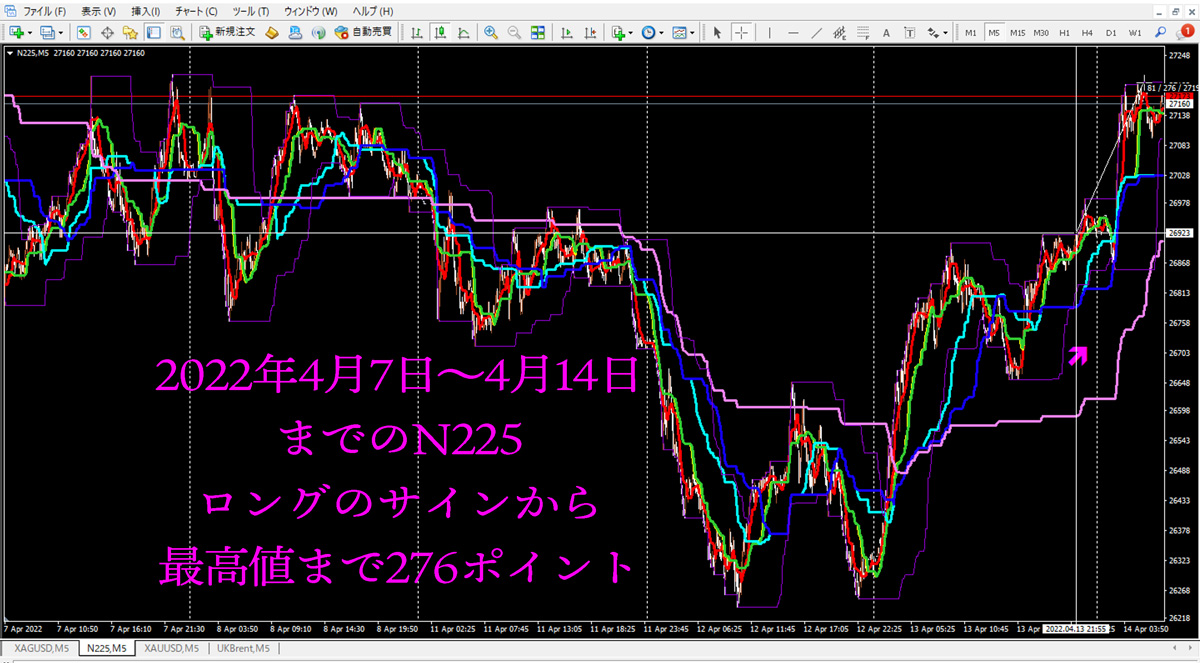
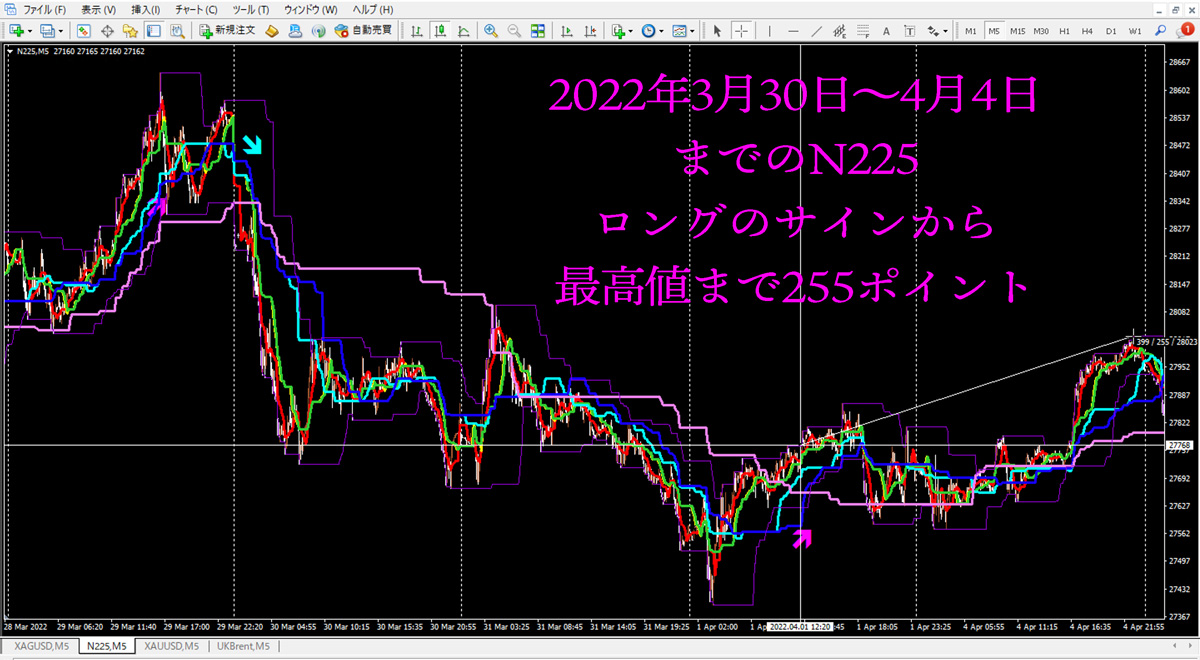
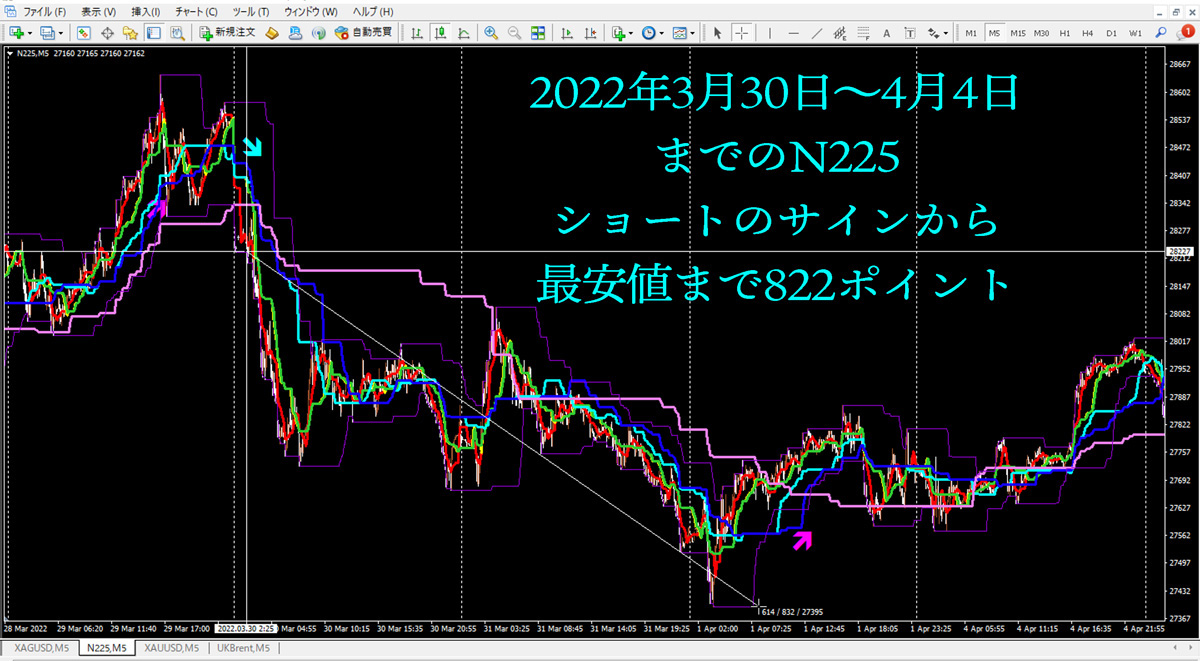
Thus, it is an excellent indicator that can determine trends on all MT4 charts, but it is not 100% accurate. Therefore I strongly recommend using the signal plus “Stop-Loss” plus “Stop-Loss, Take-Profit, and Trail” settings method mentioned at the beginning of this article as well.
If you have any questions, please ask.