

Confirming the trend reversal of the dollar/yen and the big homework I had forgotten
Hello!
This is Satori, researching FX.
In the previous article, after the new year, using Dow Theory and Fibonacci retracements, I shared an example of seven consecutive wins with a 0.382 pullback buy in USDJPY.
http://fxmt4indicator.blog.jp/archives/73914715.html
Since then, there was a trend reversal from the upward trend, so I report it.
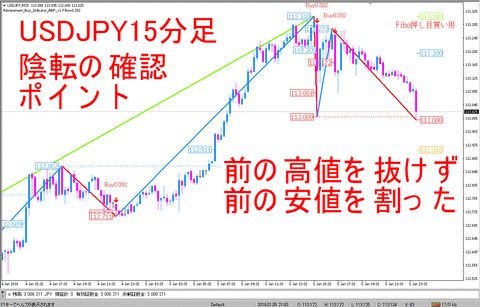
The judgment that it has turned bearish comes from not breaking the previous high and breaking the previous low.
The chart below is the USDJPY 15-minute bearish reversal chart.
http://livedoor.blogimg.jp/fxmt4indicator/imgs/b/5/b583a696.gif
If it has turned bearish, should I enter sells at the 0.382 retrace of the recent decline?
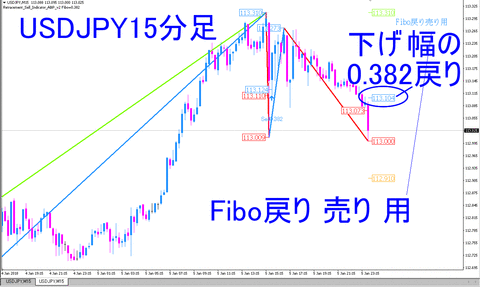
The chart below is an indicator for Fibonacci retracement sells.
It is bundled with the indicator for Fibonacci pullback buys shown above, but it is used during a downtrend.
http://livedoor.blogimg.jp/fxmt4indicator/imgs/b/8/b8092fb5.gif
In the above, the price of the 0.382 retrace calculated from the just-previous decline is 113.104 inside the ellipse.
Therefore, should I place a limit order at 113.104?
What is the answer?
Of course, no one knows.
Rather, we operate on the assumption that predictions do not come true.
Predictions are not so sweet to rely on for profit, and even if predictions are correct, there is no meaning unless there is profit.
Incidentally, the operations in the previous bearish reversal and the one before that were both correct.
Through various verifications, in reality, whether 0.236 retrace, 0.3 retrace, 0.382 retrace, 0.5 retrace, 0.618 retrace, or 0.764 retrace, as long as you place a limit below the previous high, the number of trades and win rate differ, but you can achieve similar effects with discretion as with system trading.
The more frequent with higher win rate is 0.236, but the profit per trade is small and the risk of loss is relatively large.
The less frequent with lower win rate is 0.764, but the profit per trade is large and the risk per loss is smaller.
This is up to your preference.
You can vary it depending on the situation.
In this sense, even someone who can only check the chart at 6 or 7 AM once a day, can imagine operating using a 15-minute chart without using a daily chart.
Incidentally, I will briefly touch on how to interpret the differences between technical indicators like RSI, moving averages, stochastic, Bollinger Bands, and wave analysis such as Fibonacci retracement, N-entries, and high/low breakouts.
RSI, moving averages, stochastic, and Bollinger Bands are calculated mostly using closes, not highs or lows, so the imagery is to view trends by averages.
There is a tendency to think they look profitable, so you should discount with that in mind.
In contrast, wave analyses like Fibonacci retracement, N-entries, and high/low breakouts do not involve any calculations of averages at all.
They do calculate 0.382 retracements or pullbacks, but do not average; they focus on the prior highs and lows themselves.
This means, due to human psychology, the crowd’s sentiment in a downtrend is that when the previous high is approached, selling will outweigh buying.
Conversely, if the crowd’s sentiment is uptrend, approaching the previous low means buying will outnumber selling.
Thus, the supply-demand battle for selling and buying is fought near the prior high and low.
Dow Theory can be seen as a summary of the formation of trends arising from such supply-demand near highs and lows.
RSI, moving averages, stochastic, Bollinger Bands, and wave analyses like Fibonacci retracement and N-entries/high-low breakouts are entirely different approaches, so I recommend using them in combination to make judgments.
Now, regarding the big homework I had forgotten, the following items are.
In last year’s article “Reverse-Edge Scenario RSI Bands Summary for 4-hour and daily charts,”
http://fxmt4indicator.blog.jp/archives/73737606.html
the daily risk: reward ratio was described as 1:1.
Simply put, with a 0.01 lot trade per currency, average profit per trade 800 yen, average loss per trade 800 yen, win rate 80%, the math says 10 trades would yield 800×8 - 800×2 = 6,400 - 1,600 = 4,800 yen profit, and 100 trades would yield 80,000 - 20,000 = 48,000 yen profit.
However, this is backtest data, optimized from 2013-2017, meaning five years of data that happened to be most convenient, and among thousands of parameter settings, the best one was chosen.
There is no guarantee this luck will continue in the future.
Therefore, this year’s theme is to conduct a forward test.
What is important is to validate data where risk: reward ratio is almost 1:1.
Normally, a high-win-rate system has small profits and large losses, e.g., 10 pips take profit vs. 90 pips stop loss.
Even if the win rate increases with small profits, the profit per trade becomes small and a single loss is large.
In FX as well, the overall win rate in markets is 50% in a simple buy/sell scenario; neutral.
In reality, due to spreads and fees, the win rate is about 45% in a neutral state.
In summary, the aims are as follows.
1. Risk: reward ratio ≒ 1:1
2. Optimize over four years and designate a forward period with no optimization in the most recent year
3. Among those, discover parameter combinations with as high a win-rate as possible and an upward trend
Even with risk: reward ≒ 1:1, achieving higher win-rate is desirable; for example, with 0.01 lot and fixed 80 pips take-profit and 80 pips stop-loss, a 60% win rate yields 1,600 yen profit over 10 trades and 16,000 yen profit over 100 trades.
How far can win-rate stay high and data show an upward trend including forward testing with risk: reward ≒ 1:1? This is the big homework left undone.
This big homework may take until January, but I’d like to start with daily charts first.
How one accepts losses as stop-losses is the most important aspect of operation in practice.
However, even with risk: reward ≒ 1:2 or ≒ 1:3, as long as there is an overall upward trajectory, it is acceptable.
This will be addressed in a later homework.
The indicators used today are as follows.
Fibonacci Retracement Indicator: Pull up
http://fxmt4indicator.abproducts.biz/wp/?page_id=2255
Thank you very much for reading until today.
********************************************************************************
FX Operation Seminar: Framework to achieve stability with high leverage through risk diversification
Exploration of the framework[February 11, 2018 14:00]
http://fxmt4indicator.abproducts.biz/wp/?page_id=2390
********************************************************************************