

Happy New Year 2018 New Year's Day My resolution this year: Challenge high leverage!
Happy New Year.
I look forward to your continued support this year as well.
Thank you very much for last year.
I will mention three resolutions for this year.
First, in EA, I will upload results of forward tests that are based on Dow Theory and that have good outcomes.
Second, in indicators, I will incorporate, as much as possible, filters for highs and lows that are raised and lowered based on Dow Theory.
Third, by diversifying currencies, timeframes, and logic, I will create a framework that increases trading frequency and distributes risk in both EA and discretionary trading, achieving effects similar to high leverage.
The first forward test is not practical in real-time due to time, so we will conduct a time-machine style forward test.
In other words, we will take a past four-year backtest as of January 2017, use optimization parameters from 2013–2016, run for one year in 2017, and investigate whether profits were rising; we will add to the EA a preset file or a set file.
For the second Dow Theory filter, there are methods such as counter-trend filters: a 0.382 pullback from a high, a 0.618 pullback with RSI at 35 or below; and for trend-following, filters where MACD and MACD Signal are positive and surpass a previous high are assumed.
Dow Theory summarizes the idea that bullish and bearish human psychology is reflected in the market, and I believe that to win in markets, Dow Theory is indispensable.
Because the fundamental reason for bullish and bearish human psychology in markets has existed since the old U.S. market era, and will likely remain the same for all markets in the future.
AI-based learning systems that continuously backtest to accumulate data and reflect parameters are wonderful in that sense, but what matters is how the parameters were created from which perspective and how they interact; since humans decide them, they are influenced by the creator’s experience and thinking.
The idea of a framework that diversifies risk and increases trading frequency to achieve effects similar to high leverage, while distributing risk, is about earning steadily toward the mean.
High leverage of 100x, 400x, or 888x brings large gains and large risks, so it is not stable, as you can imagine.
However, even with relatively low leverage such as 10x, by adding various currencies, timeframes, and logics and increasing trading frequency, each trade’s risk can be kept somewhat small while profits can be generated stably.
The figure below shows the order screen state of an EA that automatically places stop orders when the price breaks above the previous high on the 15-minute USD/JPY chart, and the position-holding state, plus the indicator showing signals, emails, and alerts.
This is an example of a buy for a breakout strategy.
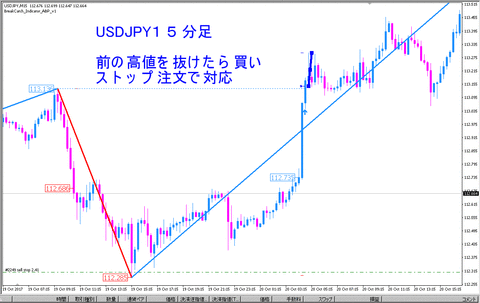
Since we use stop orders, there is almost no communication lag.
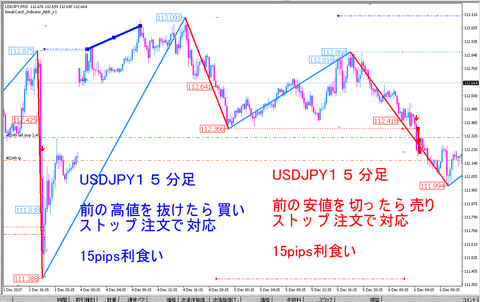
The figure below shows examples of breakout strategy buys and sells.
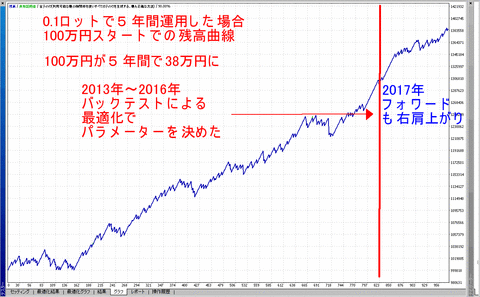
The figure below is the balance curve when the above settings were used for five years from 2013 to 2017.
The year 2017 was a forward test, but it shows a rising trend.
However, this is not real-time testing; it is a time-machine forward test.
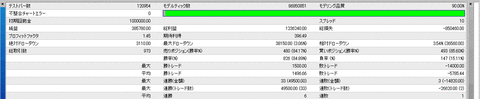
Breakouts typically have low win rates since you buy at highs and sell at lows, but for this parameter setting the five-year win rate from 2013 to 2017 is 84%.
Although it is about the past, with a 0.1 lot trading, the profit calculated was 385,780 yen.
Starting with 1,000,000 yen, it grew to 1,385,780 yen after five years.
<0.1 lot trading data summary>
Net profit: 385,780 yen
PF: 1.45
Number of trades: 973
Maximum drawdown: 38,150 yen
Win rate: 84.89%
Maximum consecutive wins: 33
Maximum consecutive losses: 3
↓
If you start with 1,000,000 yen and operate with relatively low leverage of 10x, this is what happens.
The figure below shows the balance curve when operated for five years with 10x leverage starting from 1,000,000 yen.
Over five years, the principal of 1,000,000 yen grows to 19,610,000 yen.
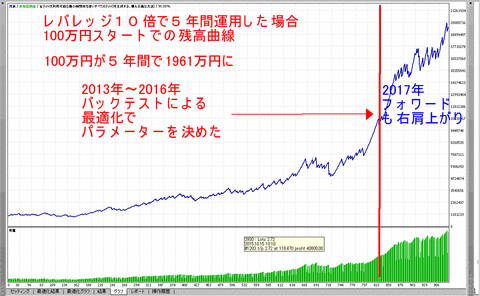
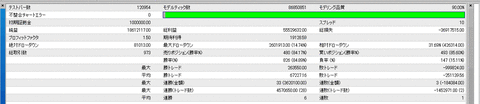
Although historical, with 0.1 lot trading, the profit was calculated as 18,612,117 yen.
Starting with 1,000,000 yen, it becomes 19.6117 million yen after five years.
<Trading data summary at 10x leverage>
Net profit: 18,612,117 yen
PF: 1.50
Number of trades: 973
Maximum drawdown: 2,601,913 yen
Win rate: 84.89%
Maximum consecutive wins: 33
Maximum consecutive losses: 3
Now, to the main topic.
Data showing a potential 19x increase over five years even with 10x leverage has been obtained.
Here, I would like you to focus on the number of trades: even with 1,000,000 yen, by combining multiple currencies, timeframes, and logics to increase trading frequency, a further 5x, 10x, or 20x effect can be expected.
If you divide into five accounts with 200,000 yen per account and operate five currencies simultaneously, and assume signals occur tenfold with more than ten logics, while margin is fully used, the actual number of trades could triple, resulting in 10,000,000 yen starting from 1,000,000 yen over five years for a net of 40x.
If we consider low leverage up to 10x as low leverage and 100x+ as high leverage, there is also a need for data for mid-level leverage (10x–99x), which will be addressed on another occasion.
There are parts that cannot be conveyed on the blog.
In this way, it is possible to achieve a similar effect to high leverage even without applying high leverage, with stable results.
The keywords are risk diversification and increasing trading frequency.
Therefore, various logics are necessary.
This year as well, I will release and improve various EAs and indicators.
This time, the following EAs and indicators were used for verification.
“MT4 Breakout Catch and Scalping Tool Indicator and Separate Selling EA for Day Trade and Swing”
http://fxmt4indicator.abproducts.biz/wp/?page_id=2372
The preset files for 0.1 lot trades and MT4 reports reflecting the test results mentioned above have been included for both the EA and indicators, along with preset files and MT4 reports configured for 10x leverage.
Finally, this year we will hold seminars.
Theme: “Exploring a risk-diversified framework that stably delivers effects similar to high leverage with FX.”
Subtitles will vary depending on the time.
Possible subtitles include “How to find forward-optimized parameters,” “What are the procedures to trade like EA in discretionary trading,” and “Systematizing cryptocurrencies.”
Scheduled to start in February, with multiple sessions.
There will be a fee, but I will announce it on the blog and via email newsletter, so if you are interested, please sign up.
This has become long.
Thank you very much for reading up to today.