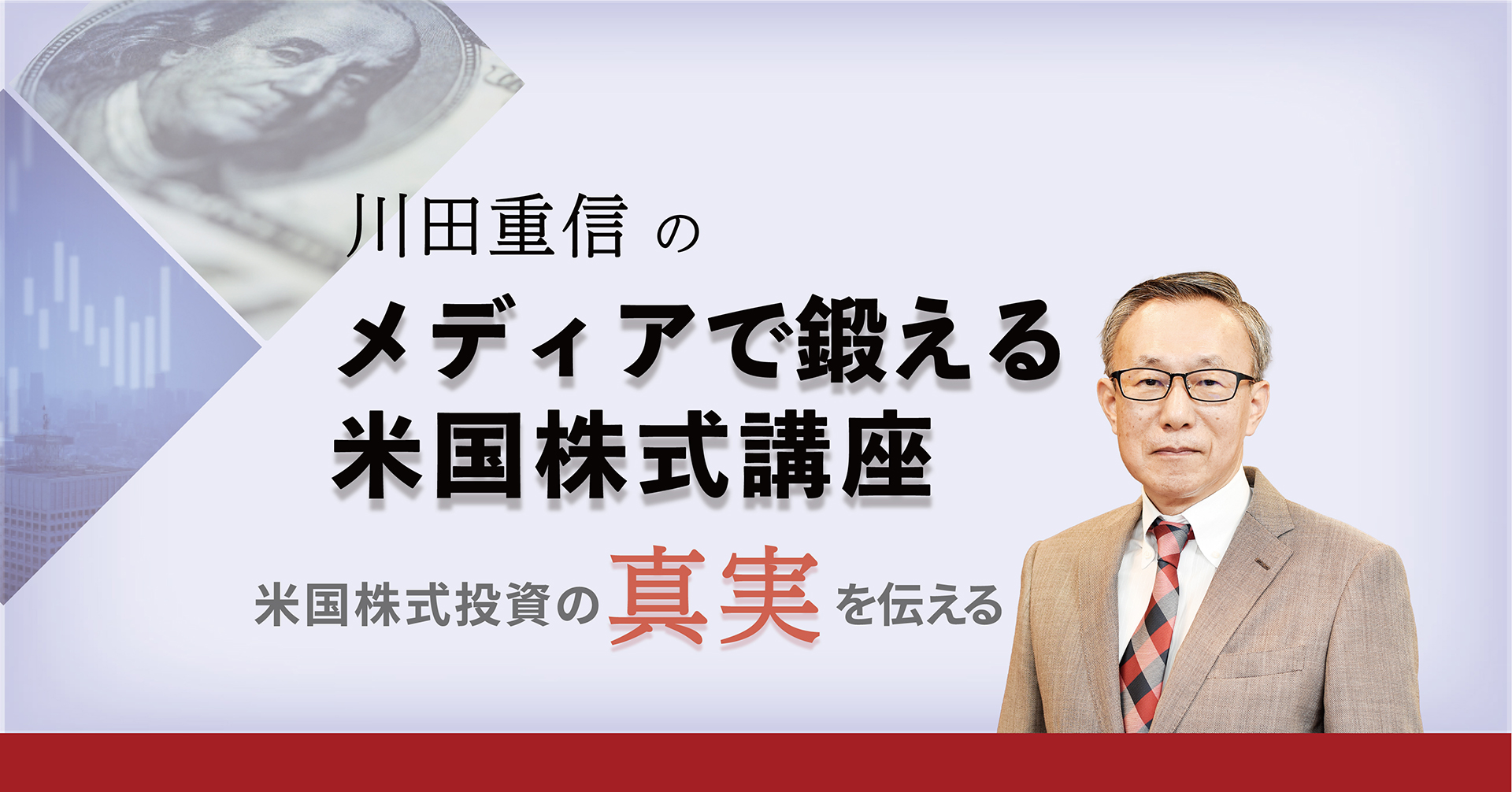
Truth about investing in U.S. stocks from Shigenobu Kawada's "U.S. Stock Training Course Shaped by the Media" [Vol.39] distributed on March 21, 2022

????????????
Delivering the Truth about U.S. Stock Investing
[Vol.39] March 21, 2022
????????????
Shigenobu Kawada's “Training in U.S. Stocks through the Media”
*** Table of Contents ***
Market Review
This Week's Picked Articles
Kawada's Stocks of Interest
Investment Tips
A Walk
A Quick Break: “FA Perspective”
What Private Investors with Extreme Wealth Practice: “Private Investment Strategy”
Activity Information
Q&A Section
Online Salon “Asset Formation School Where Dreams Come True”

An online salon where everyone learns and inspires each other to succeed in asset formation. In addition to content that goes beyond what the popular newsletter “Training in U.S. Stocks through the Media” can convey, we offer member-only seminars where you can experience the魅力 of U.S. stock investing.
2000 Million Yen Milestone Pace Maker

Source: Financial Services Agency; created by ExeTrust Co., Ltd. based on asset management simulations
※The above figures are simulations and do not guarantee future investment results. Fees and taxes are not included.
Reading guide: assumed yield and target year
3–4% over 30+ years: wrap funds and balanced funds fit here
5–7% over 25 years: this is how it might be with non-US stock funds
8–10% over about 20 years: this is the more modest expectation for the S&P 500’s rise
S&P 500 performance record (dividends reinvested, 1970-2021)

Achieve 20 million yen early with proper risk-taking
Kawada's message is incredibly simple. To reach 20 million yen, make your surplus funds work as efficiently as possible. For that, participants must correctly understand risk and reward. Before reading the weekly newsletter, glance at this table to confirm the correct investment stance.
Now, start the countdown to 20 million yen right away!
■□■□■□■□■□■□■□■□■□■□■□■□■□■□■□■□■□■
1. Market Review (March 14–18)
<Major Indices>
・Dow Jones +5.5%
・S&P 500 +6.2%
・Nasdaq Composite +8.2%
= Snapshot Version =
Early in the week, markets followed the prior week's softness, but settled gradually due to factors such as a fall in crude oil prices. Although a rate hike was announced on Wednesday, its impact was limited, and avoiding a default on Russian sovereign bonds contributed to optimism, with gains continuing into the latter part of the week.
= Slightly More Detail =
Early in the week, selling occurred mainly in tech stocks as the long-term yields hovered around the 2.1% area for the first time since July 2019, due to a sharp decline in Chinese stocks and inflation concerns, with inflation expectations rising.
Thereafter, as commodities such as crude oil settled and the February Producer Price Index (PPI) came in below market expectations, there was a rebound.
At the Federal Reserve FOMC meeting awaited by many, a 0.25% rate hike was decided and a hawkish stance against inflation was shown, but the move stayed within market expectations, and after the announcement the market rose sharply.
Toward the weekend, concerns about a Russian default diminished, and optimism about Ukraine ceasefire negotiations supported buying, continuing the upward trend.

S&P 500 index – Last 1 Year

■□■□■□■□■□■□■□■□■□■□■□■□■□■□■□■□■□■
2. This Week's Picked Articles
A column where I select information useful for asset formation from what I have gathered, rank it, and offer very personal commentary.
【1】 Nikkei Newspaper Economic Consequences of War 3/17
“The collapse of the Soviet Union was caused by America’s big wallet and Chernobyl,” said former U.S. Secretary of State George Shultz. Gorbachev first learned of the nuclear accident through the BBC in Britain.
When questioned by aides, reports indicated the accident was serious but not catastrophic. However, photos from Sweden’s reconnaissance satellites were broadcast worldwide by foreign media, clearly signaling a major disaster. Gorbachev realized that the foreign media were aware of domestic events faster and more accurately than he who held the nuclear button, and he felt there was no chance of victory.
Gorbachev’s decision to abandon the arms race and pursue détente came at that moment, leading to the collapse of communism and the Soviet Union.
Freedom and democracy, as the highest values, exist to guarantee minimal human dignity. The United Nations, unchanged for 77 years, still has Security Council permanent members with veto power, and broad reform is needed.
【Kawada Comment】
People who place “freedom and democracy” as the supreme values and believe that governance based on them is humanity’s ideal form a liberal economic sphere, namely the United States, Western Europe, and Japan. But there are many authoritarian systems on the opposite end of the spectrum, and in global population terms, they are the majority.
By the way, some say the Ukraine invasion is the culmination of longstanding grievances and resentments among Putin and others who couldn’t accept the dissolution of the Soviet Union in 1991. In peacetime, reason and economic rationality govern society. But accumulated anger, if it reaches a critical point, can erupt as in this case.
President Biden called Putin a “war criminal,” but there may be arguments from the Putin side as well. We Japanese may have faced a similar stance around 80 years ago.
That said, Putin’s actions are inexcusable. Yet such “micro-versions” of outrageous acts occur around us in everyday life. A lesson to learn from this unfortunate event is to avoid worsening situations with deceit and violence, as Putin does, and to reflect humbly on whether we are unwittingly fostering copies of Putin in our interactions with others.
【2】 Wall Street Journal How to Invest Brave Amid a Turbulent Market: The Secret of Courageous Investing Over the Last Decade or So 3/14
In the autumn of 1939, as Hitler’s army invaded Poland and the world plunged toward war, a young man in a small Tennessee town told his broker to buy $100 worth of every listed stock whose price had fallen below $1 per share on major U.S. exchanges—
The client wasJohn Templeton. He said, “As a gauge of how terrible things are, I must master my fear.” “I could not be certain that circumstances would worsen, yet I was strongly convinced that pessimism was near its limit. If the situation worsened further, civilization might not survive—I could not bear to imagine God allowing such a thing.”
The following year, France fell. In 1941, Pearl Harbor occurred. In 1942, the Nazis invaded Russia. Yet Templeton kept the stocks and sold them in 1944. Of 104 holdings, he profited from 100, and his funds more than quadrupled.
Templeton’s portfolio strategy evokes the seven virtues of great investors: curiosity, skepticism, discipline, independence, humility, patience, and above all, courage.
This time, the S&P 500 has declined by less than 1% since Russia began its invasion of Ukraine on February 24. During the same period, the exchange-traded fund “ARK Innovation” has seen inflows surpassing $770 million.
Familiar Pattern
This is a pattern I recognize. It was October 26, 1962, at the peak of the Cuban Missile Crisis. Even as the world teetered on nuclear war, U.S. stocks fell only about 7% from their mid-October 1962 highs.
Nevertheless, the Dark Era was not far off. Stock prices stalled, and inflation surged. If you had invested $1,000 in U.S. large-cap stocks in early 1966, by September 1974 you would have been worth less than $580 in real terms after inflation (Morningstar data).


Two Implications
1) Investors can become blind to risk when faced with nuclear war risks and inflation concerns.
② Investors need not only the courage to act but also the courage to not act. By the early 1980s, countless investors had sold off stocks. Meanwhile, many others were ruined by being duped by brokers into “Limited Partnerships (Investment Business Limited Partnership)”—an “alternative” investment.
If today you feel that rushing to buy energy stocks is an act of bravery, you are fooling yourself. If oil had sunk to its lowest price in April 2020, that would have been an act of courage. But now it is a consensus trade. Bravery is not doing something easy but doing something difficult..
If you listen to your intuition and then act in the opposite way, you will be convinced you are acting bravely as an investor.
【3】 Nikkei Newspaper The Irreversible Russia and the World Ian Bremmer3/16
Ian Bremmer:
Renowned for global political risk analysis. Notable works include “Superpowers: America’s Choices in a Post—G-Zero Era.” 52 years old. Twitter @ianbremmer
Russia and the Western countries are now in a state of war. The most stringent sanctions to date, supplying highly lethal weapons to Ukraine, and efforts to isolate Russia by the West amount to a declaration of war..
The world is at a turning point
The looming confrontation is not as dangerous in many respects as the Cold War of the 20th century. This is because Russia’s gross domestic product is smaller than that of New York State, and the Russian economy is expected to shrink by more than 10% over the next year due to sanctions.
The Soviet Union once had an ideology that attracted people worldwide. Today’s Russia has little ideology and few allies who share its political values.
China and Russia share the goal of reducing the United States’ international influence and tempering Europe’s hardline stance. But in the China–Russia relationship, Russia is in a weaker position. China, with an economy about ten times larger than Russia’s, is expected to buy oil, gas, and minerals that Russia cannot sell to the West, thereby supporting the Russian economy. At the same time, China will likely seek to buy resources at low prices.
Cyber capabilities
Weapons in the new cold war are becoming even more powerful. Cyber weapons are cheaper than late-20th-century heavy weapons, easier to plan, and can be deployed broadly. For instance, the April French presidential election could be an opportunity to test new strategies. The same goes for the November US–China midterm elections.
Even if the Russian army subdued the entire country, the Ukrainian people would not stop fighting, and Western leaders would continue to support Ukraine. The path to a new cold war is irreversible.
In the economics of endurance (Editorial Board: Hideo Obata)
Historically, the deepening interdependence of the world has repeatedly failed to deter major powers from colliding. The invasion of Ukraine by Russia also underscores the power of nationalism that pierces the shield of globalization.
Nevertheless, it is hard to imagine the United States or Europe resorting to military force to directly engage Russia. Bremmer suggests the main battleground of the “new cold war” is economic, and it is a long endurance contest about who wears down first.
Democracies such as the United States, Japan, and Europe must ensure economic stability and price stability while weathering sanctions against Russia. This is a moment to set an example that discourages autocratic provocations.
■□■□■□■□■□■□■□■□■□■□■□■□■□■□■□■□■□■
3. Kawada’s Interesting Stocks
A column introducing stocks that Kawata is watching, starting with his holdings in US stocks.
This Week’s Stock
Raytheon Technologies Raytheon Technologies Corporation
Overview
The company was formed in April 2020 by the merger of United Technologies’ aerospace business with Raytheon. The four main divisions are: Aerospace Electronic Systems (Collins Aerospace, Figure 1), Aircraft Engines (Pratt & Whitney, Figure 2), Software including Cybersecurity (Raytheon Intelligence & Space, Figure 3), and Defense & Missiles (Raytheon Missiles & Defense, Figure 4).
(Fig.1)

(Fig.2)

(Fig.3)

(Fig.4)

The Company’s Appeal
Balanced segment revenue
Although it is perceived mainly as a defense company, looking at the post-2020 consolidated segment revenues shows a balanced mix. Revenues include defense-related sales in the Electronic Systems and Software divisions, but the company is not solely driven by defense budgets.
(Fig.5: Raytheon Technologies by segment revenue)

Rising profitability anticipated
Q4 2021 segment operating margins: Electronics 9.5%, Aircraft Engines 3.2%, Software 10.3%, Defense & Missiles 12.6%. Aircraft engines have been affected by reduced air travel due to the COVID-19 pandemic, but with economic reopening, margins are expected to improve.
Across all segments, ongoing revenue from maintenance, consumables, and software updates provides stable cash flow.
Additionally, there remains room for cost reductions from the integration, potentially improving future margins.
Defense budget increases and shareholder returns
Defense spending is rising globally in response to Russia’s invasion of Ukraine. US influence has waned somewhat, and geopolitical shifts have increased tensions around the world.
In particular, higher defense spending in large economies like Germany and Japan is a positive factor for United Technologies.
For 2022, the company projected revenue of $68.5–$69.5 billion (internal growth 7–9%), earnings per share (EPS) of $4.60–$4.80, and free cash flow of $6.0 billion. By 2025, four years after the merger, it aims for 6–7% annual revenue growth, 5.5–6.5 percentage points higher margins, and $100 billion in free cash flow.
(Fig.6: 2025 objectives)

(Fig.1–6 from company materials)
Risks
Following Russia’s invasion of Ukraine, defense stocks have recently risen. While a peace agreement and a halt to fighting would be desirable, it could also be a near-term downside for United Technologies’ stock price.
RTX basic data (source: company data, Yahoo! Finance)
(As of March 18)
Price $97.52
Market cap $145.53 billion
Total revenue $64.3 billion
Estimated P/E 19.76x
Estimated yield 2.10%
HQ: Wilmington, Massachusetts
Listed: March 2020 (traded as RTX since issue)
5-year stock price chart (including data from the pre-merger company)

Chart provided by TradingView.com
(This column is for general information only and does not advocate buying or selling any particular securities)
■□■□■□■□■□■□■□■□■□■□■□■□■□■□■□■□■□■
4. Investment Tips
This column covers not only “investment methods” and “stock picks,” but also “interesting indicators and statements” and “societal and political movements.”
War and stock prices
Since November of last year, the decline in stock prices has been driven by
① Valuation compression of overvalued stocks due to rising interest rates in anticipation of a recovery from COVID-19
② Geopolitical risks from Russia’s invasion of Ukraine and concerns about energy security
③ Inflation surge and stagnation from rising energy prices and supply constraints, raising concerns of stagflation
This war
*For Europe, could this be the first major ground war since World War II, and could it signal an end to the broad expansion of market economies around most countries and regions of the post-Cold War world?
*Is the expansion of market economies an illusion in promoting democracy?
Some investors may have these questions. After the end of the East–West Cold War in 1989, despite several crisis-driven fluctuations, the US stock market kept making new highs.
However, when confronted with brutal war imagery, it is normal for Japanese people to doubt investing overseas. Yet, perhaps cruelly, the history suggests that “buy when war starts.”
Below is Kawata’s整理 of the relationship between recent wars and stock prices, based on a column by Heihachiro Okamoto of Monex Securities.
Lessons from about 40 years of wars for long-term US stock investors
Examine stock performance after wars began about 40 years ago
Examine the performance of US stocks around five wars from the past 40 years
The five examples
1) Soviet invasion of Afghanistan in 1979
2) Gulf War in 1990
3) Iraq War in 2003
4) Russia’s invasion of Georgia in 2008
5) 2014 Crimea Crisis
Three wars with the biggest impact on stock prices
2) 1990 Gulf War
From around June 1990, oil prices began rising; stock prices fell with the onset of war. Crude oil, which had been near $20 just before the war, surged after the war began, peaked around October 1990 above $40, then declined, settling in the $20s by February 1991. The S&P 500 found a bottom near the oil price peak and then entered an uptrend.
[Figure 1] Gulf War and economic trends for the following 3 months
Top left axis: WTI, top right axis: S&P 500, bottom axis: 10-year US Treasury yield

Source: Bloomberg, compiled by Monex Securities
3) 2003 Iraq War
From 2003 to 2011. The stock market fell for a long time after the IT bubble burst in 2000–2002, but began rising with the war. Oil prices rose before the war but fell when the war started; they then rose again, while stocks climbed substantially. The stock market peaked in the fall of 2007, driven by the US-originated global financial crisis.
[Figure 2] Iraq War ± economic trends for 3 months around the war
Top left axis: WTI, top right axis: S&P 500, bottom: 10-year US Treasuries

Source: Bloomberg, compiled by Monex Securities
5) 2014 Russia Crimea Crisis
During the Sochi Olympics (Feb 7–23, 2014), Russia’s annexation of Crimea caused a brief rise in oil prices and yields, but the impact on US stocks was not significant, as the invasion was deemed limited.
[Figure 3] 2014 Crimea Crisis ± economic trends for 3 months around the war
Top left axis: WTI, top right axis: S&P 500, bottom: 10-year US Treasuries

Source: Bloomberg, compiled by Monex Securities
Although the patterns of wars and world conditions differ, the general pattern is that wars cause a temporary dip in US stocks, and purchasing during declines is often the prudent response.
As noted in the newspaper column above, “Wall Street Journal: The market blitz—What is the secret to brave investing? Over the past decade or so, investing required little bravery—March 14.” It also stated that the Cuban missile crisis peaked on October 26, 1962; even as the world hurtled toward the brink of nuclear war, US stocks fell only about 7% from mid-October 1962. However, as noted later in the article, inflation was the truly damaging factor to stock prices.
Summary so far
Russia’s invasion of Ukraine and stock prices
Stocks peaked in late November last year and have trended downward this year. On February 24 and around March 8 they fell sharply, with the S&P 500 down over 13% and the Nasdaq down over 20%, entering a bear market. Since last Tuesday, they have rebounded sharply.
Going forward, the course of Russia’s invasion is highly uncertain, but if you believe in the market’s foresight, much of the geopolitical risk may already be priced in for the near term.
Further declines would require recession and stagflation
If stocks fall further, it would likely be due to energy-price inflation or supply constraints driving inflation higher, along with a downturn that hurts consumer demand and corporate profits, leading to stagflation and a decline in stock values.
Is a pessimistic scenario of inflation like the 1970s realistic? Admittedly, the current environment makes a strongly rising stock-price trend unlikely. Still, given globalization and advances in information technology, the US economy is more flexible and efficient, so excessive pessimism is unwarranted.
Year-to-date daily index values of major indices

■□■□■□■□■□■□■□■□■□■□■□■□■□■□■□■□■□■
5. The Walking Corner
◇◇
~ Kawabata Kaneki’s Chapter ~
A submission by former securities man and avid reader, Kawabata Kaneki.

Investment as a liberal-arts pursuit to become a business elite /Kazunari Okuno
Entering a large bookstore and facing the business books, you see many back-cover lines like “Used by business elites◇◇,” “Reached by business elites ◎◎,” and “Practiced by business elites ▲▲.”
◇◇◎◎▲▲ placeholders include topics from presentation techniques to taste Goods like wine or sake, and even classical texts like the Analects or the Bible.
I find it peculiar that, while the definition of a “business elite” and how many people in Japan fit that mold remain vague, there is a flood of traditional how-to books that do not go beyond the basics.
Nevertheless, there are many opportunities to pick up such books as entry points into unfamiliar fields.
As Takashi Tachibana once stated, the first step to researching a new field is to buy and read a lot of introductory books. But it is still a mix of gems and dross.
On the other hand, when reading introductory books in areas you know well, how should you approach it?
First, see if it helps organize your knowledge—whether it lays out chronology or categorization.
Second, assess whether you can explain the organized knowledge to others in a logical way.
Third, look for new facts you didn’t know.
The appeal of this book lies largely in author Kazunari Okuno’s name, but also in addressing timely topics like life expectancy and investment education, presenting his investment philosophy.
The core idea is to invest in “businesses with high barriers to entry that ride long-term trends,” with around 200 Japanese stocks cited as examples.
In other words, index funds that claim to invest in Japanese stocks often include too many companies, which defeats long-term holding objectives.
Indeed, the author reveals the process of selecting stocks from a global perspective, offering valuable guidance for small individual investors like me.
Thus, despite being a sophisticated introductory book, I finished it wondering why it carries the cliché subtitle “How to Become a Business Elite.”

Ikénoo Shota’s Ginza Diary(All)Ikawa Shoutaro
If we call those who achieved great things without formal schooling “independent giants,” then alongside Makino Tomitaro and Ozu Yasujirō, I would also name this person.
This book covers 1983 (Showa 58) to 1990 (Heisei 2), chronicling Ikawa Shoutaro’s wandering through Ginza in diary form.
He visited theaters, dined in restaurants, and his strolls through popular districts became the envy of readers, especially the meals at visited restaurants, which are read as gourmet guides.
However, unlike the modern culinary chase of a so-called hellish realm, Ikawa, who left early to work in society, cherished the tastes of familiar street corners in Tokyo, showing a respect for everyday life there.
In this era, overlapping with the bubble economy, he used culinary scenes to portray the moral decay of people in his distinctive style.
In 1983, when a longstanding restaurant’s snack shop was visited, he recalls the refined hospitality where a capable cook would heat proper meals and offer another cup of coffee; yet in 1989 at the same shop, he lamented that a boy was merely warming frozen dishes for girls. Tokyo has suffered and resurrected three times—the Great Kanto Earthquake, the fires of war, and the bubble economy.
Ikawa’s book, born from these experiences, is a lament for Tokyo, a city in revival, and a memorial to the vanished culture and lifestyle.
【Kawura Kaneki】
Joined Daiwa Securities in 1980. MBA from the University of Chicago Booth School of Business. Experienced in Singapore and Hong Kong, involved in Asia-Pacific business.

■□■□■□■□■□■□■□■□■□■□■□■□■□■□■□■□■□■
New Series
Introduction
We’re running a series covering the basics of wealth creation. The overall structure is as follows.
What kind of era are we living in? Part 2
Independent Japanese and essential wealth-building for independence; Part 3
Is the stock market only in the United States? Part 4
Differences in Japanese and American stock cultures
Key characteristics of the US market you should know; Part 10
Aiming for better asset management
Information sources and investing
Aiming for better asset management (Part 3)
Continuing from our YouTube channel’s “40 Years of US Stock Investing” series, Kawata Shinya contributes a piece considering long-term US stock investing. This time, as “Aiming for better asset management (Part 3),” it explains “Core-Satellite Investing.”
Core-Satellite Investing
If you’ve been investing in US stocks for a long time, you’ll have noticed that consistently outperforming the S&P 500 over the long term is extremely difficult. As mentioned earlier, even fund managers whose job is asset management face this challenge, so don’t be discouraged. According to S&P Global’s analysis (Figure 1), among active managers for large-cap stocks, only about 20% were able to beat the S&P 500 over the past decade (as of end 2020).
Figure 1: Percentage of managers who underperformed the benchmark over the past 10 years

The challenge for ordinary individuals in stock investing is diversification of risk. Often, people overconcentrate in popular industries or themes, leading to a portfolio skewed toward specific risks. While that can be fine when the trend continues, a reversal is hard to recover from.
Hence the proposal: Core-Satellite Investing. The idea is to divide the portfolio into two parts: “Core” and “Satellite.” The “Core” is the central part, and the “Satellite” is the outer part, akin to the Earth and Moon relationship—the Earth is the primary, the Moon is the satellite orbiting around it.
Key points are: ① how to operate the Core and Satellite separately, ② how to determine their ratio. In short, see Figure 2.
Figure 2: Concept of Core-Satellite Investing

Core portion
The core’s role is to follow the benchmark, so you generally use index funds or ETFs that track the benchmark. For US stocks, the benchmark is typically the S&P 500. If using ETFs, you could choose SPDR S&P 500 ETF (SPY), Vanguard S&P 500 ETF (VOO), or iShares Core S&P 500 ETF (IVV). They all track the S&P 500 and have similar performance despite differences in assets and expense ratios.
You can also use the broader Vanguard Total Stock Market ETF (VTI) as the core. While VTI does not strictly track the S&P 500, either choice will have limited impact on overall performance, as seen in prior discussions.
Satellite portion
The satellite aims to take on risk and beat the benchmark. It may involve selecting individual stocks with higher expected returns than market indices, or investing in ETFs with particular risk characteristics. (If investing in individual stocks, limit to high-quality names and diversify across about 10 stocks.)
Figure 3: Example ideas for satellite investments

The satellite’s goal is to outperform the S&P 500, so stock selection should reflect this. Approaches include growth stocks (high growth potential), or cyclicals that appear temporarily undervalued (value stocks). Use your preferred approach to seek excess returns. If investing in momentum stocks, keep position sizes modest and set selling rules to maintain discipline.
Top-down approach for sector rotation or growth-to-value style rotations can be implemented effectively by choosing sector or style ETFs that track the relevant indices. In some cycles, it might be wise to opportunistically invest in commodities-linked ETFs such as SPDR Gold Shares (GLD) or Invesco DB Agriculture Fund (DBA).
Figure 4: Relative price of energy sector versus S&P 500

If doing growth-to-value style rotation, refer to Figure 5 showing relative movements of the two indices. When growth leads, invest in growth ETFs (e.g., Vanguard US Growth ETF (VUG)); when value leads, invest in value ETFs (e.g., Vanguard US Value ETF (VTV)). The analysis focuses on the relative movement of two indices, but understanding the background behind the movements is essential.
Figure 5: Relative prices of growth vs value

If you’re rotating within the satellite, diversifying across multiple sectors or combining sector ETFs with style ETFs is advisable to spread risk as much as possible.
If you are confident in market timing, you could tactically adjust the stock-and-cash mix in the satellite. When the stock market is in an uptrend, reduce cash; when it is in a downtrend, raise cash.
If you implement this strategy using the S&P 500 index, using different ETFs for Core and Satellite simplifies asset allocation and tax considerations (for example, using SPY for core and VOO for satellite). However, this strategy is more trading than investing, so it is important to follow strict rules.
Figure 6: Using satellite as tactical asset allocation

If you truly have confidence in market timing, you could even use leveraged or inverse ETFs for the satellite (e.g., Direxion Daily S&P 500 Bull 3x ETF (SPXL) or Direxion Daily S&P 500 Bear 3x ETF (SPXS)) to significantly adjust the effective stock allocation. However, this is a highly advanced strategy and not generally recommended for ordinary investors.
Another interesting approach is to include high-dividend-growth stocks in the satellite. While this may underperform the S&P 500, it can stabilize the portfolio during market downturns and increase dividend income over the long term. You could raise the satellite allocation limit a bit in this case.
Also, you might choose not to chase benchmarks and simply invest in individual stocks in the satellite to study them. If most of the portfolio tracks the benchmark, satellite missteps will have limited impact on overall performance.
Core-to-Satellite ratio
It is recommended to keep Core at 80% or more and Satellite at 20% or less. The higher the Core share, the closer you track the benchmark.
Note that, especially early in a Core-Satellite program, even if you start with a lower Satellite exposure in a rising market, you may gradually increase risk and aim for higher returns as the investment environment improves.
It’s possible that Satellite could come to account for half or more of the portfolio, reversing the dominance of Core and Satellite. If the market turns sharply, the high-risk Satellite portion could fall more than the market index, causing large unrealized losses. Therefore, it is crucial to adhere to the preset Satellite upper limit.
Finally
If you are unsure what to put in the Satellite, or market timing is cloudy, consider simply making the entire portfolio an S&P 500 index fund. This is not Core-Satellite investing, but it eliminates the risk of underperforming the benchmark.
A seemingly dull approach may actually be the path to better performance. Even good professionals cannot always succeed; it may be wise for individual investors to spend less time and energy chasing elusive gains. A disciplined, less flashy approach could be the fastest route to success.
【Okuwa Makoto】
Hailing from Ehime Prefecture. Graduated from Osaka University, Faculty of Economics in 1984. In 2005, earned a PhD in Economics from the University of Saitama. Worked at City Bank, N.E., City Trust Bank, Societe Generale Trust Bank (now SMBC Trust Bank). Involved in pensions and public funds and private banking for the wealthy. In 2017, established EagleCapital Co., Ltd. in Kyoto’s Higashiyama. CFA charterholder and registered as an examiner with the Japan Securities Analysts Association.

■□■□■□■□■□■□■□■□■□■□■□■□■□■□■□■□■□■
6. A Short Break: “FA’s Perspective”
This column features questions from clients answered by Ryuuichiro Motohashi, a certified financial planner.
Q: What is the “fear index” you see in the media?
A: Officially, the VIX (Volatility Index).
The Chicago Board Options Exchange calculates and publishes the VIX for options on the S&P 500. It indicates the expected market volatility over the next month.
Why is it called the “fear index”? Because it reflects investor sentiment about the future stock market. When the number is low, market volatility is low and the market tends to rise.
Note: Kawata has previously provided timely, expert commentary on the VIX in a prior newsletter…
In this column, we present a more conceptual, “mindset edition” of the fear index for long-term investors facing the market.
To senior investors, we apologize…
【S&P 500 and VIX trend】
Orange: VIX, Blue: S&P 500

Source: Sumitomo Mitsui DS Asset Management Daily Market Report
Normal levels are in the 10–20 range. When the value is high, investor anxiety is strong and market volatility is expected. Generally, when the fear index rises, equities tend to fall.
As investor anxiety grows, the index can move into the 20–30 range; when it exceeds 30, it becomes a caution zone (in Kawata’s prior newsletter, such entry points were noted as potentially favorable for performance...). However, as the article later mentions, truly damaging for stocks is inflation.
During past crises like◯◯ shocks or △△ problems, the fear index has spiked to 70–80, and many investors in such times are so fearful they flee the market.
Nevertheless, by keeping an eye on the fear index and maintaining discipline—staying in the market—the long-term positive investment behavior may be most important.
Markets can swing greatly due to investor anxiety.
Therefore, understanding this anxiety and stock-price movements is crucial!
During pessimistic news or market crashes, investor fear spikes. This is precisely the time to stay calm, wait for the inevitable calm, and turn a crisis into an opportunity—think like a smart investor who stays in the market.
After graduating in 1998, he started a career in the banking industry at Yokohama Bank. He later transitioned to a private banking role at foreign financial institutions. With the onset of the global shock of Lehman, he decided to pursue genuine asset management and became a financial advisor. He has worked with a few clients and spent about 20 years in the financial sector, then started his independent advisory business focusing on client experience and overseas private banking models. He currently provides independent financial consulting to clients without being affiliated with a specific financial institution.

■□■□■□■□■□■□■□■□■□■□■□■□■□■□■□■□■□■
7. The Ultra-Wealthy’s Private Investment Strategies
Hiroshi Ichikawa, who specializes in support for financial advisors, shares the investment strategies used by the ultra-wealthy, for readers.
“Structured Bond Investing”
Continuing from last time, we’ll introduce one product in private investing strategies,“Structured Bonds”.

Among private investment strategies, the Structured Bond has a higher yield than ordinary bonds and offers fixed interest over a set term. Here we explain one of the more well-known and widely issued varieties,“EB bonds (Exchangeable Bonds)”.
What EB bonds are
EB bonds are bonds that may be redeemed at maturity not in cash, but in the physical shares or exchange-traded funds (the “underlying securities”). If the price of the underlying at maturity is at or above a predetermined exercise price, redemption is in cash; if it is below, redemption is in the underlying securities. They often include conditions like “knock-in” events or “early redemption terms.”If the underlying price stays within a certain range during the investment period, you may receive 100% of your invested capital back and earn a higher coupon rate than typical bonds.

Common EB bond condition examples
・Knock-in event
During a pre-set period, if the underlying price falls below a defined level, you may be converted into the underlying securities at maturity. If not, you receive 100% of your principal in cash at maturity regardless of the price at maturity.
・Early redemption clause
If the underlying price rises above a certain level, the bond is redeemed before maturity.
EB bonds’ caveats
Custom issuance is possible and yields can be relatively high, but there are drawbacks. In addition to the risks of ordinary bonds, EB bonds have unique downsides as follows:
・Possible redemption in underlying shares
If a knock-in occurs and it is not redeemed early, and at maturity the underlying price is such that the redemption amount could fall below the original investment, a loss is possible. If redeemed in stock, choose bonds backed by solid, redeemable stock.
・Difficulty in secondary sales
EB bonds are typically issued on a bespoke basis after direct negotiations with foreign issuers. Unlike ordinary bonds, they cannot be sold in the secondary market. The issue term should not be too long.
・Opportunity loss from early redemption
If certain conditions are met, the bond may be redeemed before maturity, and the principal is returned at face value, but future interest cannot be earned. For example, with a 12% annual yield on a 10 million yen investment, one year would yield 1.2 million yen, but if redeemed after six months, you would receive only 600,000 yen.
Should you buy EB bonds?
Privately, EB bonds carry high fees charged by financial institutions. Many bank or brokerage salespeople push them for this reason.
Nevertheless, the product itself—if you select the underlying securities wisely and manage risk well—can be highly attractive.
Therefore, obtain EB bonds only through trusted advisers.
【Hiroshi Ichikawa】
Investment Techniques to Become Ultra-Wealthy
CEO of Winviser Co., Ltd. Worked in asset management at SMBC Nikko Securities, serving offices in Ibaraki, Fukuoka, and Tokyo, before marketing financial products for the ultra-wealthy. Transitioned to an independent IFA-focused consultancy, offering third opinions on asset management based on his experience.
Now an independent financial adviser, he focuses on client-centered wealth management without affiliation to any particular financial institution.

■□■□■□■□■□■□■□■□■□■□■□■□■□■□■□■□■□■
8. Upcoming Activities
◇ Nikkei CNBC: March 29 (Tue) around 8:15 AM (studio)
■□■□■□■□■□■□■□■□■□■□■□■□■□■□■□■□■□■
9. Q&A Corner: On Break
Questions
Answers
──────────────────────────────────
★ Please read the 【Question Rules】 below before sending your questions to
info@kawata-magazine.com.
【 Question Rules 】
◆ We cannot answer all questions. Please understand.
◆ Questions may be published on our site, YouTube, SNS, or in books in a form that does not identify individuals.
◆ We will not answer questions from unsubscribed readers.
◆ Sections deemed clearly promotional may be omitted.
◆ If you post malicious questions without subscribing, we will take appropriate measures.
──────────────────────────────────
★ Disclaimers
◆ Our magazine does not provide buy/sell recommendations for securities (stocks, bonds, funds, ETFs, etc.) or sectors. Investment decisions are the responsibility of subscribers, and we provide no guarantees.
◆ We do not guarantee any damages to members arising from using our newsletter.
◆ We are not responsible for disputes between members or between members and third parties arising from information provided by our service.
◆ We do not bear any liability for damages resulting from the suspension, discontinuation, or changes to the service’s contents.
──────────────────────────────────
■ Publisher: Hibiya Technology Finance Co., Ltd.
■ Kawata Shigenobu’s Thank You, American Stocks
https://www.kawataamekabu.com/
■ Twitter:https://twitter.com/ShigenobuKawata
■ For opinions, requests, or unsubscribe, please contact
【Email】info@kawata-magazine.com
■ If you don’t receive the email, it may be classified as spam; please check in advance.
──────────────────────────────────