

Cryptocurrency Market Analysis [February 22]
Practical Cryptocurrency Investment Article February 22
Dear subscribers
* For paid subscribers, please also read the article at the hidden link below.
Please check the article at the non-public link.
* If you have topics you’d like covered in the newsletter or questions, please contact us.
We will introduce part of them in the newsletter’s
Q&A corner.Area.
Ranking of domestic and international exchanges I choose
is here↓↓
https://bitcoin-newstart.com/bitcoin-account
【Won 5th place in MagMag magazine awards】
In 2020, the major newsletter site
MagMag announced the newsletter awards
and we were able to win a prize.
(Reference)In 2020, won 5th place in MagMag’s cryptocurrency newsletter for asset management!!
※Currently MagMag distribution has ended
This article has transitioned to this page.
https://bitcoin-newstart.com/2020magmag
【Cryptocurrency Market Analysis】
The price fluctuations of cryptocurrencies since last week
(over one week) are summarized as follows
Displaying: current price (change since one week ago)
Bitcoin4,400,000 yen (-11%)
Ethereum300,000 yen(-10%)
Ripple82 yen(-11%)
Cardano102 yen(-16%)
Polkadot1,900 yen(-11%)
Binance Coin43,000 yen(-9%)
Solana10,000 yen(-10%)
Avalanche 8,500 yen(-10%)
Uniswap1,000 yen(-16%)
ICP 2,000 yen(-13%)
Bitcoin has fallen from last week’s 5,000,000 yen to the 4,400,000 yen range.
Bitcoin daily chart
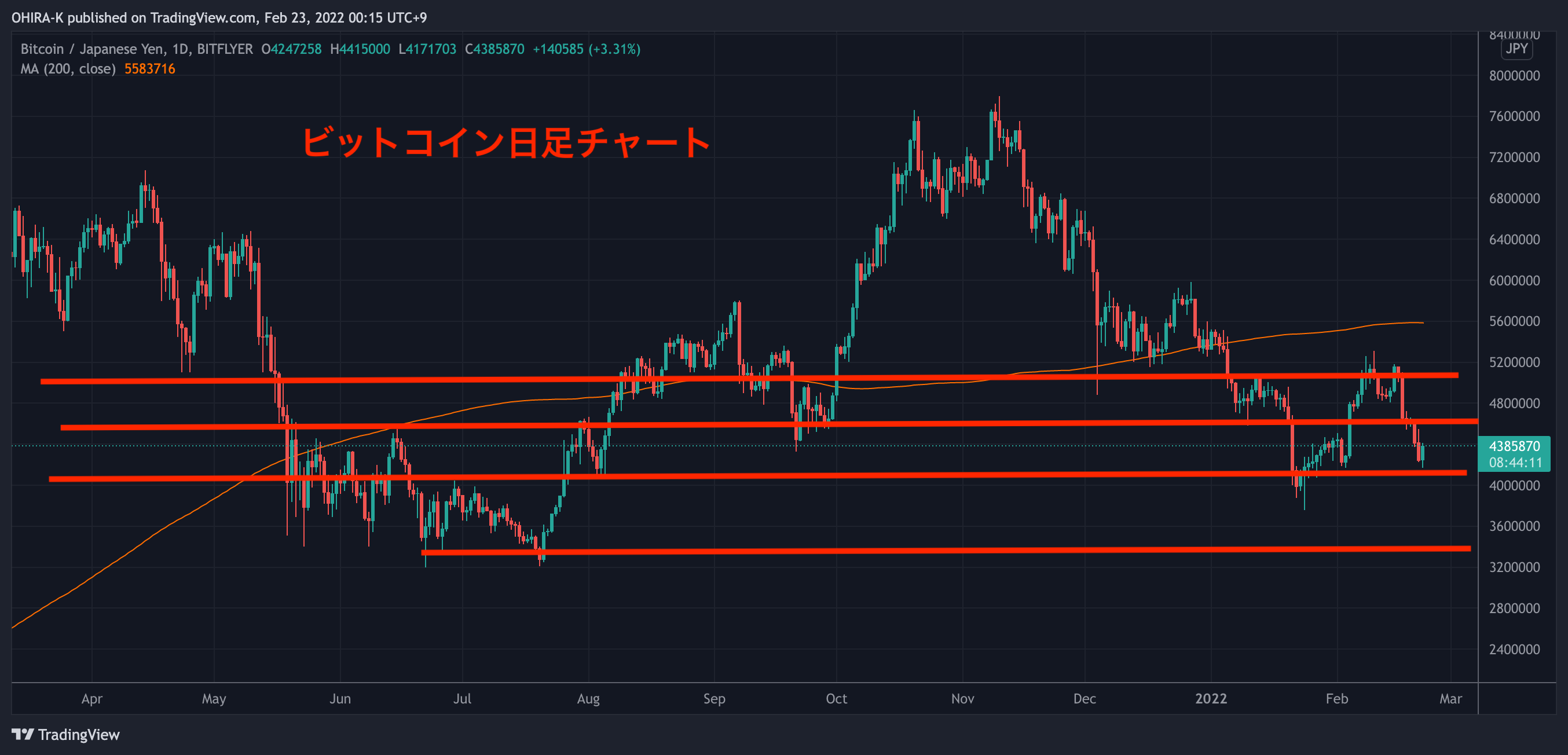
Last week, Bitcoin reached 5,000,000 yen, and the question was whether it would break above that level or stay in a short-term range of 4,800,000–5,200,000 yen; currently, it has broken below the 4,800,000 yen short-term range and is moving toward a year-end low in the mid-3,000,000 yen range.
Regarding the situation in Ukraine and Russia, Bitcoin rose on news that Russia would withdraw its troops last week.
However, more recent news
President Putin of Russia21day, recognized the Donetsk and Luhansk regions in eastern Ukraine as republics after they had declared independence.
https://www.bloomberg.co.jp/news/articles/2022-02-22/R7OMZPDWX2PT01
This became the content, and it is said to have affected Bitcoin’s price by worsening the Ukraine crisis.
From this, hedge fund analyses suggest
such increasing correlation could indicate a change in Bitcoin’s nature as an asset class; prior to 2019, correlations with other assets were negative. Since then, the correlation with “risky tech stocks” has turned positive.
https://news.yahoo.co.jp/articles/e1958b79d1da239adaf9eae64c5a60e1a05fcb5f
There is news about this.
From optimism about Ukraine to deterioration leading to declines, some view stock markets as highly correlated and moving as risk assets rather than safe assets.
Even if temporarily so, it may be premature to draw broad conclusions quickly.
Indeed, triggered by the COVID-19 pandemic, the value of cryptocurrency as a financial asset rose similarly to stock markets
If we look back at the 2017 bubble, there is certainly a strong correlation with stock market performance then as well.
However, for cryptocurrencies like Bitcoin, their performance has historically been higher than stocks, and structurally they can be opposed to fiat currency inflation.
Therefore, as a medium- to long-term view, it is important not to focus only on temporary correlations, but to consider Bitcoin’s structural aspects and how it will compare to fiat currencies in the future.
【Investors are pessimistic】
From the point where it looked like it would approach the year’s low, investors have become pessimistic.
Investors who secured profits when prices first went public last year and have increased holdings of stablecoins and fiat may still be optimistic.
Bitcoin’s near-term key price is viewed as the milestone of 4,000,000 yen.
If it breaks below this, I feel it could move toward mid-3,000,000 yen.
Huh? Me?
Although I did take some profits last year, in terms of cash vs. financial assets, financial assets still dominate, and despite a large decline, I am not particularly pessimistic.
Also, as mentioned earlier in the paid article,IC (Internet Computer),NFT is currently thriving counter to the market; for example, a single BTCBTC Flower that was bought for about 30,000 yen rose to around 800,000 yen,NFT assets are increasing.※I have purchased several.
WhyIC NFT I won’t explain here, but some are also active on IC,
Using NFT to hedge cryptocurrency declines feels somewhat peculiar.
I had not invested in art before, though I have investment experience in financial assets.
As for Ethereum’s NFT, there are so many that it’s not easy to determine which to invest in.
Nevertheless, the motivation to purchase IC’sNFT—NFT opportunities may be understood by readers who have followed this article.
This is a very interesting topic.
Intel announced it will begin producing its own Bitcoin mining hardware. They unveiled the miningASIC calledIntel Bonanza Mine (BNZ1).
Initial capacity (40TH/s) is lower than competitors likeBitmain, but they emphasize energy efficiency to reduce environmental impact. AlreadyBlock (formerly Square) andArgo Blockchain have been considering using it as a direction, announced last week.
In Bitcoin trading, the usual approval is done through mining; Intel releasing this opportunity to mine is what this means.
Going forward, predicting Bitcoin mining demand and doing this seems intended to distribute mining more broadly and strengthen the Bitcoin network.
For Bitcoin’s value, not only price but the mining network also plays a crucial role, so this is good news.
【Ordinary people receive 200 million yen back taxes without filing a tax return】

As cryptocurrency trading expands rapidly, instances of omitted or non-filing of income are increasing.200 million yen or more in back taxes for a man in his 40s in Tokyo whose crypto asset value had fallen so much that converting to cash would not be enough to cover ithttps://news.yahoo.co.jp/pickup/6418759Here is an overview of the omission of filing:○He only reported profits when converting to cash.○He did not report when his assets increased to 400 million yen and he converted part of it into other cryptocurrencies (taxable) but did not declare it.That is the gist.In cryptocurrency taxation, “exchange between cryptocurrencies” is also a taxable event.In other words, when his assets grew to 400 million yen, he→ realized profits partially in cash (taxable) → reported as gains→ exchanged cash into other cryptocurrencies (taxable) → non-declarationThus, many gains realized from converting high-valued assets into other cryptocurrencies were not declared.I’m not sure whether the person knew this was taxable or not, but normally tools like CryptoTax or other calculation software can read your P&L data and compute automatically.Then you would see taxes due beyond the cash conversion, and you would realize they came from converting into other cryptocurrencies.If the person did not think about it at all and did not know that transfers between cryptocurrencies are taxable and only declared the cash-converted portion, that could be one explanation.When I realize profits abroad, I first convert to stablecoins (cryptocurrencies pegged to fiat) and then reinvest or convert to Japanese yen.Otherwise, if I directly convert to other price-volatile cryptocurrencies, it would be harder to see visible gains and you risk losing part of the tax due to the other crypto’s price drop.Also, keeping in stablecoins allows for operations in DeFi and currency hedges.As described above, when there are profits in cryptocurrency, it is important to calculate every transaction and reflect on questions like “why do profits occur here?” and to build tax knowledge.Relying entirely on a tax accountant can also lead to risks of losing transaction knowledge, so please be mindful of that. yen or more in back taxes for a man in his 40s in Tokyo whose crypto asset value had fallen so much that converting to cash would not be enough to cover it
https://news.yahoo.co.jp/pickup/6418759
Here is an overview of the omission of filing:
○He only reported profits when converting to cash.
He did not report when his assets increased to 400 million yen and he converted part of it into other cryptocurrencies (taxable) but did not declare it.
That is the gist.
In cryptocurrency taxation, “exchange between cryptocurrencies” is also a taxable event.
In other words, when his assets grew to 400 million yen, he
→ realized profits partially in cash (taxable) → reported as gains
→ exchanged cash into other cryptocurrencies (taxable) → non-declaration
Thus, many gains realized from converting high-valued assets into other cryptocurrencies were not declared.
I’m not sure whether the person knew this was taxable or not, but normally tools like CryptoTax or other calculation software can read your P&L data and compute automatically.
Then you would see taxes due beyond the cash conversion, and you would realize they came from converting into other cryptocurrencies.
If the person did not think about it at all and did not know that transfers between cryptocurrencies are taxable and only declared the cash-converted portion, that could be one explanation.
When I realize profits abroad, I first convert to stablecoins (cryptocurrencies pegged to fiat) and then reinvest or convert to Japanese yen.
Otherwise, if I directly convert to other price-volatile cryptocurrencies, it would be harder to see visible gains and you risk losing part of the tax due to the other crypto’s price drop.
Also, keeping in stablecoins allows for operations in DeFi and currency hedges.
As described above, when there are profits in cryptocurrency, it is important to calculate every transaction and reflect on questions like “why do profits occur here?” and to build tax knowledge.
Relying entirely on a tax accountant can also lead to risks of losing transaction knowledge, so please be mindful of that.