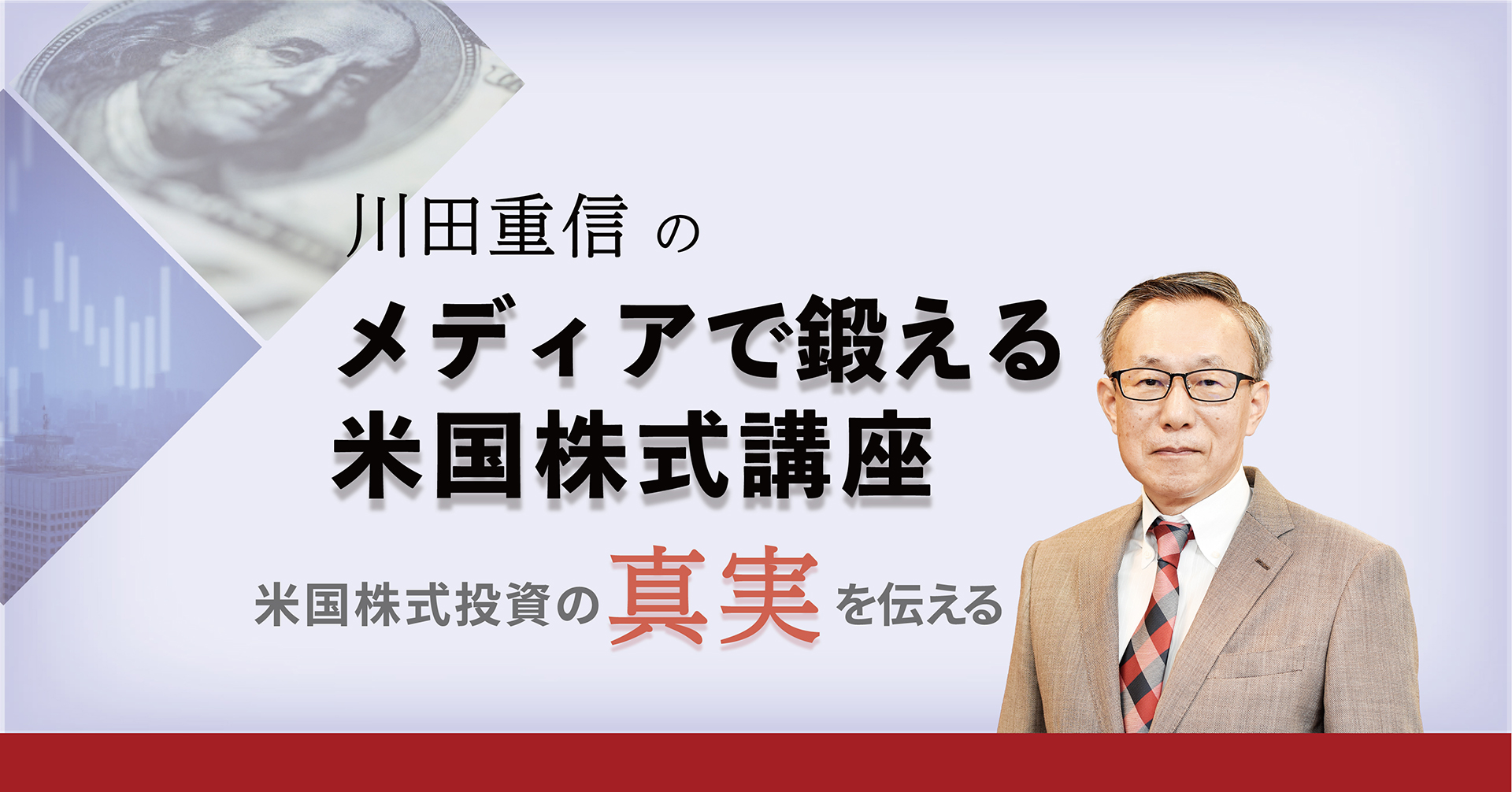
Translating the Truth of U.S. Stock Investment by Shigenobu Kawada: "U.S. Stock Investment Course Trained by the Media" [Vol.26] Distributed December 13, 2021

━━━━━━━━━━━━━━━━
Delivering the truth about U.S. stock investing
Shigenobu Kawada's “Training in U.S. Stocks through the Media”
[Vol.26] Distributed December 13, 2021
━━━━━━━━━━━━━━━━
*** Table of contents ***
Market recap
This week's straight talk!
This week's pickup articles
【Large-scale/Small-scale Wisdom: Investment secrets learned from quotes】】【80 years since Pearl Harbor—lessons from U.S.-Japan experts】
Investment tips
Kawada's walk
Activity information
Q&A corner
Achievement pace-maker of ¥20,000,000

Source: Financial Services Agency, asset management simulation prepared by ExeTrust Co., Ltd.
※The figures above are for simulation purposes only and do not guarantee future investment performance. Fees and taxes are not taken into account.
How to read: assumed earnings rate and attainment horizon
If 3–4%: over 30 years, this is typical for wrap funds or balanced funds
Even at 5–7%, it takes about 25 years for non-U.S. equity funds
If 8–10%, about 20 years: a modest view of S&P 500 gains
S&P 500 performance (dividends reinvested, 1970-2021)

Reach ¥20,000,000 earlier through proper risk-taking
Kawada’s message is remarkably simple. To reach ¥20,000,000, let your surplus funds work as efficiently as possible. That requires participants to correctly understand the meaning of risk and reward. Before reading the weekly newsletter, glance at this table and confirm your correct investment posture.
Now, start the countdown to reaching ¥20,000,000 right away!
Online salon “Asset Formation that Fulfills Dreams”

This is an online salon where everyone learns and encourages each other to succeed in asset formation. It offers member-only seminars that showcase the魅力 of U.S. stock investing and cover content that the popular newsletter “Training in U.S. Stocks through the Media” cannot fully convey.
■□■□■□■□■□■□■□■□■□■□■□■□■□■□■□■□■□■
1. Market recap (Dec 6–Dec 10)
<Major indices>
・Dow Jones +4.0%
・S&P 500 +3.8%
・Nasdaq Composite +3.6%
=Quick version=
In the first half of the week, concerns about Omicron eased and stocks rose. Ahead of Friday’s CPI release, markets hovered but then rose as inflation outlook improved in line with expectations, pushing the S&P 500 to a new high.
=A bit more detail=
Positive news on vaccines and treatments for Omicron, and hopes that it would be less severe, combined with a lack of major economic data in the early part of the week, led to a rebound as risk-off sentiment faded. However, with rising long-term yields, cyclicals and economically sensitive stocks outperformed growth stocks. Friday’s CPI rose 6.8% year-over-year—the largest since June 1982—which investors largely viewed as peaking, helping bonds settle and stocks, especially large caps, advance to new highs.

S&P 500 1-year chart

■□■□■□■□■□■□■□■□■□■□■□■□■□■□■□■□■□■
2. This week's straight talk!
A section that delivers the essential information you should know.
Kida.
Sharp rebound and new highs
From after Thanksgiving until the end of last week, the market seemed to forget concerns and declines, and the S&P 500 reached new highs. The declines were likely tied to Omicron concerns and FED policy uncertainty, along with profit-taking related to fund performance and stock rebalancing at month-end. From various reports, concerns about Omicron appear to be easing, and while social caution (especially in Japan) remains high, market catalysts seem to have passed their peak.
In this pullback, richly valued growth stocks were sold off. SaaS names like DocuSign and Zoom, which had benefited from pandemic-era growth, were pushed lower as investors questioned post-pandemic sustainability instead of relying on Omicron-driven growth. This shows that coronavirus is gradually becoming less central to market themes.
Year-end events
Now, the Federal Open Market Committee (FOMC) meets on the 14th and 15th for what may be the year’s last event. With Powell signaling a faster pace of tapering in congressional testimony, the pace of policy normalization will be a focal point. Market participants will be watching whether the Fed’s outlook for growth and inflation shifts materially.
Given last week’s CPI reaction was relatively muted, a bullish view has emerged that policy tightening will not overdo inflation対応. If there is no change in the Fed’s stance based on data, the market may interpret that inflation is peaking, suggesting limited impact from earlier tapering. Considering ongoing asset purchases, the overall trend for markets should remain solid.
Towards Christmas holidays
Moreover, the anticipated U.S. debt ceiling issue in mid-December is unlikely to derail markets as Congress appears to approve raising the ceiling this week. Once the FOMC concludes and the Friday “quadruple witching” (day when futures and options expire) passes, markets are likely to enter a true Christmas break.
■□■□■□■□■□■□■□■□■□■□■□■□■□■□■□■□■□■
3. This week's featured articles
A corner that selects information useful for asset building from what I found, ranks them, and comments with my highly personal views.
【1】 Nikkei Newspaper大機小機Learning Investment Secrets from Famous Quotes 12/10
“There is no free lunch in investing” is a maxim we should keep in mind. Just as there is no free lunch, success in investing requires some burden or cost.
① U.S. Securities and Exchange Commission (SEC) website Beginner's Guide: Even if you invest in large-quality stocks, you should expect a loss for about one year in three years.
② “Do not put eggs in one basket” The investing world likewise suggests diversifying across asset classes such as stocks, bonds, domestic investment trusts, and foreign investment trusts to reduce risk.
③ “Past performance does not guarantee future results” SEC’s homepage also has a section titled “Funds, past performance,” arguing that basing fund selection on past returns is risky.
④ The legendary economist Paul Samuelson once said, “The road of investing is as dull and boring as waiting for an oil painting’s colors to dry or watching plants grow.”
【Kawada comment】
This column is basically correct. However, the author is influenced by a Japanese way of thinking, and strictly speaking there are misunderstandings and views that may be detrimental to asset formation.
① Is the S&P 500 negative once every three years? Or once every five years?
“One negative year every three years” is a bit exaggerated. In the past 51 years, the S&P 500 had negative years 10 times. So the annual negative occurrence is about once every five years.
For 2011 (−0.05%) and 2015 (−0.77%), the index was nearly flat, but with dividends included it’s slightly positive. 1994 (−1.54%) was also similar. Even counting these as negative years, there have been 13 negative years in 51 years, i.e., roughly once every four years.
SEC’s beginner-oriented webpage seems to be designed to avoid raising investors’ unrealistic expectations (refer to the top table in this newsletter).
② The basics of asset allocation are three: stocks, bonds, and cash
Although several asset classes are listed, for asset formation the essential asset classes in securities are stocks and bonds. Add cash to make three categories.
Domestic and international investment trusts mostly target stocks or bonds. While diversifying across many asset classes seems to reduce risk, the actual performance quality often declines. If we imagine the author’s background, perhaps they come from a securities or asset management firm; otherwise, perhaps they are a media or major institution commentator who promotes world-wide funds as a quick fix?
③ When choosing funds, past performance does not guarantee future results
I would paraphrase this as “the past performance of active funds does not guarantee the future.”
Of course, the overall U.S. stock market may not guarantee absolute returns either. However, if you look at the past performance of major indices like the S&P 500 or the total U.S. stock market and understand the factors driving the rise, you wouldn’t cite such warnings.
Americans have absolute trust in the U.S. stock market and bear risks with their own judgment. This risk appetite is something Japanese people cannot easily grasp.
If one denies long-term rise of U.S. stocks, there would hardly be any investment target worldwide that yields returns through securities investments. Without understanding this fact correctly, it would only generate needless anxiety.
Indeed, “Past performance does not guarantee future results,” but Americans trust the future of the United States. If that were not the case, one would not remain in that country. Its citizens are like that.

As a side note: Japanese are born Japanese, but Americans are not. Americans are those who can believe in and share the founding spirit of the United States and can contribute to it. People who do not believe in their country do not stay there; hence they are strong and thus fearsome.
Again, this is about active funds, so let us understand it as such.
S&P 500 90-year chart (log scale)


④ “The path of investing is a dull, unexciting one”
I completely agree. By the way, do you know the economist Samuelson? Our student days’ standard textbook was his Economics.
As a student I only bought the two-volume set’s upper volumes. I vaguely remember flipping through them but did not study deeply (I drank a lot of sake for various reasons, sob).
His maxim is completely correct for asset formation. On the other hand, there are stocks with long-term high growth and rising stock prices like platform stocks, and those like Tesla that drift for a period and then surge suddenly.
If stock investing were merely boring, memes and high-flying stocks would not appear. Yet reality is different. Our desires tempt us, and many investors profit greatly in bubbles.

【2】 Nikkei Newspaper
80 years since Pearl Harbor: lessons from American and Japanese experts Japan Institute of International Affairs President Kenichiro Sasaki, 12/9
Eight decades have passed since the Pearl Harbor attack, the surprise strike by the former Japanese army on Pearl Harbor in Hawaii. What should we learn from that war? We asked experts.
Graduated from University of Tokyo Law in 1974, joined the Ministry of Foreign Affairs. Held various posts including vice-minister. As ambassador to the United States, he contributed to Prime Minister Shinzo Abe’s Pearl Harbor visit in 2016. Since 2018, he has been in his current position. 70 years old.

What Japan should learn from the Pacific War that began with Pearl Harbor.
① It is necessary to reposition defense capability correctly. (Overly powerful prewar military and the postwar “military is evil” view are both wrong.)
② The importance of correct international perception (experts at the time also knew that victory wasn’t assured).
③ In diplomacy, it is important not to lose even if you do not win (there were options to retreat from China and wait for the next change).
➃ Japan’s defeat in information warfare (Japan’s information protection system was sloppy).
Lessons for the United States as well
Overestimating Japan’s threats and realities (was it necessary to drop the atomic bomb?)
Stressing the need for deterrence (did we convey the fact that the U.S. could not be matched?).
Lack of direct dialogue (no leaders’ level talks).
Japan must urgently strengthen its defense capabilities
We must show the world that democracy is not perfect but better than other systems. Japan and the United States must not neglect strengthening their nations.
【Kawada comment】
This period features many articles and programs that evaluate and seek lessons from the era around World War II, considering Japan’s position and the path Japan chose at that time.
I like Sasaki’s line, “Japan must not neglect strengthening its nation.” It implies we must strengthen militarily, economically, and culturally.
For that, it is important that each individual becomes economically strong so as not to misjudge. And my work is to help with that. I want to pursue this mission daily.
【3 NHK TV】
①The Century of Film Premium (18) “Hitler: The Madness of a Dictator”

Hitler’s madness became reality through his close aides. Propaganda Minister Goebbels, who controlled all media and built a propaganda state. Himmler, leader of the SS, who executed the Holocaust through coldly rational plans based on racial purity. Each was an ordinary person. Why did they follow to commit madness? And why did the German people get possessed by madness? A discovery of the birth and collapse of the Nazi regime through archival footage—a shocking story.
② (21) “World War II: After the Gun Behind the Front—Another Front” - The Century of Image Premium
First broadcast: December 4, 2021
80 years since the outbreak; while propaganda reports described victory at the front, the camera captured daily life under wartime. From ecstasy to despair, it depicts 1,347 days of life behind the front through archival footage.

Women smuggling their own photos in care packages to comfort soldiers; children’s school evacuees called “little citizens”; students’ tattered boots as they head to student mobilization; and bows repeatedly given by the Japanese toward new rulers in the south. It depicts 1,347 days behind the front, not the battlefield, through archival footage.
③The Heroes’ Choices Show: “Why did Japan Open War in 1941?”
Showa 16 (1941) December 8, the start of the Pacific War. Why did Japan, with overwhelming military disparity, begin the war? Was there really no path to avoid it? The program focuses on the year 1941, thoroughly examining six turning points that led Japan to open war and the leaders’ choices.
Based on the diary of writer Nagai Kafu, who lived in the populace, the program re-creates the era in anime and features experts from various fields digging into the road to war to seek lessons for today and the future.
【Guest】Yabunaka Mitsuzou, Miyama Jin, Koba Ken, Ichinose Toshiya, Nakano Nobuko,【Host】Sugiyura Yuki【Narration】Matsushige Yutaka【Voice】Sano Shiro
【Watch the three videos】
My childhood memories begin around 1960 for me. World War II began in 1941, and the atomic bombs fell in 1945, so I have lived in a period almost contiguous with the tragedies of world history. In other words, the outbreak of war happened 80 years ago, but it is also an event in our generation.

“Video Century OP Theme: Paris is Burning”NHK’s “The Century of Image” series features the popular theme song written by Takashi Kago for NHK Special “The New Century of Image”—“Video Century OP Theme: Paris is Burning.”
This piece expresses the folly of those who wage war, the human strength when facing difficulties, and the beauty of mutual understanding. Many of you may have heard it. After finishing the program, this music stuck with me for days.
Common points you can learn from the program about Germany and Japan:
Germany: “Anger born of victim mentality,” narrow vision, and faith in racial purity led everyone to lose their minds.
Japan: “Ignorance and misunderstandings of world affairs,” linear thinking limited to Japanese language, and dysfunction of democracy were major issues.
By the way, since I also watched this program, please consider this: “Hitler’s Admirer: The Confession of Hiroshi Oshima, a Class-A War Criminal” — BS1 Special
* Hiroshi Oshima (photograph)
Ambassador to Germany at the end of the Pacific War. Army general. In 1934, he became a military attaché at the German embassy, contributing to deepening Japan-Germany relations, and played a role in the anti-Comintern Pact through the army route without going through the Foreign Ministry. In 1938 he became the German ambassador and played a part in forming the Tripartite Pact among Japan-Germany-Italy.

This ambassador Oshima was reportedly a great Germany admirer who said, “Hitler was a genius, and my best ally.” The program concludes that Germany’s cooperation contributed to the war, but not solely his fault.

That is of course obvious. Yet even if we regard attitudes like stock price predictions and levels differently (to me they look the same), why did people praise those high-flying or meme stocks to such heights? Why could they not cut losses midway? This is the same as stock investing, and there are always post hoc reasons.
Looking at Hitler’s dictatorship and the process of Nazi power, I feel parallels with Donald Trump’s remarks and entourage. Both are capable of turning public discontent into power. Did Trump consciously imitate Hitler’s methods? Or is it a universal method of manipulating public opinion that has existed since ancient times?
Saying is easy; doing is hard
Many intellectuals we know were, in their time, typical “militaristic youths.” If I had been born one or two generations earlier, could I have opposed my nation's decisions? Even with the same moral values today, would I have resisted accommodating the regime? Many intellectuals supported the government’s decision to go to war at the time.
On the other hand, diaries of students sent to the front show many records of soldiers who, though opposing government decisions, followed orders. Individual judgment was easily swayed, and powerless before authority.
The third piece, The Heroes’ Choices Show “Why Did Japan Open War in 1941?” was a two-hour program, intriguing even when fast-forwarded.
From early 1941 to the outbreak, it discusses six turning points that led to war and examines leaders’ choices and the hearts of people in power and the public in detail. The program uses Nagai Kafu’s diaries (38 years from age 38 to his death at 79) to reflect the era through conversations between him and a hostess. It blends experts from various fields to explore the road to war and to seek lessons for today and the future.
The program also includes the diaries of Nagai Kafu (1879–1959), which he wrote from age 38 to 79, and uses conversations between Kafu and a hostess to reflect the mood of the era. It also uses anime to depict the times.
The segment features Nagai Kafu’s diary “Dankoutei Nichijou” and the hostess as two voices to reflect the era. The approach reveals the public opinion’s shifts under increasing military pressure as well as Kafu’s grumblings about misreading world affairs. Those grumblings resonate with our current regrets.
By the way, after the program I ordered the “Dankoutei Nichijou” (two volumes) on Amazon, but delivery is expected in late January. Perhaps there was a surge of orders around this period.
Among the guests, I like former Foreign Affairs Administrative Vice-Minister Mitsuo Yabunaka’s speaking style. It is not pompous or condescending, which is good.

Hearing statements backed by experience from someone who has navigated the diplomatic crucible is valuable. At the same time, much information is confidential, so we should be cautious about taking every statement at face value.
To make these statements meaningful, you should compare them with other statements in the chronology and with other people’s remarks, linking them for more accurate information.
In any case, to understand events correctly you must invest cost and energy. If you no longer feel the thrill of effort, you should retire from the field.
■□■□■□■□■□■□■□■□■□■□■□■□■□■□■□■□■□■
4 Investment tips
This column covers not only “investment methods” and “stock picks,” but also “indicators and remarks that caught my eye” and “social and political movements.”
Interest rates and stock prices
Although stock prices had been rising, they fell for about two weeks until the week before last, then quickly recovered, and the S&P 500 reached a new high for the week.
Until the week before last, the pullback was mainly due to concerns about the Omicron variant, but market observers had also started factoring in faster monetary tightening to curb inflation.
This time, let me review the latest items related to interest rates and stock prices.
① Flat yield curve
During the summer, due to tight labor markets and inflation concerns, the yield curve did not steepen; in fact, the gap narrowed considerably.
The Fed wants to focus on inflation control at the expense of labor market activity. That is how the market perceives it.
A flattening yield curve is a leading indicator of lower inflation, slower economic growth, or both.
US 10-year vs 2-year yield curve

② FF rate: three rate hikes in the next year?
According to CME’s Fed Watch, the futures market expects the Federal Funds rate target range to rise by 25 basis points in May next year from the current 0.00–0.25%. It also factors in a possible hike in September and a third hike in December.
If so, the target for the FF rate in one year would be 0.75–1.00%. Other financial derivatives price in a peak around 1.50% in three years, but that is far in the future for the market.
CME’s Fed Watch

③ FF rate and stock price declines
Historically, it takes about a year from the FF rate peak to a stock market decline.
Case of 2004–2006
The Fed raised FF rate by 25bp at each FOMC meeting, pushing FF rate from the bottom at 1.00% to 5.25% after the tech-bubble burst.
But long-term yields did not respond, creating what Greenspan called “konandoramu” (mystery). As a result, financial conditions were accommodative, fueling a housing bubble.
US economic indicators (1980–2017)

Case of 2018
Under Powell, the Fed raised FF rates toward nearly 2.50%, while shrinking the balance sheet to tighten financial conditions.
As a result, late 2018 saw a bear market-like condition, with the S&P 500 down almost 20%.
Back then, the 2-year and 10-year yield spread narrowed to only 12bp, one-twelfth of the current spread.
S&P 500 and 10-year yield (2018)

S&P 500 reached all-time highs
Last Friday, CPI for November was released, and the stock market responded positively to the high figure (up 6.8% year over year). The S&P 500 rose 3.8% for the week and reached an all-time high.
After the CPI release, the BEI for the 10-year Treasuries (difference between nominal and real yields) fell from 2.51% to 2.46%, reflecting a decline in expected inflation. The BEI peak was 2.76% on November 15 and has since declined.
Many recently released indicators point to higher inflation, but investors have grown skeptical about sustained inflation and are more optimistic about equities.
Reference:Return comparison with nominal bonds: Break-even inflation rate
Break-even inflation rate is the inflation rate at which the yields on inflation-linked bonds and nominal bonds would be equal for the same maturity.
Also, since both nominal yields and real yields are determined by market price of bonds, the break-even inflation rate can be seen as roughly equal to the market-implied expected inflation rate.
If expressed mathematically: the nominal yield decomposes into real yield + expected inflation + risk premium
And the break-even inflation rate that makes nominal and inflation-adjusted yields equal is given by: nominal yield = real yield + break-even inflation
However, since measuring risk premiums is difficult, it is common to assume break-even inflation rate is nearly equal to the market’s expected inflation.
Break-even inflation ≈ expected inflation
Nominal yield ≈ real yield + expected inflation
Nominal yield = real yield + break-even inflation
Break-even inflation rate chart (year to date)

What I learned
Until recently, the yield-curve had flattened, inflation remained high, and concerns about Omicron kept risk appetite subdued. But in the last week, everything changed. The annual return is looking strong for the year.
In the latter half of this year, prices fell about 5% in September and early December. Yet those declines did not cause much fear.
The past two decades’ typical stock price patterns align fairly well with this year’s movements.
On the other hand, the declines in high-flying stocks have been severe, and many may not recover for some time.
Some people may be reacting to daily information and regretting excessive trading that hurt performance.
S&P 500 reached a new high, but Nasdaq 100 is only 1.5% from its all-time high. Apple’s market capitalization may reach around $3 trillion (roughly 340 trillion yen), potentially half the market cap of Japan’s stock market by itself.
These are examples that investors’ stock preferences have not weakened. For the time being, it is better to stay composed and not be swayed by daily noise.
If your goal is asset formation through stock investing, it is best to adhere to Paul Samuelson’s adage: “The road of investing is a dull thing; you should patiently wait for the oil paints to dry or for the plants to grow.”
In that case, the core-satellite approach seems best. Core (about 80–90%) could be ETFs or funds tracking the S&P 500 or Nasdaq 100, with satellites consisting of a handful of individual stocks. The time will come to wait and let the market do its work.

Apple (green) vs. Nasdaq 100 (light blue) 5-year chart

■□■□■□■□■□■□■□■□■□■□■□■□■□■□■□■□■□■
New serial “All About Asset Formation Using U.S. Stocks”
Introduction
We have started a series that covers the basic content necessary for asset formation. The overall structure is planned as follows.
What era are we living in? Part 1–2
Independent Japanese and asset formation essential for independence—Part 1–3
Is the stock market only in the U.S.? Part 1–4
Differences in stock market cultures between Japan and the U.S.
Key features of the U.S. market you should know
What is the S&P 500?
Why is the U.S. strong?
Recommended investing strategies — Core-Satellite investing —
Core investment strategy
Satellite investment strategy
What should I buy?
Sources and investing
Episode 4 Differences in Japan-US stock market cultures Fourth installment
Until the last episode I boldly proclaimed that “the stock market exists only in the U.S.,” and I truly believe that. In reality, there is no market like the U.S. stock market elsewhere.

Therefore, to help readers understand more clearly, I proceed with comparing the U.S. market to the most familiar Japanese stock market.
Differences in investment cultures between Japan and the U.S.
For a long time, I have advocated the appeal of U.S. stocks to Japanese investors. Now the reaction is somewhat different, but generally was as follows.
* Stock investment? Isn’t it just buy and sell? Stocks!
→ A deeply rooted distrust
* A home-country bias (Japan-centric)
→ If Japanese stocks don’t make money, why would U.S. stocks?
* Lack of understanding of the U.S. economy (dominating in finance, military, tech, and communications)
→ Japan can do great too.
→ A hegemonic nation; the gap with the U.S. is decisive.
My analysis suggests that people are stuck in cycles and causal belief, unable to imagine the survivability and creative destruction. Hence perpetual skepticism?
Here’s my clear claim: U.S. stocks are not gambling but legitimate investments, whose prices are determined by the fundamentals of the economy and corporate earnings.
This may be hard to visualize for beginners and unbelievable for those who are familiar with Japanese stocks.
■ When I was assigned to New York, I didn’t understand at all.
As noted in the November 15 issue of this column, I realized the true appeal of U.S. stocks when I was stationed in the U.S. and Asia and later returned to Japan.

I was in charge of the U.S. stock desk at Daiwa Securities NY. The current person in that department has prepared the following video. If you share the same feeling, please take a look.
Now, today’s discussion is “Differences in Japan-U.S. stock market cultures”, and I will list what I can say from my own experience.
■ Japanese stocks are not equity even though they are stocks. U.S. stock equity means owning the portion of the company itself.
First, what is a stock? In a word, it is the right to own a company.
“Stocks are securities issued by a company when raising capital. In simple terms, it is a certificate proving you provided funds.”
Companies need funds to operate and grow.
When funds are raised by issuing stock, unlike loans, the company does not have to repay that money, and the company gains stable capital.
Investors provide funds in exchange for stock. Those who acquire stock become shareholders and gain shareholder rights.
What is stock? Easy explanation
Now, what are the rights of shareholders?
■ Shareholder rights
The Japan Securities Dealers Association site ( What rights do you have as a shareholder? ) explains that shareholder rights are mainly threefold.

(1) The right to participate in and vote at the general meeting of shareholders (voting rights)
(2) The right to receive profits such as dividends (right to receive distributions)
(3) The right to receive remaining assets upon dissolution (right to residual property distribution)
These rights are stipulated. By the way, the Tokyo Stock Exchange site lists main rights for shareholders as
■ Dividends… you receive a portion of the company’s profits in proportion to the number of shares you own.
■ Voting rights… you can express opinions at the general meeting and vote on important resolutions (e.g., appointment/removal of directors, changes to corporate rules).
■ Shareholder benefits… you can receive company products or facility vouchers.
※ Not all companies offer these.
■ Are shareholder benefit programs strange?

This Tokyo Stock Exchange explanation can be misleading. The Japanese Securities Dealers Association site does not have a residual property distribution right and lists “shareholder benefits” as a main right for shareholders.
Shareholder benefits include free passes, dango, canned goods, etc.—too many items can be confusing, and it is not sure you want them.
In Japan, shareholder benefits are a unique system where companies thank shareholders for owning stock by sending products or coupons. However, the real purpose is promotion by the company.
In any case, Japanese shareholder benefits are a misleading practice when viewed from the shareholder-rights perspective.
For this reason, I think Japanese stocks are Japanese stocks, not the “Stock” or “Equity” label used for U.S. stocks.
Japanese stocks are a device for Japanese people to preserve jobs and communities within a corporate group, so we should not expect the same shareholder rights or returns as in U.S. stocks.
What is the biggest difference between Japan and the United States in stock culture?
Now we come to the main point: by identifying the biggest difference between Japanese and U.S. stock cultures, I aim to clarify the difference in stock culture itself.
Recently, there is a rising momentum to switch from “shareholder supremacy” centered in the United States to “stakeholder capitalism,” which has gained momentum since Europe and is now spreading to the U.S. and Japan.
This movement focuses on managers’ decisions becoming short-term oriented, which leads to social inequality, environmental destruction, and adverse effects on work styles. The aim is to rebuild capitalism on a qualitative basis, considering a broader set of stakeholders and sharing the gains with them for long-term corporate value growth.
However, I want to clarify the purpose of stocks by reaffirming the stock’s original function to reveal the reasons behind differences in stock performance between Japan and the U.S.
Absolute ownership of U.S. stockholders
If you ask what is the biggest difference between Japan and the U.S., I am most convinced by the explanation that “U.S. stockholders’ ownership is absolute.” And this term “absolute” is difficult for us Japanese to grasp.
This is heavily influenced by sociologist Naoki Komuro’s The Capitalism Theory of Komuro Naoki.
And the following article nicely summarizes it.
The article explains the病根 of Japanese corporate scandals using Komuro’s theory.
Key points listed below:
■ Who owns the company?

Komuro notes that there is a large gap between Japanese capitalism and Western capitalism. A corporation is inherently owned by shareholders. Komuro argues that “capitalistic ownership is absolute.”
The absoluteness of ownership is the cornerstone that supports the resource allocation function of capitalism, where ownership transfers are clear and unambiguous when trading goods.
Therefore, the absoluteness of ownership is clearly defined in Japan’s Civil Code (Article 206): “The owner has the right to use, profit from, and dispose of the owner’s property within the limits of the law.”
Komuro argues that in Western capitalist countries ownership is natural, but in Japan’s less mature capitalism, the law says so but the practical effect is weak.

In Japanese thought, “ownership” has traditionally been tightly linked to actual control. Komuro draws on Yamamoto Nanpei’s concept of ownership from the Kamakura period to explain this. Yamamoto’s reference describes a framework where ownership is granted to those who possess and actively manage assets rather than abstractly holding them.
For example, those who receive fiefs or pay revenues and actually manage them are considered owners.
This is the ownership concept that remains strongly in today’s Japanese society.
There is a huge gap between Japanese and capitalist ownership concepts.
“The owner of a company is the manager” — a typical Japanese belief.
In other words, many Japanese feel the owner of a company is its managers. The managers also feel the company is theirs. This traditional view is almost incompatible with capitalism, and when managers think they own and control the company, the company becomes their private property, and conflicts with true owners become intense.
Moreover, this thinking leads to pushing shareholders away from corporate management. The term “the activist shareholder” reflects the view that shareholders speaking to managers is abnormal and shareholders should simply provide money and obey managers.
If managers neglect the principles of capitalism and shareholders tolerate such deceit, the “system of irresponsibility” will spread, and managers will hide their wrongdoing.
(Summary from “The System of Irresponsibility rampant among Japanese managers and the fate of immature Japanese capitalism — Komuro Naoki | Weekly Economist Online”)
U.S. companies belong to shareholders
Companies belong purely to shareholders. This is the simple relationship between U.S. companies and shareholders. The trend of “stakeholder capitalism” has recently become a focal point.
However, to understand U.S. stock investments, it is essential for Japanese people to grasp the meaning of ownership in American capitalism.
For example, if shareholder wishes prioritize short-term profits, managers will act accordingly. If shareholders take a longer-term view and instruct managers to balance among stakeholders for the long-term value, managers will follow.
Furthermore, shareholders can decide to adjust business portfolios for the future or consider selling a company.
In any case, shareholders delegate management to the executives but the relationship between shareholders and management does not collapse.
Japanese companies frequently have employees and employee-sourced managers who effectively control the company; this should not be confused with the U.S. model.
This is the biggest difference between Japan and the U.S., and I think it is what Japanese investors tend to misunderstand when analyzing U.S. companies.
Overseas activists’ claims may seem strange to Japanese people due to these historical and cultural differences.
Activists think they are acting within Japanese law as written, but the reality may be different. Could this be the case?
When investing in U.S. stocks, remember that “the owners are the shareholders,” and ownership is “absolute”—don’t lose sight of capitalism’s core principles.
(To be continued)
■□■□■□■□■□■□■□■□■□■□■□■□■□■□■□■□■□■
5. Kawata’s stroll
◇◇Recently visited favorite places (books, films, museums)◇◇

The “Christmas Market” is a traditional European festival dating back to medieval times, including Germany.
In every city, the central square features distinctive Christmas decorations, illuminations, traditional sweets and mulled wine, and various goods sold at stalls, becoming an indispensable sight from late November to December 25.

In the romantic atmosphere, sharing mulled wine with friends and choosing Christmas ornaments or gifts is a unique enjoyment of the Christmas Market.
【Kawada comment】
The annual Christmas Market at Hibiya Park begins on Friday the 10th. I noticed preparations a couple of days earlier. Admission is 1000 yen, but the venue wasn’t open yet (Friday lunchtime).
About ten years ago, I traveled to Germany and visited local Christmas markets. In the square, small tents line up, and people enjoy beer and wine under warm orange glow.
This season’s festivities carry a solemn and sacred mood. Passersby’s expressions are relaxed, and there is a sense of relief. It reflects deeply complex geopolitics, history, ethnicity, religion, and class differences that Japanese people cannot easily imagine, yet people can find a moment of peace there.
■□■□■□■□■□■□■□■□■□■□■□■□■□■□■□■□■□■

6. Future activities
◇ December 15 (Wed) 11:00 AM Stock Voice
◇ December 16 (Thu) 8:15 AM Nikkei CNBC telephone interview
■□■□■□■□■□■□■□■□■□■□■□■□■□■□■□■□■□■
7 Questions Corner
How to handle high-flying stocks
Question 1
Questioner
The stock price drop of DocuSign (DOCU) has hit me hard. Mr. Kawata, would you simply cut the position in such a situation?
Kawata
In my case, I give up and exit. But isn’t this stock potentially worthwhile in the long run? However, I don’t know when that would show up in price. Therefore, I have come to think it is dangerous to fall in love with a stock.
Questioner
Thank you for your guidance! I cut it in tears... It’s really painful to be hit so hard...
① Cut loss
The size of the position matters, but close your eyes and cut losses in several steps, then forget about it. That’s a relief.
② Salted away (hold)
Again, depending on position size, you can forget it and “salt away” for a period. The position will go to zero, so treat it as a gamble-limiting option. After several years, it might become a big winner like Tesla, though the chances are low.
Questioner 2
Triggered by the Omicron scare, many high-flying stocks like Zoom (ZM), Teladoc (TDOC), and DocuSign (DOCU) have fallen by more than half, right? What do you think?
Kawata
These stocks were previously priced on expectations, often with price-to-sales multiples in tens of times, but that is unlikely to continue.
However, among the depressed, the genuine will be bought. I could not sell at the peak, but I avoided major losses. Do you hold any of them? I always think, these high-flying stocks are hard for me to handle. I tend to wait and pick up cheap ones, but I have memory of being burned in the past.
Year-to-date chart
NDQ Nasdaq 100, DOCU DocuSign, ZM Zoom, APPN Apian, TDOC Teladoc, LMND Lemonade, PTON Peloton
Nasdaq 100 is up over 28% year-to-date, while others have fallen sharply

───────────────────────────────────
★ If you have questions, please read the following 【Question Rules】 and email to info@kawata-magazine.com.
【 Question Rules 】
◆We may not answer all questions. Please understand in advance.
◆Questions may be published on our site, YouTube, social media, books, etc., in a form that does not identify individuals.
◆We will not respond to questions from non-subscribers.
◆We may omit clearly promotional or advertising portions.
◆We may take appropriate measures against those who post malicious questions without a subscription.
───────────────────────────────────
★Disclaimer
◆We do not provide stock, bond, fund, ETF, or sector recommendations via this newsletter. Investment decisions are the responsibility of subscribers, and we accept no guarantee or liability.
◆We do not guarantee damages suffered by subscribers using our newsletter.
◆We are not responsible for any disputes arising among subscribers using this service.
◆If the information in this service infringes on rights or leads to disputes, we accept no responsibility.
◆We do not owe any obligation to compensate for interruptions or changes to this service.
───────────────────────────────────
■ Publisher: Hibiya Technology & Finance Co., Ltd.
■ Shigenobu Kawata’s Thank You, America Stocks
https://www.kawataamekabu.com/
■ Twitter:https://twitter.com/ShigenobuKawata
■ For comments, requests, or to unsubscribe, please contact
【Email】info@kawata-magazine.com
■ If you do not receive the email, it may be categorized as spam; please check in advance.
───────────────────────────────────