Trading strategy considering USD/JPY chart points and Omicron impact【December 06–December 10】
Last Week's Foreign Exchange Range (Volatility)
| Open | Low | High | Close | Change | |
|---|---|---|---|---|---|
| USD/JPY | 113.51 | 112.54 | 113.96 | 112.80 | ▲0.63% |
| EUR/USD | 1.1302 | 1.1236 | 1.1383 | 1.1313 | +0.10% |
| EUR/JPY | 128.49 | 127.37 | 128.79 | 127.61 | ▲0.68% |
| USD/CNH | 6.3955 | 6.3631 | 6.3969 | 6.3698 | ▲0.40% |
| CNH/JPY | 17.7493 | 17.6551 | 17.8465 | 17.7002 | ▲0.28% |
Last Week's Foreign Exchange Summary
USD/JPY
- Last week's USD/JPY started at 113.51. Early in the week saw broad buying pushing up to 113.96, but the upside faced resistance and it trended lower. Meanwhile, around the 112.50–113.50 area, it found support and traded in a range from midweek to weekend. The week closed at the low level of 112.80.
EUR/USD
- The euro started at 1.1302. Heading into the London fix, the euro surged to 1.1383, then fell to 1.1236 in volatile moves, but later settled into a range of 1.1270–1.1350. The week ended at 1.1313.
USD/CNH
- The yuan started at 6.3955 per dollar. It fell gradually to the 6.36s after failing to clear the 6.40 resistance, then traded narrowly around 6.37. By the weekend, after a rate cut for a one-year loan, it weakened slightly to 6.3698.
What Happened Last Week
* Price indices and monetary statistics are year-over-year except where noted; GDP is quarter-over-quarter; indicators without special mention are month-over-month or for the current month.29th
- Turkey October trade balance: -$1.44 billion
- Germany November HICP: +5.2%
- US October existing-home sales: +7.5%
- WHO stated that while the new Omicron variant of COVID-19 may be more transmissible, its severity characteristics remain unclear.
30th
- Japan October industrial production: +1.1%
- Australia Q3 current account balance: A$23.9 billion
- Australia October building approvals: ▼12.9%
- China November Caixin Manufacturing PMI: 50.1
- Japan October housing starts: +10.4%
- France November CPI: +2.8%
- Eurozone November CPI: +4.9% (high inflation)
- November Chicago PMI: 61.8
- US November Consumer Confidence Index: 109.5
- Federal Reserve Chair Jerome Powell effectively withdrew the phrase that high inflation would be temporary, signaling a shift from supporting continued accommodative policy and suggesting the end of the quantitative easing program started in November.He signaled a quicker path to reducing the balance sheet.
31st
- Australia Q3 GDP: ▼1.9%
- China November Caixin Manufacturing PMI: 49.9
- US November ADP Employment: 534,000
- US November ISM Manufacturing: 61.1
1st
- Japan November monetary base: +9.3%
- Australia October Trade Balance: A$12.22 billion
- Eurozone October PPI: +21.9%
- US initial jobless claims (previous week): 222,000
- Mexico Senate approved Rodriguez, the Deputy Minister of Finance, as the next president of the Bank of Mexico
- OPEC+ decided to continue current oil production increases in January 2022, maintaining the previous policy of adding 40,000 barrels per day each month.
2nd
- China November Caixin Services PMI: 52.1
- Turkey November CPI: 21.31%
- US November Nonfarm Payrolls: +210,000; Unemployment Rate: 4.2%
- Canada November Employment: +154,000; Unemployment Rate: 6.0%
- US November ISM Non-Manufacturing: 69.1
- US Treasury, in its semiannual Foreign Exchange Policies Report, concluded that no country or region engaged in improper currency manipulation.
- Chinese Premier Li Keqiang said the central bank should timely lower the reserve requirement ratio to support liquidity for small and medium enterprises amid rising costs and slowing growth.This aims to ease financing constraints for smaller firms.
- Omicron variant infections are rising globally. US media report cases in about 10 states including New York; South Africa reported ~16,000 new cases, up 39% from the previous day, many suspected Omicron. WHO urged calm and cautious response.
- Google to delay return-to-work for employees.
Economic Terms Glossary
- GDP = Gross Domestic Product: high growth is positive
- CPI = Consumer Price Index: many advanced economies target 2%
- PCE = Personal Consumption Expenditures: personal spending; closely correlates with consumer prices
- PPI = Producer Price Index: influences CPI
- PMI = Purchasing Manager Index: 50 is the baseline
- ZEW = Leibniz Centre for European Economic Research: 0 is the baseline
- NAHB = National Association of Home Builders: 50 is the baseline
- NY Fed Manufacturing Index: 0 is the baseline
- Philly Fed Manufacturing Index: 0 is the baseline
- Richmond Fed Manufacturing Index: 0 is the baseline
- Chicago PMI: 50 is the baseline
- University of Michigan Consumer Sentiment Index: indexed with 1966=100
- S&P/ Case-Shiller Home Price Index: "20-Ccity Home Price Index" is widely used; important for assessing housing market health
- Pending Home Sales Index: contracts signed but not yet closed
- European Consumer Confidence Index: 100 = average 2000–2020
- European Economic Sentiment Index: 100 = average 2000–2020
- Consumer Confidence Index: 100 = 1985=100
- Japan’s Leading Index (Koyomi): 2015=100
- Japan "Watchers" Survey: 50 is baseline
- Japanese Corporate Goods Pricing Index: 0 is baseline
Key Economic Indicators and Political Events
6th
- World Petroleum Congress (5–9 in Houston)
- 16:00 Germany October Manufacturing New Orders
7th
- China November Trade Balance
- 09:30 Australia Q3 Housing Prices
- 12:30 RBA Policy Rate Decision
- 16:00 Germany October Industrial Production
- 19:00 Germany December ZEW Economic Sentiment
- 22:30 US October Trade Balance
8th
- Poland National Bank policy rate
- India RBI policy rate
- 08:50 Japan October Balance of Payments
- 24:00US JOLTS Job Openings
- 25:00 Russia November CPI
- 30:30 Brazil Central Bank Policy Rate
9th
- Democracy Summit (through 10th)
- 08:50 Japan Oct–Dec Corporate Goods Price Index
- 10:30China November CPI
- 10:30China November PPI
- 22:30 Previous week's initial jobless claims
10th
- 08:50 Japan November Domestic Corporate Goods Prices
- 16:00 Germany November CPI
- 22:30US November CPI
- 24:00 December University of Michigan Consumer Sentiment
Beyond Next Week
- Dec 14–15: FOMC (with economic projections)
- Dec 16: ECB
- Dec 16–17: BOJ Monetary Policy Meeting
- Jan 17–21: Davos Meetings
- Jan 18: BOJ Monetary Policy Meeting (outlook for economy and prices)
- Jan 26: FOMC
- Feb 3: ECB
- Mar 10: ECB
- Mar 16: FOMC (with projections)
- Mar 18: BOJ Monetary Policy Meeting
- Apr 14: ECB
- Apr 28: BOJ Monetary Policy Meeting (outlook for economy and prices)
- May 4: FOMC
- Jun 9: ECB
- Jun 15: FOMC (with projections)
- Jun 17: BOJ Monetary Policy Meeting
- Jul 21: BOJ Monetary Policy Meeting (outlook for economy and prices)
- Jul 21: ECB
- Jul 27: FOMC
- Sep 8: ECB
- Sep 21: FOMC (with projections)
- Sep 22: BOJ Monetary Policy Meeting
- Oct 27: ECB
- Oct 28: BOJ Monetary Policy Meeting (outlook for economy and prices)
- Nov 2: FOMC
- Dec 14: FOMC (with projections)
- Dec 15: ECB
- Dec 20: BOJ Monetary Policy Meeting
Last Week's Currency Strength


- Last week, movements varied by currency
- Turkish lira continued to be sold, and central bank intervention effects have been limited
- Australian dollar and Norwegian krone were sold due to declines in commodity prices
- On the other hand, funds returned to currencies that had been under selling pressure recently, such as Mexico, Russia, and South Africa
- There isn’t a strong trend in advanced economies' currencies, but yen buying is somewhat dominant
- In summary, currency strength/weakness is as followsMexican and other previously bought emerging market currencies > Yen > Chinese yuan > US dollar > Euro > Oceania currencies > Turkish lira
整理 Global Macro Environment (Latest)
- The market theme has shifted, at least in the short term, toward the fourth wave of COVID-19, “Omicron.”
- The US 10-year yield has fallen sharply, dipping below 1.40%,and risk-off mode continues to dominate the market.
- Over the weekend Bitcoin fell sharply; at the start of next week risk-off is likely to prevail for now.
- On the other handVaccination rates in advanced countries are rising and experience with the virus is accumulating,so we should avoid excessive risk-off expectations.
- The core themes remain—“disruption of the supply chain” and “higher resource prices,” and their impact on global “inflationary pressures” and the resulting “differences in monetary policy.”It is important to watch when these can return to the previous state.
- Also, whether the US Democratic Party's Build Back Better bill will pass Congress remains a focal point. For now, markets seem to be risk-off, making passage seem more likely.
- We will continue to monitor Omicron’s impact while also discerning the inflationary pressures in the currencies we trade and any changes in monetary policy.。
Global Macro Environment (Supplement)
- New COVID-19 cases are rising and seem poised to surpass the third wave's numbers (see attached chart Daily New Cases).
- New deaths remain subduedand the spread of Omicron does not seem to lead to a large increase in deaths as before(see attached Daily Deaths chart)
- However, if some countries reimpose lockdowns, economies will halt, so we must pay attention to each country’s responses going forward.
- The market participants’ expectations for US rate hikes remain centered on the first hike in June 2022 and the second in September 2022, but overall expectations for hikes are gradually being pushed back.
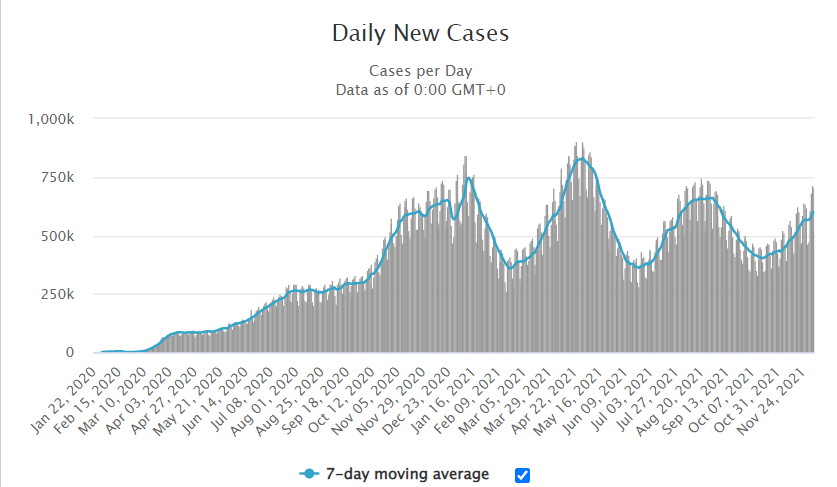
COVID-19 New Daily Cases, excerpted from Worldmeters
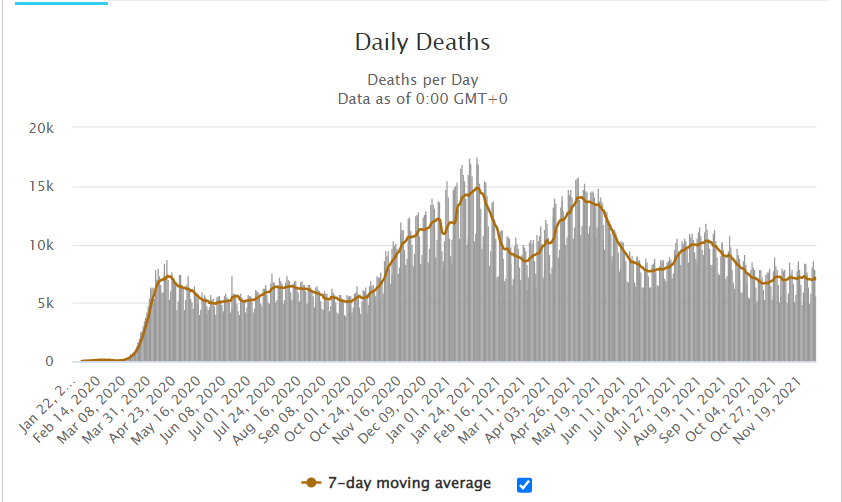
COVID-19 New Daily Cases, excerpted from Worldmeters
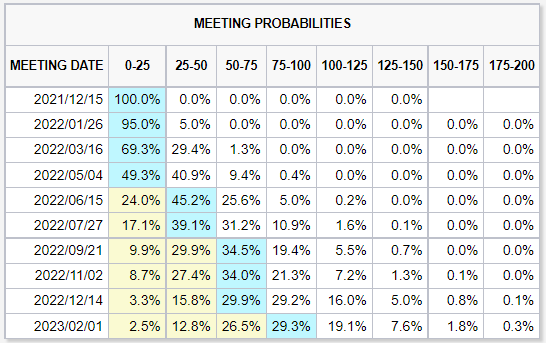
Chart Analysis
USD Index (Daily)
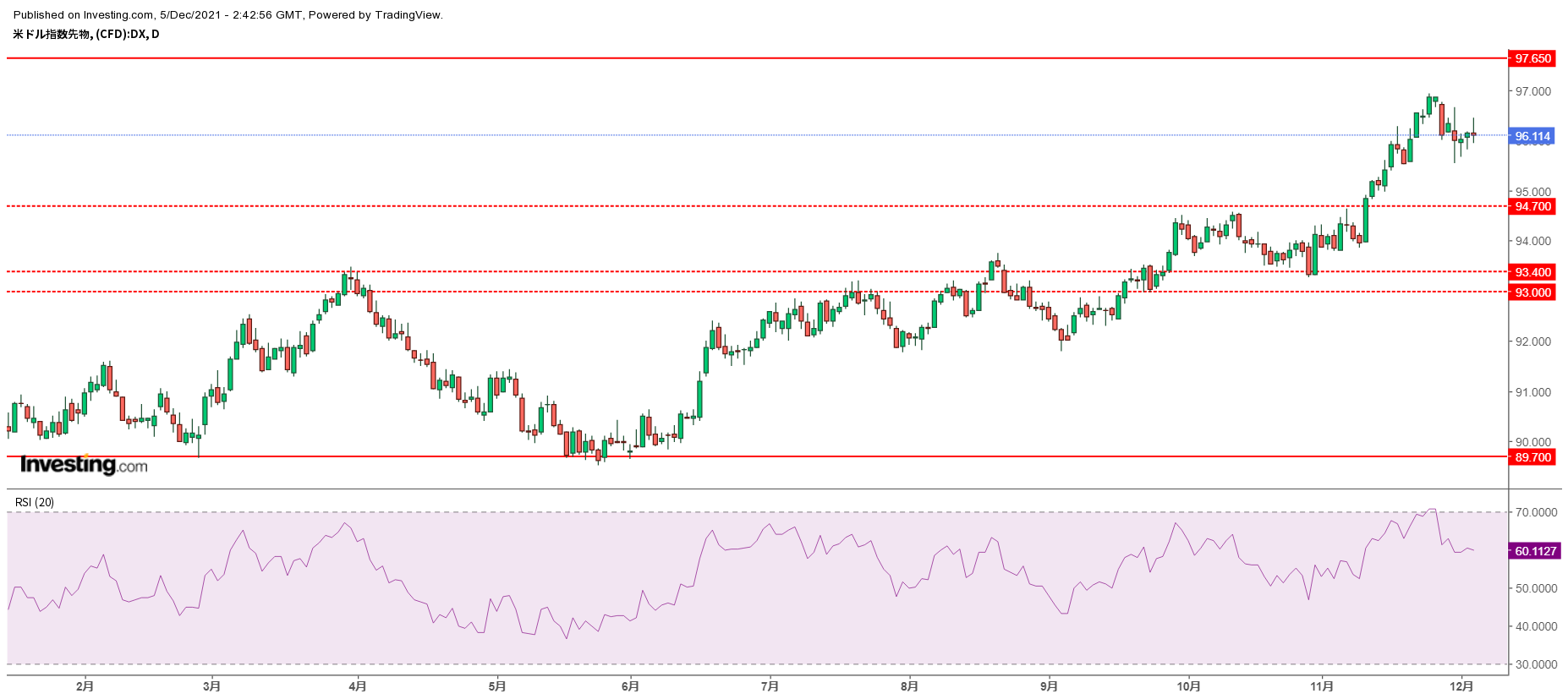
- Dollar Index is an indicator of the overall strength of the dollar (basket composition: EUR 57.6%, JPY 13.6%, GBP 11.9%, CAD 9.1%, SEK 4.2%, CHF 3.6%)
- The index has briefly rebounded near 97.00, pulled back to around 95.50, and has returned to the mid-96s
- There is still no sign that the dollar’s strength will reverse dramatically
USD/JPY Medium-Term (Daily)
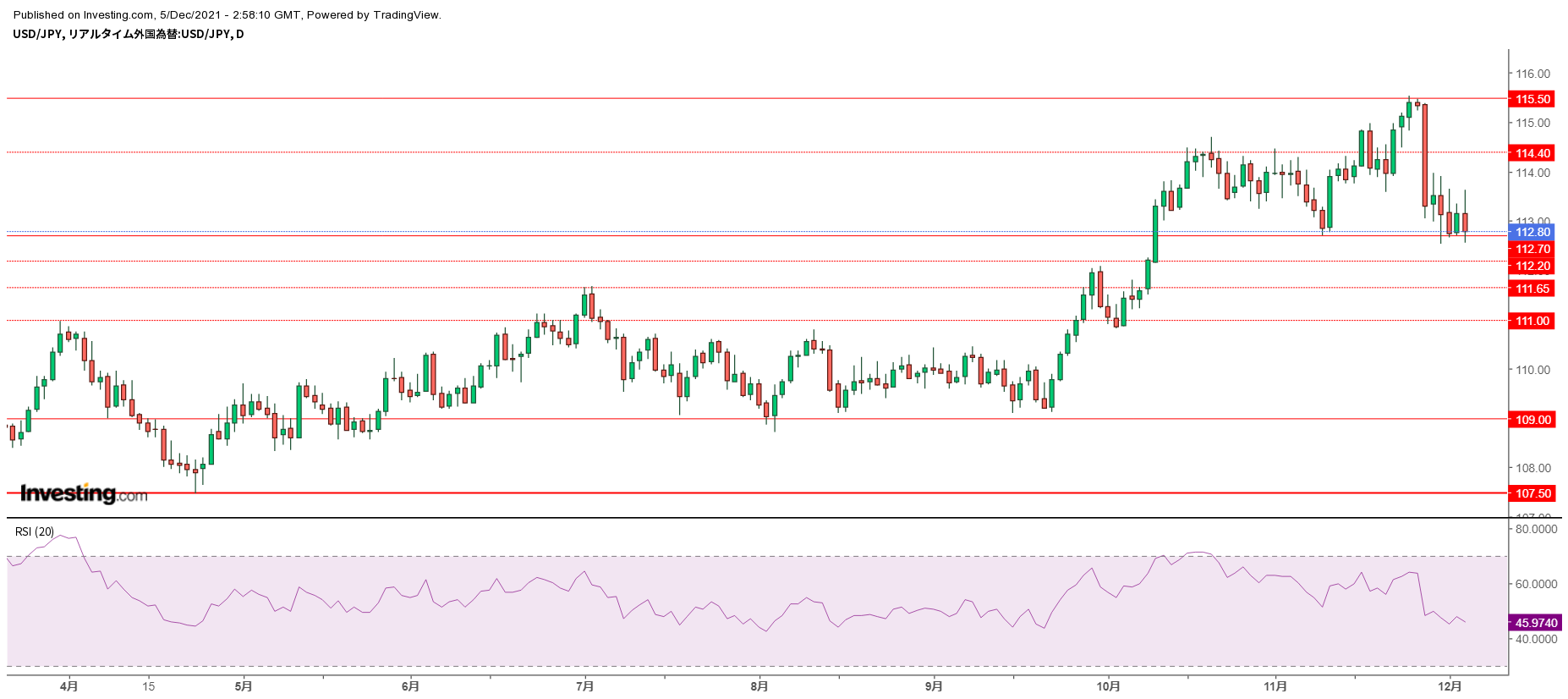
- If it falls, the key levels to watch are the midpoints 112.25, between the firm floor of 112.70 last week and 109.00, and the 115.50
- If 112.25 is clearly broken to the downside, consider exiting long positions in the medium term
USD/JPY Short-Term (Hourly)
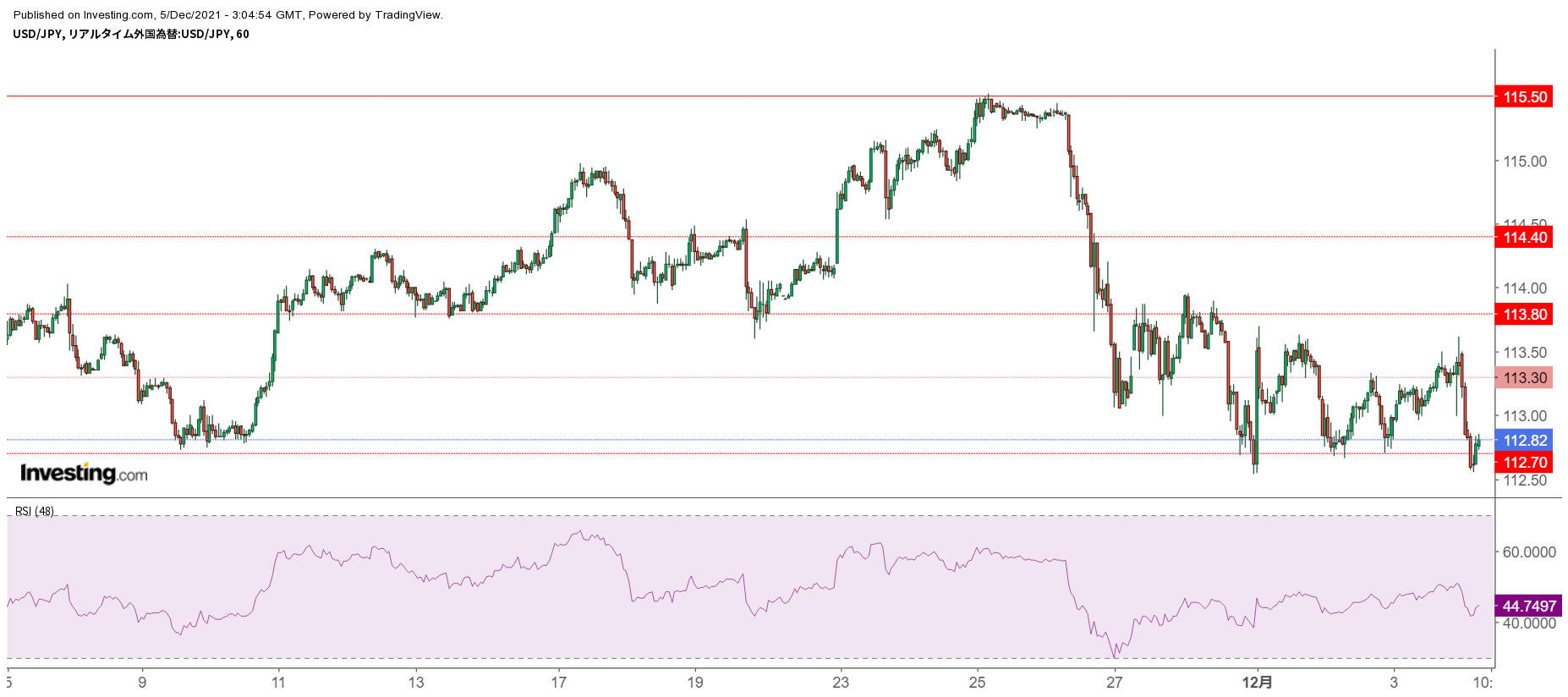
- Downward pressure is strong; watch for a break below 112.70
- Pay attention to whether 112.25 holds as support
EUR/USD Medium-Term (Daily)
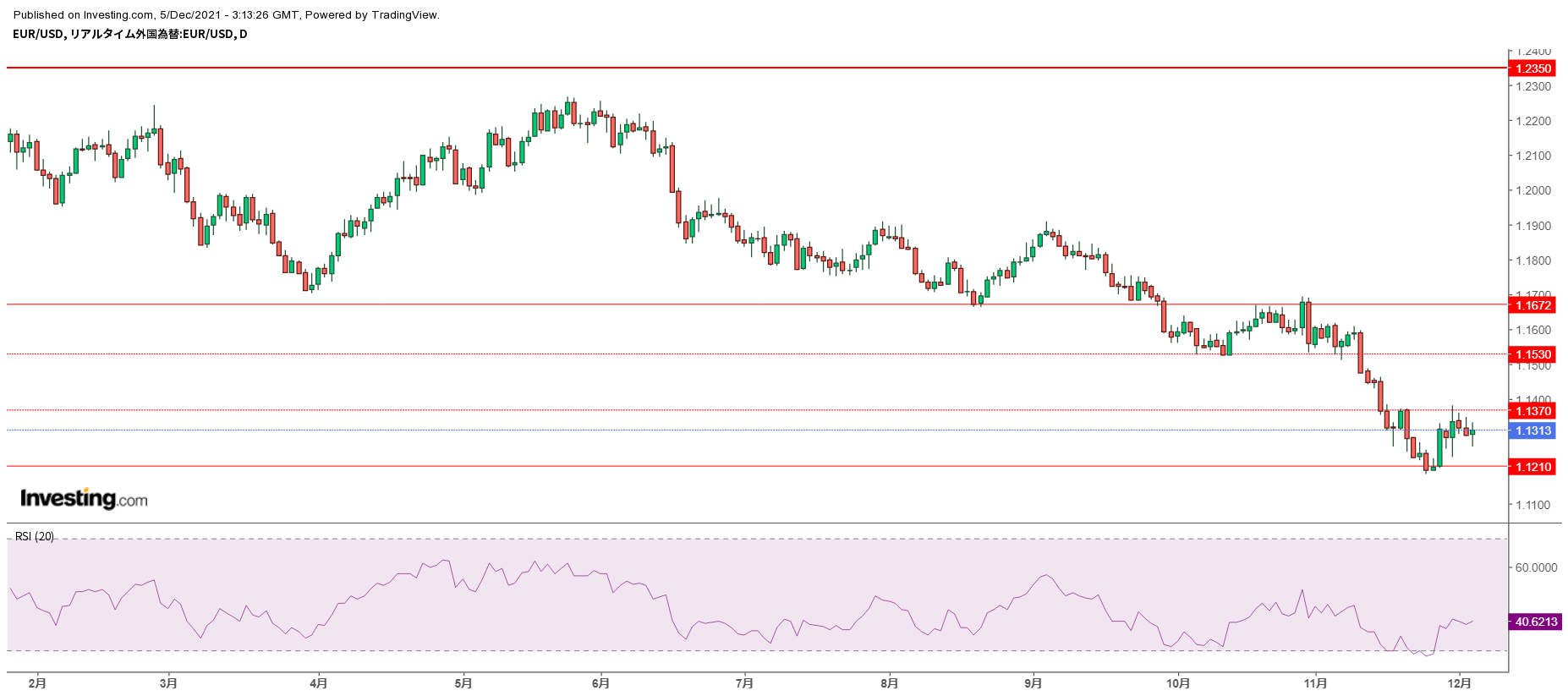
- Rebound from the June 2020 low near 1.1210 appears to have been contained
- Fibonacci retracement at 1.1370 is acting as resistance as the pair falls
- The downtrend seems likely to continue testing support
EUR/USD Short-Term (Hourly)
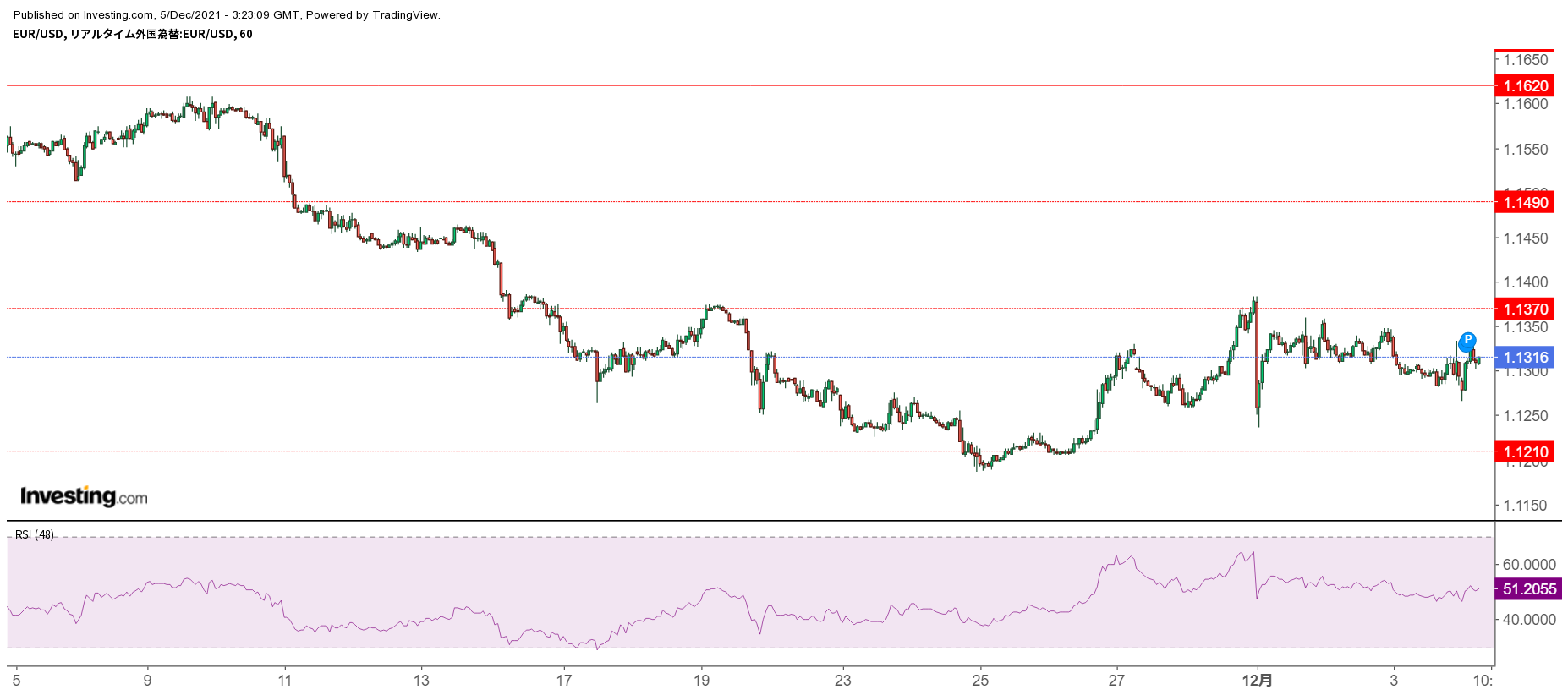
- Sell-on-rallies could improve performance
USD/CNH Medium-Term (Daily)
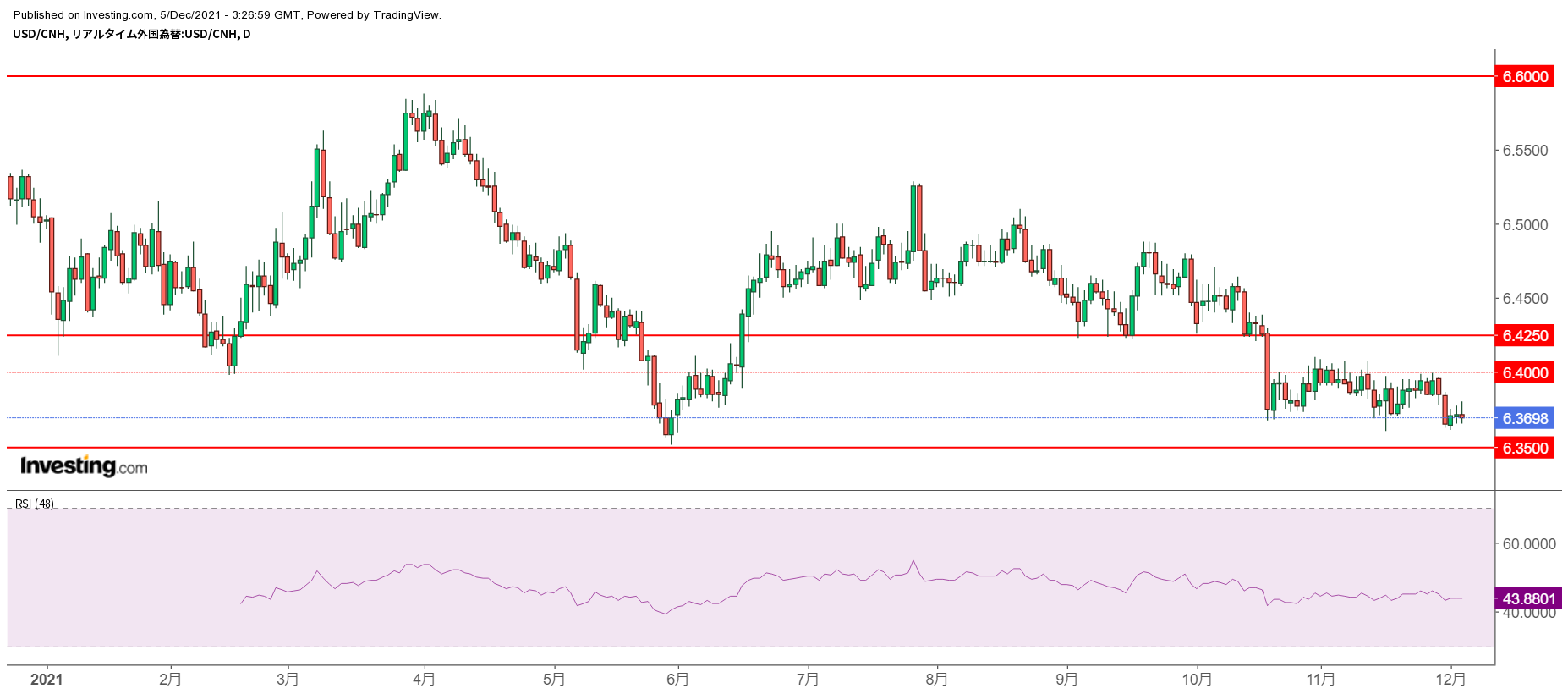
- The range 6.3500–6.4250 remains in effect
- Within the range, 6.40 is a notable resistance
- From the chart alone, the yuan appears to be strengthening
USD/CNH Short-Term (Hourly)
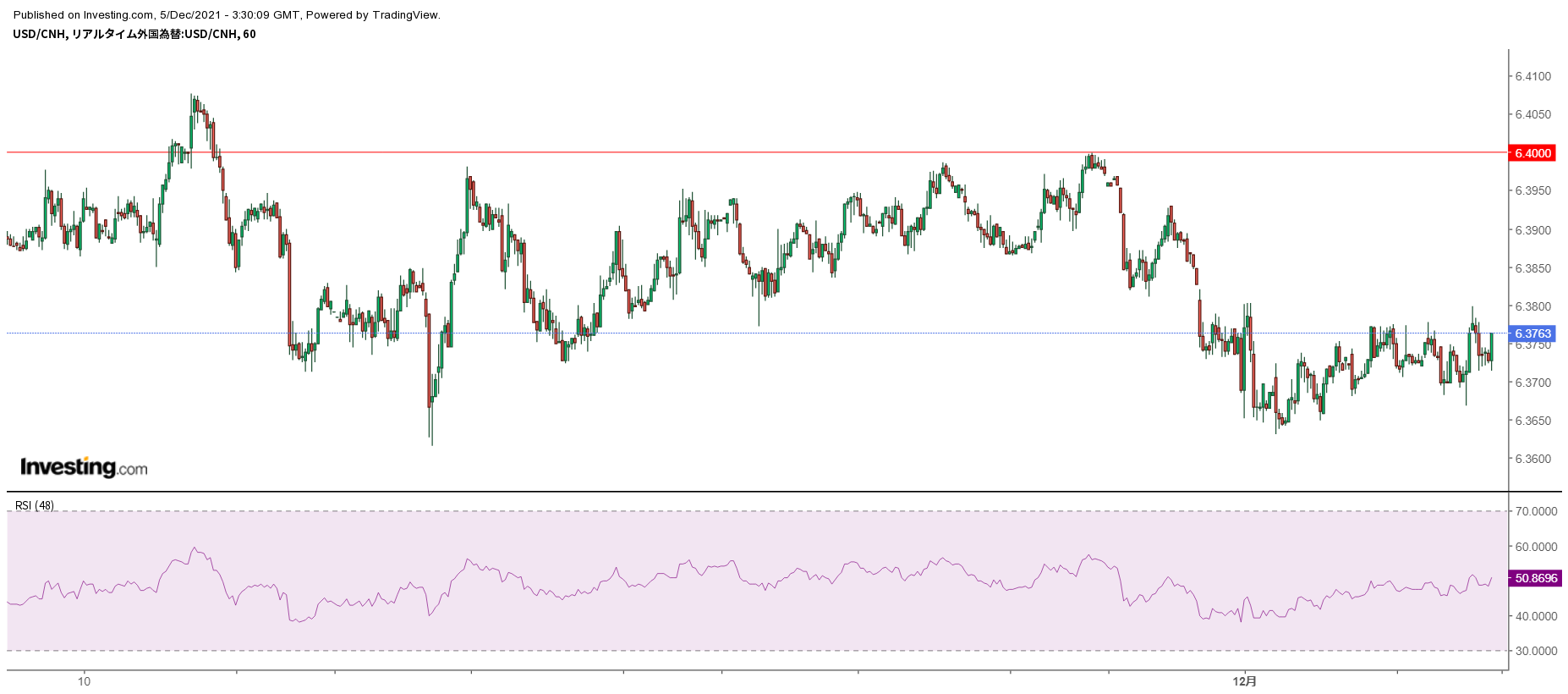
- In the short term, a rebound-selling approach around 6.38 seems viable
This Week's Todo/Toda’s Trading Strategy
Overall Policy
- Prepare for volatile markets by reducing positions
- Early in the week, yen buying leads; after that, monitor Omicron’s impact and decide
- Maintain a strategy of selling into rallies for the euro
- However, do not rely on excessive risk-off expectations; be prepared to move with markets
USD/JPY
- Last Friday's close: 112.80
- View: range-bound to slightly lower
- Estimated range: 112.20–113.30 (assume as a core range; a break below or above may signal a change in direction)
- Current position: USD/JPY flat
- In the medium-long term, a bullish bias exists, but for this week, initiating selling at least at the start is prudent
- Volatility is high up and down; plan to place tight stops and take profits in small increments
EUR/USD, EUR/JPY
- Last Friday's close: EUR/USD 1.1313
- View: EUR/USD range-bound to down; EUR/JPY slightly down
- Projected range: EUR/USD 1.1210–1.1370
- Current position: EUR/USD ±0, EUR/JPY ±0
- Around 1.13, lean to selling; around 1.12, favor taking profits
CNH/JPY, USD/CNH
- Last Friday's close: USD/CNH 6.3698
- View: USD/CNH flat, CNH/JPY flat
- Estimated range: USD/CNH 6.3500–6.4000
- Current positions: USD/CNH ± 0.0, CNH/JPY +3.0
- First thing Monday, close positions and monitor fresh COVID news
- There are reports of potential high-angle reserve rate cuts, which could ease yuan buying
- If yen selling continues, we would straightforwardly buy USD/JPY
Subscriber-Only Discord Invite Code
Please apply via the URL below
Note: Please align the registered name with your GogoJungle nickname
Important Notice
Unauthorized reproduction or copying of any content appearing in this email magazine is prohibited. This newsletter is created for information purposes only, and its accuracy is not guaranteed by us or the information providers. The contents may change due to shifts in economic conditions, and users should rely on their own judgment and consult professionals in law, accounting, or taxation for individual matters. If the user incurs any damages from using this information, we and the information providers do not bear liability regardless of the cause.