Trade strategy considering the absolute level of U.S. interest rates and key dollar chart points from October 4 to October 8
Last Week's Foreign Exchange Range (Volatility Range)
| Open | Low | High | Close | Change | |
|---|---|---|---|---|---|
| USD/JPY | 110.69 | 110.53 | 112.08 | 111.05 | +0.33% |
| EUR/USD | 1.1724 | 1.1562 | 1.1728 | 1.1594 | ▲1.11% |
| EUR/JPY | 129.82 | 128.54 | 130.49 | 128.75 | ▲0.82% |
| USD/CNH | 6.4593 | 6.4260 | 6.4801 | 6.4332 | ▲0.40% |
| CNH/JPY | 17.1394 | 17.1072 | 17.3297 | 17.2540 | +0.67% |
Last Week's FX Market Summary
USD/JPY
- Last week's USD/JPY moved from 110.69 to start. In the early week, driven by the prior week's trend of a stronger dollar and weaker yen, it briefly broke through 111 on Tuesday. Ahead of the Liberal Democratic Party leadership election on Wednesday, there were some pullbacks from position adjustments, but afterward dollar strength and yen weakness accelerated again,surpassing the year-to-date high of 111.66 and breaking through 112. Thereafter, movement hovered around 112, but heading toward the London fixing on Thursday the 30th, end-quarter balance trades favored selling dollars and buying yen.The dollar/yen dipped again below 111 on the back of this, but regained strength toward weekend and closed at 111.05.
EUR/USD
- The euro started at 1.1724 per euro against the dollar. With dollar strength in mind, euro selling and dollar buying dominated from the week’s start. It gradually declined, fell below the implied 1.1670 level, and plunged to around 1.1600. At month-end another dip pushed it to 1.1563 briefly, before a gradual rebound. The week closed at 1.1594.
USD/CNH
- The yuan started at 6.4712 per dollar. Early in the week, dollar buying and yuan selling remained dominant, pushing into the 6.48 range. In the latter part of the week, as U.S. yields declined, dollar selling and yuan buying gained—pushing the dollar below 6.43 at times. Despite various Chinese concerns, the yuan held firm and finished at 6.4342.
What Happened Last Week
Note: Price indexes and money statistics are year-on-year; GDP is quarter-on-quarter; indicators without special notes are month-on-month or that month’s figures27th
- U.S. August Durable Goods Orders: ▲0.1%
- In Germany's federal election, the center-left Social Democrats (SPD) won narrowly. The race to succeed Chancellor Merkel, who served 16 years, is expected to hinge on SPD front-runner and Finance Minister Olaf Scholz.Coalition negotiations to secure a majority are focused, with a three-party coalition becoming likely.
28th
- July Case-Shiller U.S. Home Price Index: +1.48%
- U.S. September Consumer Confidence: 109.3
- September Richmond Fed Manufacturing Index: ▲3
29th
- Euro-area September Consumer Confidence: ▲4.0
- Euro-area September Economic Confidence: 117.8
- U.S. August Existing Home Sales: ▼1.8%
- U.S. Weekly Crude Oil Inventories: +4.578M barrels
- Liberal Democratic leadership election held; Kishida Fumio elected as new LDP leader
- Leaders of Japan, the U.S., and Europe participated in an ECB-hosted Forum on the European Central Bank; discussions highlighted concerns over supply chain blockages hindering economic recovery. The three central banks except Japan are pursuing exits from extraordinary monetary easing implemented during the COVID period, but uncertainties remain.
- China's real estate giant, Evergrande Group, announced it would sell 19.93% of its subsidiary Shengjing Bank. Sale amount about 9.9 billion yuan (about 170 billion yen).State-owned enterprise Shengyang Shengjing JinKong Investment Group in Liaoning province to buy.
30th
- Japan August Industrial Production: ▼3.2%
- China September PMI (Manufacturing): 49.6
- China September Caixin PMI (Manufacturing): 50.0
- Europe August Unemployment Rate: 7.5%
- U.S. Initial Jobless Claims: 362,000
- U.S. Q2 GDP (Preliminary, annualized): +6.7%
- U.S. Q2 PCE (Chained, annualized): +6.5%
- Chicago PMI: 64.7
- In relation to COVID-19 policies,emergency declarations in 19 prefectures and a full lifting of “priority measures to curb the spread” in eight prefectures
- Congress Democrats postponed a vote on a $1 trillion infrastructure bill.Progressives in the party argued they would not support the infrastructure bill until the $3.5 trillion plan for family and social programs passes. Meanwhile, centrists concerned about fiscal expansion pressed to scale back the $3.5 trillion proposal,causing internal party wrangling.
- The UN Security Council held a closed emergency meeting after North Korea conducted a missile test, claiming to have tested an “hypersonic missile” capable of speeds over five times the speed of sound, making radar tracking and intercepts extremely difficult.
- President Biden signed a continuing resolution passed by Congress to avert a lapse in government funding, effective October 1, thus avoiding a government shutdown.
1st
- China & Hong Kong—National Day holiday period (mainland holiday through 7th)
- Japan August Unemployment Rate: 2.8%
- BOJ Q3 Outlook for Economic Activity (Overall) for large manufacturing: 18
- Eurozone September Harmonized Index of Consumer Prices (HICP): +3.4%
- U.S. August Personal Consumption Expenditures (PCE Deflator): +4.3%
- U.S. September University of Michigan Consumer Sentiment: 72.8
- U.S. September ISM Manufacturing Index: 61.1
- It became known on the 1st that the Biden administration is considering imposing bank-like stringent regulations on issuers of stablecoins, a type of cryptocurrency backed by fiat currencies, to stabilize value.
- Rent rises across U.S. cities. According to Zillow, the national average monthly rent in August was $1,787, up 9% from two years earlier before the pandemic. This is attributed to economic reopening with increased office returns and a housing supply shortage driving rents higher.
- In China, measures to raise electricity tariffs are spreading.In the southern Guangdong province, peak pricing will be raised by 25% due to higher demand in hot weather. Zhejiang province near Shanghai will also raise peak pricing in mid-October, mostly affecting factories.
Glossary of Economic Terms
- GDP = Gross Domestic Product; high growth is considered positive
- CPI = Consumer Price Index; many advanced economies target around 2%
- PCE = Personal Consumption Expenditures; closely linked to consumer prices
- PPI = Producer Price Index; influences CPI
- PMI = Purchasing Manager Index; 50 is the baseline
- ZEW = Leibniz Centre for European Economic Research; 0 is baseline
- NAHB = National Association of Home Builders; 50 is baseline
- New York Fed Manufacturing Index: 0 is baseline
- Philadelphia Fed Manufacturing Index: 0 is baseline
- Richmond Fed Manufacturing Index: 0 is baseline
- Chicago PMI: 50 is baseline
- University of Michigan Consumer Sentiment Index: indexed with 1966=100
- S&P/Case-Shiller Home Price Indices are widely used, especially the 20-Ccity Home Price Index, important for assessing housing-related economic conditions
- Housing Permits Index: accounts for contracts signed but not yet settled or closed
- European Consumer Confidence Index: index with 2000–2020 average set to 100; release is month-to-month
- European Economic Sentiment: index with 2000–2020 average set to 100; release is based on actual figures
- Consumer Confidence Index: index with 1985=100
- Japan's Economic Trend Index: index with 2015=100
- Japan’s Economy Watchers Survey: 50 is baseline
- Japan Corporate Sentiment Survey: 0 is baseline
Key Economic Indicators and Political Events
4th
- China Holiday (National Day to 7th)
- Eurogroup Finance Ministers Meeting
- 08:50 Japan September Monetary Base (YoY)
- 23:00 U.S. August Durable Goods New Orders (MoM)
5th
- 08:30 Tokyo Metropolitan Area Consumer Price Index (September)
- 12:30 RBA Policy Rate Announcement
- 21:30 U.S. August Trade Balance
- 23:00 U.S. September ISM Non-Manufacturing Composite
6th
- Hong Kong Chief Executive Carrie Lam delivers Policy Address
- 10:00 RBNZ Policy Rate
- 18:00 Eurozone August Retail Sales
- 20:00 MBA Mortgage Applications
- 21:15 U.S. September ADP Employment
7th
- 14:00 Japan August Coincident Index
- 20:30 ECB Governing Council Meeting Minutes
- 21:30 U.S. Initial Unemployment Claims
8th
- 08:30 Japan August Balance of Payments & Current Account
- 13:30 India RBI Policy Rate
- 10:45 China September Caixin Services PMI
- 14:00 Japan September Economic Watchers Survey - Current Assessment DI
- 21:30 U.S. September Employment Report
- 21:30 Canada September Employment
- 23:00 U.S. August Wholesale Inventories
And Next Week
- Oct 27–28: BOJ Monetary Policy Meeting
- Oct 28: ECB
- Oct 30–31: G20 Summit
- Nov 2–3: FOMC
- Dec 14–15: FOMC
- Dec 16: ECB
- Dec 16–17: BOJ Policy Meeting
- Jan 17–21: Davos Conference
This section from here on (“Last Week's Currencies by Strength/Weakness,” “Global Macro Environment Overview,” “Chart Analysis,” “This Week's Toda Trading Strategy”) is a paid article
Last Week's Currency Strength


- The dollar remains dominant(Value of currencies in 154 of 196 countries fell)
- Cross-yen results were mixed depending on the currency(target currencies are selectively chosen)
- Although the Mexican peso raised rates by 0.25bp, it fell sharply. The cause is unclear, but production activity may be disrupted, such as Mazda's Mexico plant halting operations due to semiconductor shortagespotentially being restrained.
- The yuan remains at the lower end of its range
- In summary, currency strength/weakness is as followsRMB > USD > JPY > EUR > Mexico and other emerging markets
Global Macro Environment Overview
- Regarding the default of real estate giant Evergrande Group, market attention remains high. Asset sales are advancing, and near-term interest payments are expected to be made. While a deterioration in the real estate market is plausible, the impact may remain limited.
- Global attention is focused on China’s power shortage. Historically, factories pause operations around the National Day, but even accounting for that, coal imports from Australia have halted. HoweverChina accounts for about half of the world's coal production, so even with reduced imports, control is likely achievablein the end.
- China-related information often contains unverified or sensational content, so it should not be taken at face value; nevertheless, investor sentiment is unlikely to improve immediately.(Temporary declines in Chinese stocks and yuan as risk-off signals)
- Nevertheless, fundamentally, these two issues are likely to be overcome(Expecting a shift from risk-off to risk-on)
- Furthermore, the PBOC’s stance of supporting the financial markets has been positively received.(Risk-on factor)
- Global semiconductor shortages remain severe. Japanese automakers are increasing inventories, and in China mobile phone manufacturing is becoming more difficult, indicating macroeconomic impacts. Such phenomena contribute to higher semiconductor prices and cost inflation for products,driving global inflationary pressures.
- As a result, global producer prices stay high, squeezing corporate profits and applying downward pressure on stock prices.(Bearish stock factor)
- Inflationary pressures have led the latest FOMC to suggest an earlier completion of tapering. The dollar continued to rise last week.
- The decline in U.S. stocks is a concern. We will determine in the session whether it reflects a mere correction or if it factors in China-related and global supply chain adjustments that imply medium-to-long-term weaker growth.
- The key lies in the COVID-19 containment and the impact of supply chain changes, and the resulting prolongation of U.S. monetary easing.
- New COVID-19 cases continue to decline(The attached chart Daily New Cases shows a seven-day moving average trending downward)
- Investors see the U.S. monetary policy outlook as tapering decision and announcement in November, with rate hikes beginning in the second half of 2022 as the consensus.(Rate hike outlook centers on December 2022)
- Market participants’ rate-hike expectations are slightly lagging(about a one-month delay versus last week). This reflects broadly turning U.S. economic indicators.(Dollar weakness factor)

COVID-19 new case numbers, excerpt from Worldometers

Chart Analysis
USD Index (Daily)
- The Dollar Index indicates overall strength of the dollar (basket composition: EUR57.6%, JPY13.6%, GBP11.9%, CAD9.1%, SEK4.2%, CHF3.6%)
- Dollar strength pushed above the 93.4 resistance
- Watch whether it breaks above 94.7
USD/JPY Medium-term (Daily)

- Bars broke above 111.00 and even surpassed the YTD high of 111.65, reaching the 112 range, but then retreated
- Whether 111.00 becomes support is in focus
- Further upside would require stronger U.S. economic data
- Better to be cautious about chasing highs
USD/JPY Short-term (Hourly)
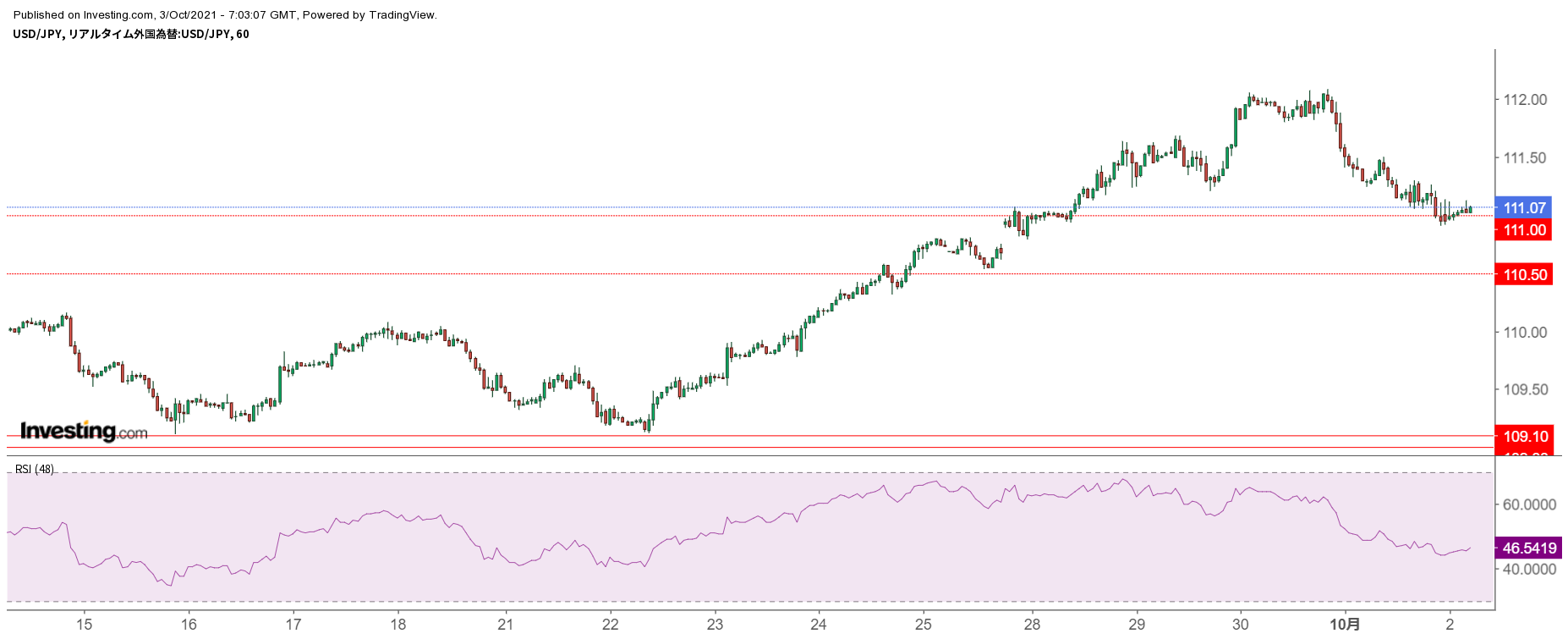
- From 109.10 the move rose, reversing at 112.10 (a rise of about 3 yen)
- A 1-yen pullback to 111.10, and a 0.5-yen pullback to 110.60, suggests buying on dips around this zone could work
EUR/USD Medium-term (Daily)

- Broke through the 1.1630 support
- Lacking immediate support, the chart suggests further downsidelikely continuation of the decline
EUR/USD Short-term (Hourly)

- 1.1600 may act as resistance
- Target for a rebound is around 1.1670
USD/CNH Medium-term (Daily)

- Broad range seen as 6.35–6.60
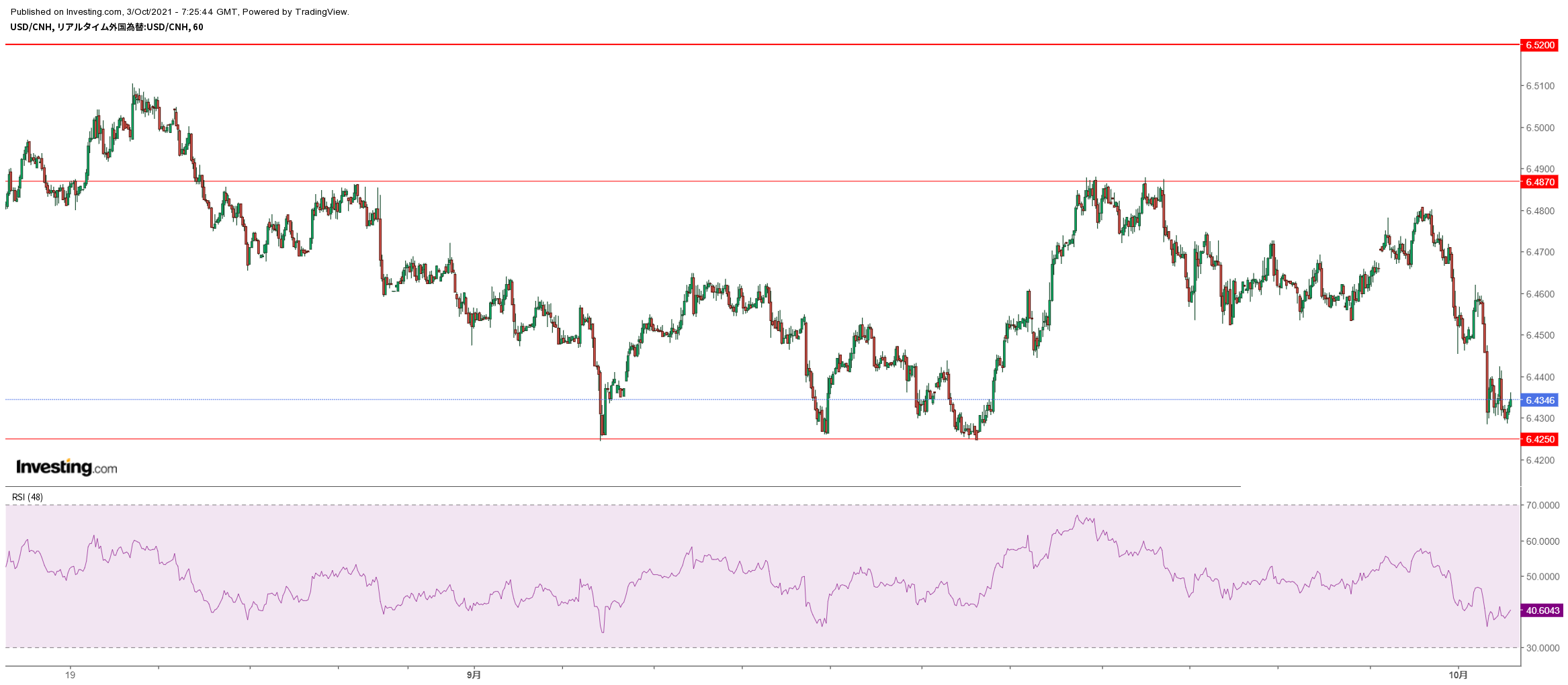
- Recently, around 6.4250 has been a support
USD/CNH Short-term (Hourly)
- Core range is 6.4250–6.4870
- Breaking 6.4250 opens a path to 6.35
This Week’s Togata Trading Strategy
Overall Policy
- Keep a close eye on global stock market trends and detect risk-off signals early(Be cautious of risk-off)
- Assume limited room for U.S. rate rises; refrain from easy dollar buys(Dollar buying on dips)
- Anticipate a longer period of Japanese monetary easing,leading to yen selling
- Consider domestic weakness from U.S.-China tensions and power struggles for the yuan(Not likely to collapse drastically, but stay wary of China-related headlines)
- Euroshows a major chart breakout, so sell euros first. However, with improving economic indicators, don’t sell Euro on weak data alone.
USD/JPY
- Last Friday’s close: 111.05
- Bias: sideways to up
- Expected range: 110.50–112.20
- Current position: USD/JPY around zero
- Strategy: start with small dollar buying early in the week, then buy the lower 110s and sell in the upper 111s
EUR/USD, EUR/JPY
- Last Friday’s close: EUR/USD 1.1594
- Bias: EUR/USD down, EUR/JPY sideways
- Expected range: EUR/USD 1.1470–1.1670
- Strategy: start with selling EUR, cut losses if it moves above 1.1600. If above 1.1630, add to shorts.
CNH/JPY, USD/CNH
- Last Friday’s close: USD/CNH 6.4332
- Bias: USD/CNH sideways, CNH/JPY sideways to upside
- Expected range: USD/CNH 6.4000–6.4870
- Current positions: USD/CNH ± 0.0 CNH/JPY +3.0
- Strategy: with National Day in mind, refrain from aggressive USD buying/selling. Monitor USD/JPY and take profit on high-yen positions. In declines, consider adding CNH/JPY
- to buy more CNH/JPY
Subscriber-only Discord Invitation Code
Please apply from the URL below
Please align the registered name with your GogoJungle nickname
Important Notes
Unauthorized reproduction or reprinting of any content in this newsletter is prohibited. This newsletter is created solely for information provision, and its accuracy is not guaranteed by us or the information provider, and the contents may change due to changes in economic conditions. Use the information at your own risk and consult professionals in law, accounting, and tax for individual matters. If users incur damages from using this information, we and the information provider shall not be liable for compensation regardless of the cause.