

What is the principle of Elliott Wave formation
Hello!
Satori here, researching FX.
Today, I have examined the principles for the validity of the Elliott Wave pattern.
Based on the idea that when taking action one should perform an N-shaped entry that reflects the price highs and lows being raised and lowered, I will introduce a case using “MT4 Non-repainting arrows and email alerts N-shaped entry indicator.”MT4 Non-repainting arrows and email alerts N-shaped entry indicator
Generally, there are three principles for the validity of the Elliott Wave pattern.
This time, since USDJPY is in a downtrend in the near term, we will apply the principles to the decline.
Principle 1: In a down move of waves 1, 3, and 5, Wave 3 is never the shortest.
Principle 2: There is no rise in Wave 2 that fully cancels the fall of Wave 1.
Principle 3: Wave 4's rise does not exceed the bottom price of Wave 1.
Let's verify the recent market!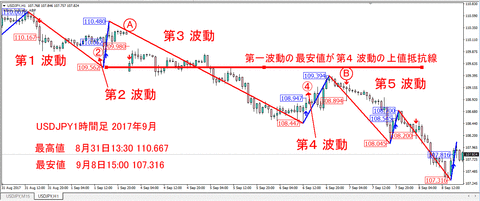
The figure above applies Elliott Wave analysis to USDJPY 1-hour in the downtrend from August 31 to September 8.
The chart's high price, the start of Elliott Wave 1, is at the upper left on August 31 at 13:30, 110.667 yen,
The chart's low price, the current end of Elliott Wave 5, is at the lower right on September 8 at 15:00, 107.316 yen.
The price range is 3.351 yen.
Now, let's look at Principle 1!
Principle 1: In the down moves of Waves 1, 3, and 5, Wave 3 is never the shortest.
If we consider the recent movement as Wave 5 being in progress, it is the assumption that the down move has not yet finished.
Wave 1: 110.667 − 109.562 = 1.105
Wave 3: 110.667 − 109.562 = 2.033
Wave 5: 110.667 − 109.562 = 2.078
For the minor waves of Wave 5, I think the idea of an Extension, adjusting for deformation and extension to remove noise, is acceptable.
As shown above, Wave 5 is longer than Wave 3, so Principle 1 is cleared.
Next, let's examine Principle 2.
Principle 2: There is no rise in Wave 2 that fully cancels the fall of Wave 1.
Wave 1 fell from a high of 110.667 to a low of 109.562 by 1.105, then rose to 110.480 by 0.375, forming Wave 2.
In Wave 2, the high price is 0.187 yen lower than Wave 1's high of 110.667, before turning down to 108.447 for Wave 3, thus satisfying “Principle 2: There is no rise in Wave 2 that fully cancels the fall of Wave 1.”
Finally, let's look at Principle 3.
Principle 3: Wave 4's rise does not exceed the bottom price of Wave 1.
Wave 4 rose from Wave 3's low of 108.447 by 0.947 to 109.394.
Wave 4's retrace high of 109.394 did not exceed Wave 1's bottom at 109.562.
Therefore, the third principle is also satisfied.
Timing for N-shaped and inverted N-shaped entries based on Elliott Wave is determined by two points.
Point A: Confirmation of a reversal to Wave 3, derived from Principle 2 (no Wave 2 rise that fully negates Wave 1).
Point B: Confirmation of a reversal to Wave 5, derived from Principle 3 (Wave 4 rise does not exceed Wave 1 bottom).
For Principle 1, since Wave 5 needs to form to some extent, the actual N-shaped and inverted N-shaped entry timings are two points: Point A and Point B.
Point B, where Wave 4 did not exceed Wave 1 bottom and turned downward toward Wave 5, provides a clearer condition.
Of course, if you can draw a scenario, you can enter early, enter late, or pyramid based on Points A and B as you see fit.
Now, in August 2017 there was a similar downtrend that lasted about a week.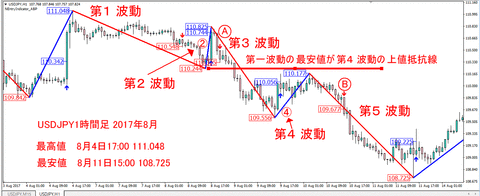
The figure above applies Elliott Wave analysis to USDJPY 1-hour from August 4 to August 11.
The chart's high price, start of Wave 1, is August 4, 17:00, 111.048 yen,
The chart's low price, end of Wave 5, is August 11, 15:00, 108.725 yen.
The price range is 2.323 yen.
The August decline should be easier to fit into Elliott Wave, so please check the three principles.
Generally, line trading is based on this Elliott Wave principle: “Principle 3. Wave 4's rise does not exceed Wave 1 bottom.”
If you divide Wave 1's bottom support line (the red horizontal line) by Wave 3, the support line for Wave 1's bottom becomes the resistance for Wave 4.
In line trading, this is called a roll change.
Note: The red horizontal line in the figure above is automatically drawn as a dotted line in the latest version of the N-shaped entry indicator and will notify you by email.
In a buy scenario, Wave 4's down move does not fall below Wave 1's high, reverses upward, and forms Wave 5.
If you reverse at the upward turn, you have a higher probability to ride Wave 5 with an N-shaped entry.
Technical Trade Blog Ranking