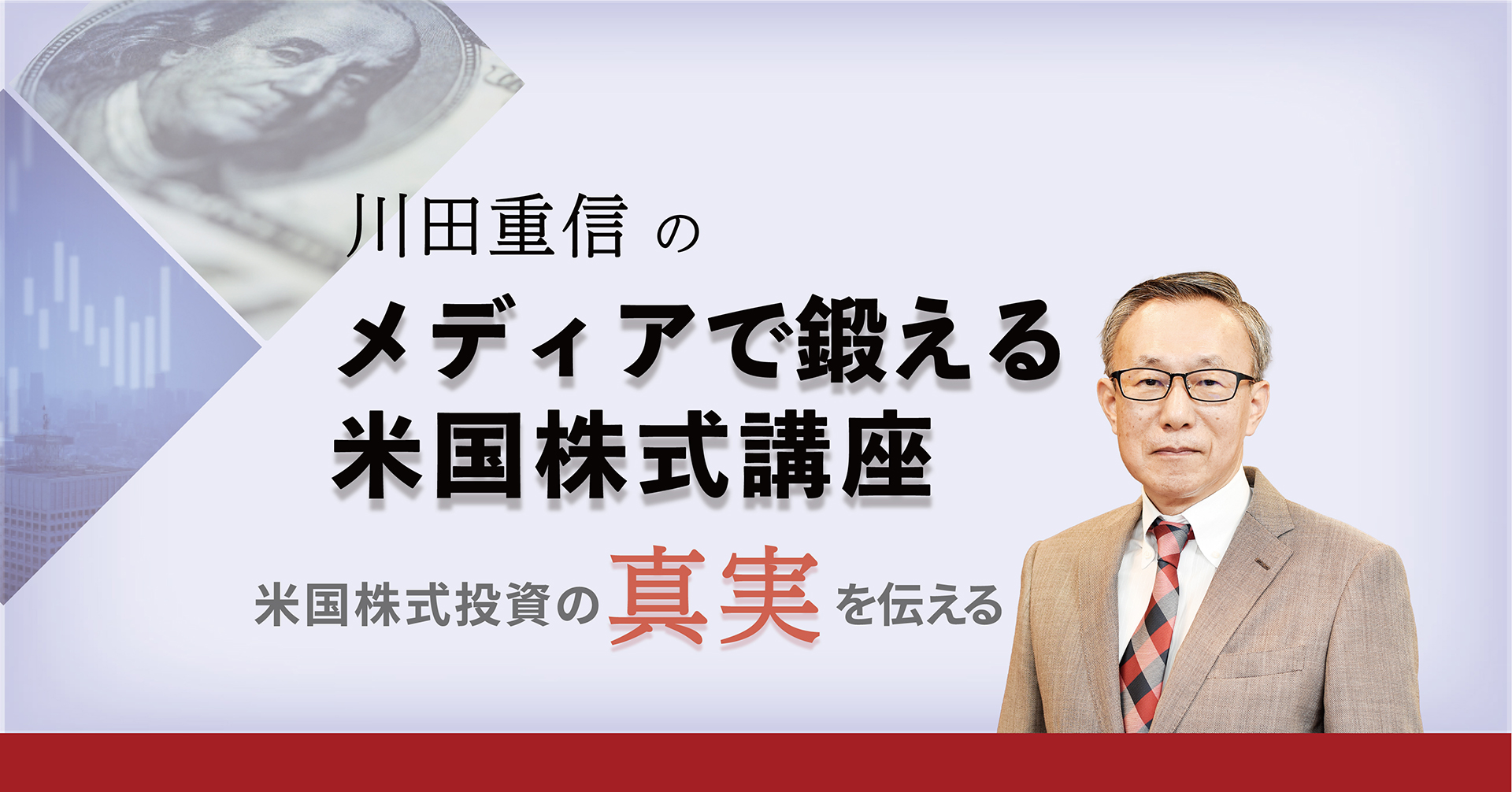
Truth about U.S. stock investment conveyed by Shigenobu Kawada in "Training American Stocks through the Media" [Vol.8] distributed July 26, 2021
Given the following: 〓〓〓〓〓〓〓〓〓〓〓〓〓〓〓
Delivering the truth about U.S. stock investing
Shigenobu Kawada's "Training in U.S. Stocks through the Media"
[Vol.8]Distributed July 26, 2021
〓〓〓〓〓〓〓〓〓〓〓〓〓〓〓
*** Table of contents ***
Market recap
This week's straight truth!
This week's selected articles
Investment tips
Kawada's stroll
Activity information
Q&A corner
■□■□■□■□■□■□■□■□■□■□■□■□■□■□■□■□■□■
1. Market recap (July 19–July 23)
<Major indices>
・Dow Jones Industrial Average 1.1%
・S&P 500 Index 2.0%
・Nasdaq Composite 2.8%
= Quick version =
Concerns about a renewed spread of the coronavirus causing economic slowdown led to heavy selling on Monday, but expectations were surpassed by earnings results, and buying returned; the three major indices hit new intraday highs and closed at their highs on Friday.
= A little more detail =
Fears of the global economy peaking early due to the Delta variant of the coronavirus led to a sharp drop on Monday, following the trend in Asia and Europe. From Tuesday onward, as longer-term yields fell, growth stocks, especially tech, were bought, and better-than-expected earnings results supported a rebound. Although initial jobless claims rose unexpectedly and some declines occurred, strong results from airlines and consumer-related stocks offset worries about the economy. Next week's major IT earnings were anticipated, and the market extended gains on Friday, with the Dow Jones reaching above 30,000 for the first time, and the S&P 500 and Nasdaq also reaching all-time highs for the week.
Stock price table

S&P 500 Index past 1 year, daily

■□■□■□■□■□■□■□■□■□■□■□■□■□■□■□■□■□■
2. This week's Straight Truth!
A section delivering information you should know.
Many investors were surprised by last Monday's plunge in the U.S. market. The Nikkei newspaper even ran a chart noting that the drop was about the largest in approximately nine months.
One way to describe stock market movements is: "riding up an escalator, but going down a freight elevator." When prices rise, it is gradual; when they fall, they can drop all at once. Look at the Nikkei chart above and you can see that pattern.
However, the reason for the decline was worries about economic deterioration from the Delta variant of the coronavirus. Since this had been noted here to some extent, the decline was somewhat anticipated, and a much larger and longer fall did not seem likely.
Whether good or bad, what moves markets are surprises and unexpected factors. Materials that were anticipated do not cause big short-term market swings, and many unexpected factors are negative, so most trajectories trend downward.
Conversely, good material is already anticipated, so there is no surprise, but gradually it is priced in over time. Essentially, U.S. corporate fundamentals overall tend to rise, so you eventually find yourself higher up the floors.
Next week, the outcome of the Federal Open Market Committee (FOMC) policy decision on July 28 will be released, but given that the previous decision had a mild surprise, this one may be a non-event. The advance estimate of Q2 GDP will be announced on the 29th, and high growth is already priced in; only if the number is unusually high and inflation fears rise would there be a surprise.
More importantly, next week's earnings reports. In particular, on Tuesday the 27th, Alphabet (Google's parent), Apple, and Microsoft will report. The market values of these three companies are all among the top five globally, with a combined market cap of about $6.4 trillion. A 1% move would translate to over ¥6.5 trillion in value, which is substantial.
Finally, this week's Barron's noted that the fifth Friday in July tends to be a lower day. Think about it: the fifth Friday is always end-of-month, and “weekend + end-of-month + earnings-season peak” means not many buyers. From this, it seems the summer trading period will likely remain somewhat light.
■□■□■□■□■□■□■□■□■□■□■□■□■□■□■□■□■□■
3. This Week's Picked Articles
A column that selects and ranks information useful for asset formation from what I found, and comments with my very personal views.
【1】Nikkei NewspaperPost-COVID Investment: Brace for Turmoil, Focus on Bonds and Dollar-Denominated Products7/24
This article is about individual investors constructing their asset management. The article highlights three points and recommends diversification.
① Diversification of financial products
② Regional diversification
③ Dynamic review of asset allocation among financial products
There are many individual investors with differing circumstances, but above points are unnecessary for those who can earn the main income (e.g., employed workers) for a while.
As I have repeatedly said, regional diversification can be achieved with S&P 500 ETFs or index funds, and if you have ongoing earnings from your main job, basically all financial assets should be in US stocks (risk assets) except for the funds you plan to keep for future needs.
Nevertheless, for seniors, diversification of financial products and adjusting their ratios might be necessary. However, the article references the allocation of the Government Pension Investment Fund (GPIF): “Hold domestic bonds, foreign bonds, domestic equities, and foreign equities at 25% each, which yields a 20-year return of 3.61% and is solid.” But 3.61% is too low, and following GPIF does not guarantee no losses.
Even for individual investors, with a bit of study you can see that this reasoning is flawed. The author has a basic misunderstanding of the market.
What exactly is wrong with this article? What is the rightful path to asset formation? The quickest way is to watch my videos and learn. If you have questions afterward, please ask. I will answer them in this newsletter as well.
【YouTube Live Seminar】Emergency Seminar
Retirement funds and FIRE too! How to grow money in the US market
【Seminar Video】Asset-building techniques that leverage the US economy
【2】Nikkei NewspaperAmerican Dream, Now a Distant Past? Becoming Wealthier than Parents Is Difficult7/19
No matter the origin, a person can become wealthier than their parents through effort and talent. This has been the engine of freedom and capitalism that underpins US development. However, the article notes that the “American Dream” is now shaky.
Recently, one solution often proposed is “relocation support.” Among 18–29-year-olds, the percentage living with their parents is at a 120-year high, and those who move out have a lower probability of surpassing their parents’ income by age 30. The migration rate has dropped since 1990, hitting a 2020 low of 9.3%.
Relocating to better areas increases lifetime earnings; some states have started relocation support. It is estimated that children who move to better regions see their lifetime earnings rise by 8.4%. A founder of a hedge fund has funded a project offering free robust internet access to help young people pursue growth paths. The belief is that digital divides are decisive for youth.
Reading this article, I think the foundation of the American Dream is not merely meritocracy but equality of opportunity. To correct inequality and promote equal conditions, both government and private sectors need to act. This sense of justice upholds democracy. Equality of opportunity rather than outcome matters here.
For many immigrants, the United States is still a land where dreams can be realized, and helping the next generation step forward to break the cycle of poverty is part of the American way. From this perspective, the concepts of equality, justice, and democracy as pillars of the capital markets can be seen. The capital markets provide a space where everyone can realize their dreams and exercise “freedom of how to live.”
【3】Nishi-nihon ShimbunDelta variant worsens... US vaccine skeptics turn to vaccination urges7/23
“As the Delta variant spreads in the United States, some Republican leaders and conservative media are urging vaccination more actively. Many GOP supporters believe anti-vaccine conspiracy theories, which has hindered vaccination efforts.”
I found the article's content while reading FT (Financial Times) titled Republications urge supporters to embrace vaccines in abrupt shift of tone. Of course, Japanese is quicker to read, so I searched in Japanese, but at the moment only Nishinippon Shimbun hit.
Now, the GOP leaders who were once staunchly anti-vaccine have begun issuing messages encouraging vaccination. Senate Republican leader Mitch McConnell reportedly warned on the 20th: “If you remain unvaccinated, by autumn we could face a repeat of last year's disaster.”
I want you to read the article; however, the GOP’s stance on vaccination is truly foolish and insane. Politicians who oppose vaccination may understand the vaccine's effects but have political motives. A politician should possess high humanity, yet sometimes that appears as ignorance and cruelty in arrogance.
Even in this vaccine debate, it is difficult for democracy to prevail in the US. Meanwhile, despite Japan's high literacy rate and deep understanding of international affairs, many feel their voices are not reflected in national policy.
Speaking of which, during this vaccine turmoil, the food, leisure, and travel industries have suffered greatly, yet protests have not occurred. You know how other countries look in the media. Or perhaps there is some “candy” being distributed that the media in Japan does not report?
In such moments, I feel Japan also needs “anger.” It has been a long time since Japanese people openly express anger. We should more openly challenge the injustices of this world. But perhaps that emotional energy is being drained somewhere?
【4】Nikkei NewspaperUS companies, Q2-Q2 earnings near record highs; IT fuels profits, consumption recovering7/23
US corporate earnings for Apr–Jun are becoming fully reported. Analysts expect operating profit to be more than 40% higher than a year earlier, likely hitting a record. The pace of record-high profits is expected to continue into Q3 and beyond, but with costs rising (e.g., wages, materials) and the spread of a highly infectious variant, the recovery may face headwinds.
IT giants are expanding profits. Apple's iPhone sales are strong, with profits rising about 50%. Alphabet's internet ad revenue is expected to double profits. Across the US, the economy is reopening, service-related and consumer spending rebounding quickly. Walmart, Disney, and McDonald's are also expected to see 80–90% higher profits year over year.
On the other hand, Walmart's CEO cited rising raw material costs, labor shortages, and logistics bottlenecks as concerns. PepsiCo's CFO indicated margin pressure from higher logistics and material costs and planned price increases. GM warned that steel and resin costs could weigh on profits in the second half.
The article's content seems unusual, but consensus projects that second-quarter results will yield about 66% higher profits year over year once all are out. AndWeekly US Stock Outlook notes in its table on page 7 that high growth is expected to continue through next year.
Why do US companies consistently deliver such strong earnings? It seems to me that they invest heavily in growth, cut unnecessary costs (i.e., labor costs), and prioritize share buybacks. Still, maintaining this growth rate is extraordinary. That’s why US equities should not be sold.
【5】Nikkei NewspaperThe Shock of GX (4) Shareholders’ Meeting Questions on Climate Policy: Green Money Moves the World7/22
Environmental NGOs are entering shareholder meetings to push corporate actions. Investors behind this pressure are large asset managers; NGOs cooperate with them. An NGO leader states, “Rather than pressuring governments to address climate issues, stopping funds flowing to fossil fuels is the faster path to carbon neutrality.”
The close collaboration between environmental groups and investors is drastically changing the flow of investment. From January to May 2021, decarbonization investments surpassed fossil fuels. A senior executive at a major US bank says, “With more extreme weather due to global warming, companies have a responsibility to solve this problem, and finance must accelerate it.” Green money is pushing investors to scrutinize companies for decarbonization, and it is natural for individual investors to consider the impact of decarbonization on corporate performance along with ethical considerations.
Therefore, investors may turn to funds focusing on decarbonization or ESG (environmental, social, governance). However, if you have a special interest in ESG and prioritize values over profits, such funds are an option. Yet the S&P 500 index comprises companies selected from broad criteria; if those companies face warming-related risks, they will strive to address them, and companies that do not address them will eventually be淘汰ed by the market.
Thus, by investing in passive funds like S&P 500 ETFs or index funds, individual investors become providers of “green money.”
■□■□■□■□■□■□■□■□■□■□■□■□■□■□■□■□■□■
4. Investment Tips
This column covers not only “investment methods” and “stock ideas” but also “indicators and statements that catch my eye” and “movements in society and politics.”
■ Is index investing a cheat?
Recently there has been much discussion about index funds. This matters for Japanese household asset formation. There was also an article in Nikkei on July 19 titled “The Dangers of Passive Investing Erodes Markets.”
“Passive management” has expanded, and the share of passive management in stock funds rose to 44% by the end of 2020. The article questions whether this distortion is causing problems.
■ Active management or analysts riding along?
What problems are being pointed out?
① Index funds buy according to predefined ratios, causing certain stock values to be inflated or reflected inaccurately.
② If passive becomes the majority, the market’s price discovery function could be eroded.
That would reduce the number of analysts and fund managers who discover a company’s intrinsic value, harming market efficiency.
③ Passive funds maintain their holdings unless funds exit, so the stocks they hold may become quasi-stable holdings. Could this reduce market liquidity and disadvantage investors?
Supporters of active management criticize these points. On the other hand, responses include:
① Passive investing buys and sells according to fixed ratios; individual stocks are not artificially pushed up or down.
② Even if passive holds a majority, it does not mean company information is not reflected in prices. The task of active investing is about depth, not just quantity. Creator of index funds, John C. Bogle, noted that even if passive is 5% or 10%, the value discovery function remains effective.
③ The idea that passive investments create fixed stock holdings like cross-holdings is incorrect. Cross-holdings are kept for policy reasons, but stock fund investors do not operate the same. They compare with other assets, decide, and sell, causing capital outflows. With current fund managers’ dynamics, engagement with companies and voting rights can occur, just like in the US, where engagement is common and may involve exercising voting rights.
■ We must dispel misunderstandings
In short, objections raised by active managers to index investing appear reasonable at first glance but are largely misunderstandings.
Also regarding point ②, my view is as follows. In lectures I used to say that S&P 500’s performance is superior because selection criteria are stringent, and companies that fail to meet them are excluded by the index—survival of the fittest. This is not necessarily true. A long-term comparison of S&P 500 vs. total US stock market shows similar performance. Compare the past decade of Vanguard S&P 500 ETF (VOO) and Vanguard Total Stock Market ETF (VTI); their performance is nearly identical.
What does this tell us? Simply put, the outperformance of the S&P 500 is not because of selective survival with strict criteria. VTI may include many companies with little analyst coverage, indicating that in the US stock market, market forces purge or select publicly listed companies as shown by VTI.
■ The smart ones are not analysts or active managers
More importantly, the presence of countless retail investors, corporate managers, and serious investors who strive to realize a company’s intrinsic value through mergers, acquisitions, and divestitures keeps a generally efficient market—the cleansing of the market, so to speak.
In other words, the collective intelligence of diverse stakeholders may measure a company’s value better than any single analyst or manager. Don’t you think?
VTI
Holds all US stocks across market capitalizations. Targets the entire US equity market. Holds over 3,500 names and weights by market cap.
VOO
Aims to track the performance of the S&P 500 index. Primarily holds large US stocks. Invests in all S&P 500 constituents and periodically reweights holdings by market cap weights.
Relative chart of VTI vs VOO over roughly the last 10 years

■□■□■□■□■□■□■□■□■□■□■□■□■□■□■□■□■□■
5. Kawada's Walk
◇◇My Recently Favorite Store◇◇
About a year and a half ago, I started going to the gym on weekdays. I exercise in the park on weekends, and I feel off if I don’t stretch on weekdays. So I looked for a gym near my home, and there indeed was one. Since then I went about twice a week, but after COVID-19 the gym closed several times, so visits dropped. Recently I started going again.
At this gym, after using each machine you must disinfect the equipment with disinfectant. Of course I follow the rule.
However, not long ago, by sheer coincidence, I forgot the disinfection routine once. A guy a few meters away noticed my slip and gave me a sharp warning. I immediately bowed and apologized, then harshly blamed myself and scrubbed the equipment for about 20 seconds (not really). I even thought, “Is this enough? My lord!” I’ve been reprimanded by younger people recently.
I must have forgotten before, but I doubt I’ve done it more than 100 times. This person noticed it so quickly; his antenna is keen.
I don’t care about others’ slips. I’ve had both doses of the vaccine. I don’t think it’s necessary to over-sanitize, and why should I help clean up? (I don’t have the courage to say that.) If I forget, most germophobic Japanese will scrub it, and if I protest, it would be scary.
Also, the younger folks around us seem to be going out to drink and potentially spreading infection more than seniors. So the likelihood that gym instructors and young users roam nightlife is higher than us (at least I won’t assume).
In short, if you keep things clean and don’t go out to crowded venues without vaccines, you don’t need to be so nervous.
When I glanced at that brother's disinfection work, he was remarkably gentle with the equipment. Was he thinking I was watching? He’s not a soft person; he truly does it. I could never do that. Come to think of it, at home I still rough-house the tub and sometimes forget to turn off lights and fans.
But unless it’s work, I’m not as sharp in policing others’ mistakes. It’s scary to watch, honestly.
However, people who constantly nitpick others’ mistakes are odd, aren’t they? People may be snoring loudly at home and disturbing others, dozing off on the train, loudly slurping while eating, or spilling sauce on their ties when they go out. It’s human to unintentionally upset others. We can’t be so intolerant; it has degraded Japan’s stock market, perhaps abruptly. I can’t do that to others, so I’ll just be more careful with disinfecting in the future!
■□■□■□■□■□■□■□■□■□■□■□■□■□■□■□■□■□■
6. Upcoming Activities
◇August 4 (Wed) 11:00 AMStock Voice
◇August 10 (Tue) 10:15 AMNikkei CNBC
■□■□■□■□■□■□■□■□■□■□■□■□■□■□■□■□■□■
7. Q&A
Questions (Summary)
Kawata-san has been telling beginners of US stocks to buy ETFs. I found that in the US, the major ETFs are S&P 500 ETF (ticker SPY) and Nasdaq-100 ETF (QQQ).
On the other hand, Tokyo Stock Exchange also has similar ETFs: an ETF matching the S&P 500 with code 1557, and one for Nasdaq-100 with code 1545.
Which should I invest in? What are the advantages and disadvantages?
Answer
There are no major differences, but the following points are advantages/disadvantages.
① Overseas SPY and QQQ settle in USD, so when converting yen to USD, fees arise.
② SPY and QQQ reflect the market and their prices change in US market hours, whereas Tokyo's market hours generally do not. They display around the previous day's close price converted to yen. Therefore, if you intend to buy and sell during trading hours (day trading), SPY or QQQ are the only options.
③ Related to ②, Tokyo ETFs may have lower liquidity and wider spreads from market makers, which can disadvantage price.
④ Tokyo ETFs, in yen, have standard tax treatment like usual Japanese stocks. NISA support is generally fine.
⑤ Expense ratios are slightly lower for SPY or QQQ, but the actual difference is not large.
⑥ For Tokyo ETF, if volume becomes too low, delisting could occur, but SPY or QQQ do not have this risk.
That is all. The risk of delisting is unlikely for the current 1557 or 1545.
Conclusion: fees are not much different, so for non-day-trading, such as through NISA or regular savings, the Tokyo market (TSE ETFs) seems preferable for less hassle.
───────────────────────────────────
★ Please read the following【Question Rules】 before asking a question.
Please email info@kawata-magazine.com.
【 Question Rules 】
◆We cannot answer all questions. Please understand in advance.
◆Questions may be published on our site, YouTube videos, SNS, books, etc. in a non-identifying form.
◆We will not respond to questions from non-subscribers.
◆Advertisement or promotional content may be omitted.
◆We will take appropriate measures against those who post malicious questions without subscribing.
───────────────────────────────────
★ Disclaimer
◆Our newsletter does not provide buy/sell recommendations for stocks, bonds, funds, ETFs, or sectors. Investment decisions are the subscriber’s responsibility, and we do not provide guarantees.
◆We do not guarantee damages incurred by subscribers using our newsletter.
◆We are not responsible for disputes between subscribers or between subscribers and third parties arising from information in this service, including violations of law or public order, defamation, insult, privacy invasion, threats, harassment, or slander.
◆If the content of this service infringes the rights of subscribers or third parties, or if disputes arise from such infringements, we bear no responsibility.
◆We shall not be liable for any damages arising from suspension or termination of this service or changes to its content.
───────────────────────────────────
■ Publisher: Hibiya Technology Finance, Inc.
■ Kawata Shigenobu's Thank You, America Stocks
https://www.kawataamekabu.com/
■ Twitter:https://twitter.com/ShigenobuKawata
■ For feedback, requests, or to unsubscribe, click here
【Email】info@kawata-magazine.com
■ If you don’t receive emails, they may be classified as spam; please check in advance.
───────────────────────────────────