

Regarding the planned strike price
Hello.
This is Satori, researching FX.
Starting today, we will begin a new serialized category.
The title of the series is "N-shaped Entry Action."
Based on the idea of performing N-shaped entries that emphasize raising highs and lows when taking action, we will introduce a case using "MT4 Repaint-Free Arrows and Email Alerts N-shaped Entry Indicator."
Taking these cases into account, we will create new EAs and reflect them in existing EAs.
This time, we have added a new feature to the “N-shaped Entry Indicator,” and we will introduce examples of the projected bullish price on the USDJPY 15-minute chart, the projected bullish price on the EURUSD 15-minute chart, and the projected bearish price on the GBPJPY 5-minute chart.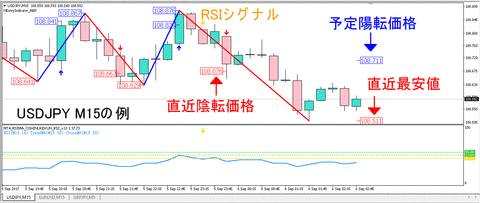
The figure above shows an example displaying the projected bullish price for USDJPY on the 15-minute chart.
The most recent low and bearish price, etc., are displayed by default, including them.
As shown above, even when used together with RSI (sell if 45 breaks, buy if 55 is exceeded), it becomes easier to determine entry timing, take-profit, and stop-loss guidelines.
It becomes easier to make concrete decisions to take action.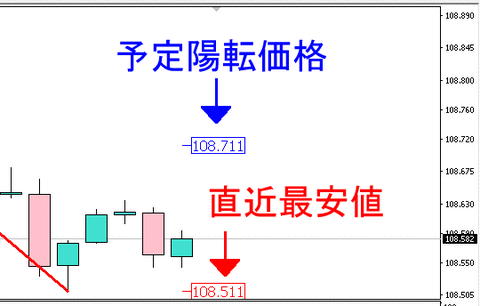
The above figure shows an example zooming in on the USDJPY 15-minute chart with the projected bullish price and the most recent low.
The most recent high and low, and the projected reversal price are displayed to the right of the latest candle.
Past highs, lows, and reversal prices are displayed on the left side of the candles.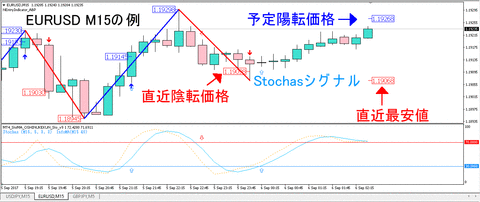
The above figure shows an example displaying the projected bullish price for EURUSD on the 15-minute chart.
The most recent low and bearish price, etc., are displayed by default, including them.
As shown above, when used together with Stochastics (Slow %D 30-70), it is easy to determine entry timing, take-profit, and stop-loss guidelines.
It becomes easier to make concrete decisions to take action.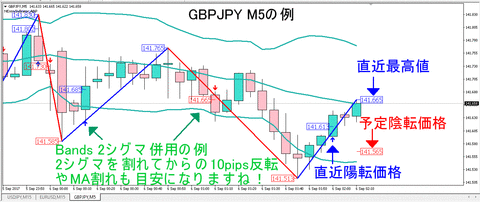
The above figure shows the projected bullish price for GBPJPY 5-minute chart.
The most recent high and bullish price, etc., are displayed by default.
As shown above, it is also easy to determine entry timing, take-profit, and stop-loss guidelines when used with Bollinger Bands.
Entering a counter-trend trade by breaking 2 standard deviations, or entering a sell when the price reverses after breaking the MA in a downtrend, is also an option.
It becomes easier to make concrete decisions to take action.
Indicators related to today’s article are as follows.
Technical Trade Blog Ranking