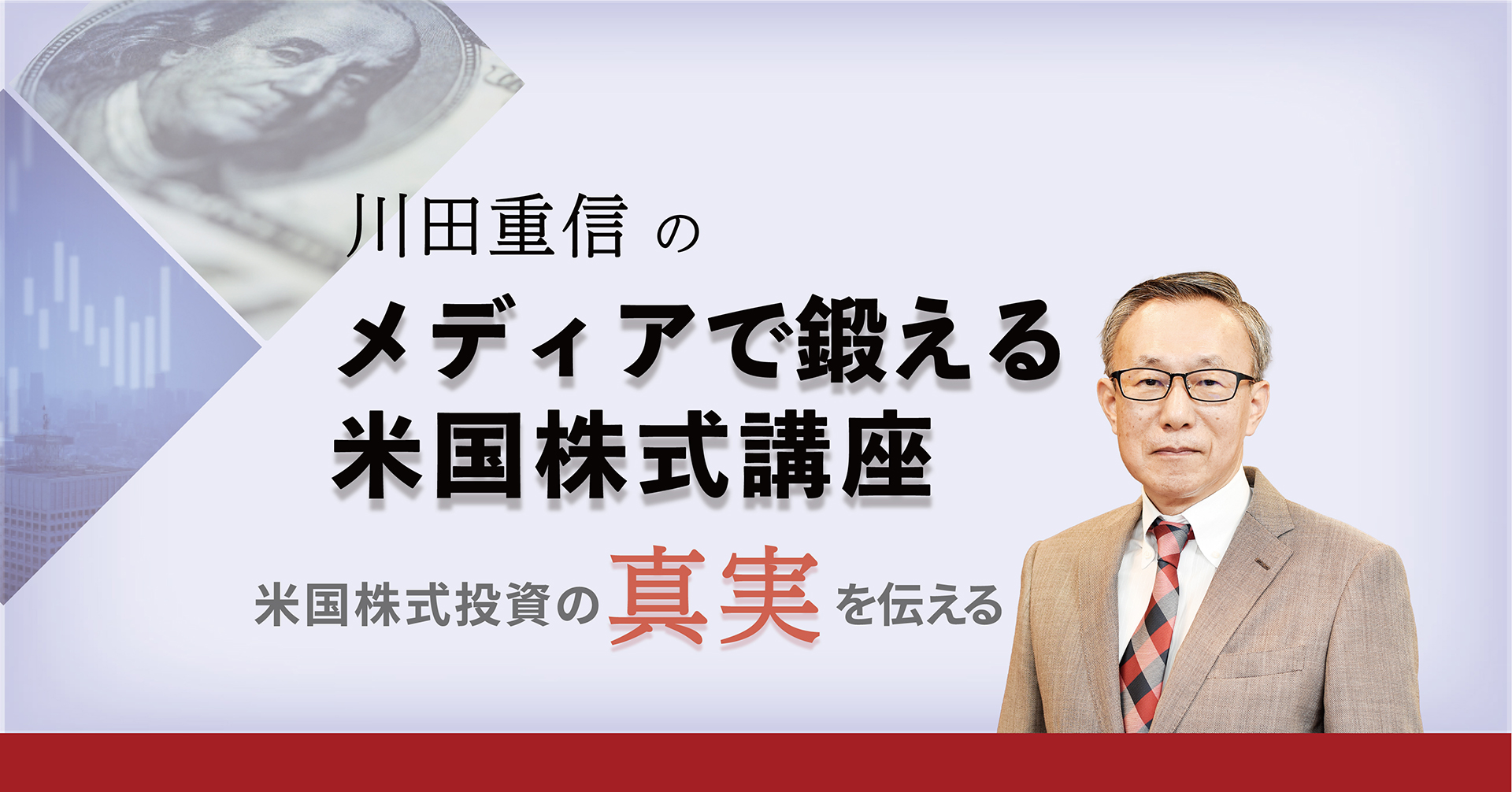
The Truth About U.S. Stock Investment by Shigenobu Kawada: "Training U.S. Stocks via the Media" [Vol.5] Distributed on July 5, 2021
━━━━━━━━━━━━━━━━
The Truth of U.S. Stock Investments
Shigenobu Kawada's "Training in U.S. Stocks Through the Media"
[Vol.5]Distributed on July 5, 2021
━━━━━━━━━━━━━━━━
***Table of Contents***
Market Recap
This Week’s Spotlight!
This Week’s Picked Articles
Investment Tips
Kawada’s Walk
Activity Information
Q&A Corner
■□■□■□■□■□■□■□■□■□■□■□■□■□■□■□■□■□■
1. Market Recap (June 28 – July 2)
<Major Indices>
・Dow Jones +1.0%
・S&P 500 Index +1.7%
・Nasdaq Composite +1.9%
= Fast Version =
Fueled by a favorable combination of falling long-term yields and an improving economy and corporate earnings due to reopening, the S&P 500 reached a new intraday high for seven consecutive trading days from the previous week, and the major three indices closed at all-time highs broadly across the market.
= Slightly More Details =
As inflation fears cooled and concerns about earlier tightening by the Federal Reserve (Fed) eased, long-term yields fell. Overall economic indicators suggested a healthy reopening, supporting the stock market. Semiconductor indices hit new highs midweek, while financials rose on buybacks and related announcements.
The June employment report released at week’s end surpassed market expectations in payroll growth, but the still-small payrolls and a slightly higher unemployment rate kept long-term yields on a downtrend. In the stock market, optimism for the reopening persisted, and in a Goldilocks market where both growth and value seem favorable, the major indices posted record highs. The S&P 500 on seven consecutive trading days of gains marked a record since June 1997.
■□■□■□■□■□■□■□■□■□■□■□■□■□■□■□■□■□■
2. This Week’s Spotlight!
A section delivering essential information you should know.
In June, the U.S. stock market (S&P 500) extended its gain for five consecutive months on a monthly basis, finishing very strongly. On a quarterly basis, it was five straight quarters of gains, with each quarter's rise exceeding 5%, a level not seen since 1954.
As July markets have begun, history shows July has a 56% probability of a gain. The average return is +1.6%, with up moves averaging +4.9% and declines averaging -3.2% when it does rise or fall.
The U.S. markets will be closed on July 4 for Independence Day (this year, July 5 is a holiday). From then until early September for Labor Day, it’s the so-called “summer lull.” However, around July 10, the Q2 earnings reporting season begins, and many market participants may take vacations afterward. Hedge funds are typically less aggressive with positions, and trading tends to be light and the market subdued.
That said, June was quite strong, and after Friday’s payroll data, the market rose as long-term yields fell while good earnings were already priced in. The June FOMC hinted at earlier rate hikes, which may have prompted some investors to rush in to buy on the expectation of rising yields and stock price adjustments. Fund flows remain robust, and the supply-demand dynamics support an upward trend.
Nevertheless, continuing the summer rally is questionable. The market has likely priced in many positives, and with the quarter-end behind us, positions seem balanced between long and short. In other words, with limited upside momentum, the favorable factors such as lower interest rates and strong earnings are already reflected. If yields rise or earnings concerns re-emerge due to any catalyst, a pullback could intensify.
Bold projection: by mid-July, a mild correction is likely. Potential triggers include (1) the June FOMC minutes or inflation data pushing long-term yields higher, (2) Q2 earnings or guidance that, while strong, do not exceed market expectations, (3) renewed concerns about rising COVID-19 cases and a slow pace of economic re-opening in Europe and elsewhere.
However, the current trend is unlikely to break dramatically, and the market may remain in a “high-price volatility” phase. The truly notable event to watch will be the Economic Symposium in Jackson Hole, Wyoming, on August 26–28, where Chair Powell and central bankers overseeing major economies are often invited to indicate future monetary policy directions. Until then, a cautious stance is prudent. For those who have managed to ride the wave so far this year, it may be wise to practice the sensible strategy of occasionally taking a break rather than pushing for more gains.
Major Index Stock Prices Table

S&P 500 Index — Last 12 Months

■□■□■□■□■□■□■□■□■□■□■□■□■□■□■□■□■□■
3. This Week's Featured Articles
A column that selects information useful for wealth building from what I have found, ranks them, and comments from a very personal viewpoint.
【1】Nikkei Newspaper 6/29Trust in government vs. corporate nation-building
The failures of Toshiba and Mizuho Financial Group send a strong message to Japanese companies: “Economies led by government reliance have reached their limit.”
In the preface of the article, there is a recognition that the once-central companies of the "Japan Inc." are faltering. Telecommunications, banking, heavy electricals, and even consumer electronics are affected. Toshiba and Mizuho Financial Group, which have long been the backbone of Japanese industry, are facing scandals. By contrast, industrial robots maker Yaskawa Electric and home furniture giant Nitori Holdings have built up results through their own discretion and effort, with little government entanglement and distant from the policy command centers in Kasumigaseki, thus they are developing healthily as companies.
Regarding these kinds of scandals, my view is as follows. In a homogeneous society like Japan, educational background and hierarchical order by seniority are embedded in many aspects of society. This tendency is said to be stronger in bureaucratic organizations and traditional large Japanese firms. It is evident in the personnel changes section in newspapers and the composition of the Keidanren (Japan Business Federation) top members, which strongly reflect the ranking of Japan's industry.
This kind of authority, collusion, and deference likely translates into numbers and actions that cannot be disclosed publicly for a listed company.
What Japan needs now is organizational reform that shatters existing structures and brings new wind to organizations. For example, top graduates who enter government bureaus or large corporations should leave their organizations during early career to experience a different environment and be sharpened there. If opportunities arise, they should return to similar organizations to test their abilities. Or they should start their own business to provide new added value to society. I believe such a society where these values are socially celebrated is necessary to bring new vitality to Japan. However, can we transform society to recognize these values? Am I the only one who feels that there are chains everywhere in Japanese society that hinder this reform?

【2】Nikkei Newspaper 6/30Customers entrusting funds to “Fund Wrap” intensifies competition
Regional banks under attack as deposits swell
With fund wrap, where customers entrust the management of substantial funds, securities firms and major banks are vying to pitch to regional banks.
Fund Wrap is a product that, after confirming the investment objectives and policies for each customer, provides comprehensive asset management services based on an asset management agreement, including asset allocation, selection of fund investments, and reporting on performance.
This article notes that regional banks are increasingly focusing on selling this product. However, fund wrap has long been criticized as being high in fees. The Financial Services Agency recently noted in a published report that it expects a reconsideration of the products and services offered.
I think not many customers need this product. Yet it might suit those who have little knowledge of markets or products. Depending on the amount, it might be wiser to invest in multiple installments rather than a lump sum. But again, it is not a product you should force yourself to invest in.
【3】Nikkei Newspaper 6/30Outflow of US aging funds as investors seek lower costs; shift to index-tracking funds
“Investors are pulling money from long-established global mutual funds. A study of fund flows from January–May 2021 shows outflows among active U.S. stock funds, especially among older, well-known funds. Even in a rising market, individuals continue to choose low-cost index funds.”
In the U.S., individual investors are shifting from active to passive management because passive funds outperform in terms of performance, efficiency, and cost-effectiveness. Media and advisors actively communicate this truth to investors, who accept it, driving fund flows. I hope Japan will reach this point soon.
【4】Nikkei Newspaper 7/2“Decarbonization” funds proliferate; clearer criteria than ESG; Nomura Asset Management and others select qualifying stocks
Articles on mutual funds investing in firms contributing to decarbonization (electric vehicles, related semiconductor firms, etc.). It mentions Nomura Asset Management's contemplated Japan stock funds and SMBC Trust Asset's world stock funds.
There have long been ESG-themed funds. While Asset Management One's global ESG fund has about 1 trillion yen in assets, this decarbonization-focused approach differentiates by narrowing selection criteria to decarbonization itself. Yet it may simply be a trendy fund setup.
Such investment themes are easy to explain to individual investors, and the theme is currently in vogue, making it easy to understand. But how many companies truly earn profits from the decarbonization theme alone? Funds’ prospectuses often say they will include companies expected to benefit as decarbonization progresses, but in reality, the dominant holdings may be companies for whom decarbonization is only one business among many, with the core business driving stock prices.
As the article concludes, funds tied to trendy themes may enjoy short-term popularity but are prone to decline once the next theme appears. Not long ago, there were robot and AI-related funds, but they are not as prominent now (you hardly see them in newspaper ads).
Even if it is business-driven, how long will such funds created by sellers continue to be produced?
【5】Nikkei Newspaper 7/2, Politics ZoomLong-term strategy, a thinking freeze among ruling and opposition parties
I agree with all of this; here are some favorite phrases:
*In Japan, there is little fundamental ideological clash in economic policy; the dichotomy of conservative vs. liberal is a hollow theory
*Shinzo Abe, former Prime Minister: he reframed the redistribution policies attempted by the former Democratic Party into a name like “All-Generation Social Security.” While foreign and security policy leans to the right, he actively adopted liberal economic policies and won elections.
*Democratic Party for Constitutional Liberalism and other opposition parties: “If you tax less but have no money, how will you spend?” If policies do not align with tax cuts, they are not serious about governing.
*The Liberal Democratic Party has governed for nearly half a century, with a deep understanding of the country’s institutions—“If you knock here, money comes out.”
■□■□■□■□■□■□■□■□■□■□■□■□■□■□■□■□■□■
4. Investment Tips
A column that not only covers investment methods and stock ideas but also discusses intriguing indicators, remarks, and movements in society and politics.
Japanese asset management should not rely only on active mutual funds!
■ Household and private financial assets in Japan and the U.S.
As of the end of March, the balance of financial assets held by Japanese households reached a record high of 1946 trillion yen, up 7.1% year over year. Breakdown: currency and deposits rose 5.5% to 1056 trillion yen; Insurance, pensions, and fixed guarantees rose 1.3% to 533 trillion yen; Stocks and other equities rose 32.1% to 195 trillion yen; Investment trusts rose 33.9% to 84 trillion yen. Investment trust balances reached a record high.〔Nikkei Quick News 6/25Household assets show signs of investment expansion〕
Meanwhile, according to Federal Reserve Board data, household net worth (total assets minus liabilities) was $136.9 trillion (approximately 1.5 quadrillion yen). In Q1, financial assets increased by $5 trillion (about 550 trillion yen), and stock assets alone increased by $3.2 trillion (about 350 trillion yen). In other words, rising asset prices in stocks and real estate have accelerated the rapid growth of household net worth.〔Reuters 6/10 USHousehold assets peak at $136.9 trillion in Q1; room for further growth〕
■ The keys to Japanese wealth formation
① Increased amount of money exposed to market risk
② Control of market risk
These two points are essential to wealth formation, and I will delve into them using examples from US and Japanese fund balances.
■ Top 10 public mutual funds by assets in Japan
This table shows the top ten mutual funds for Japanese individual investors. Among the ten, seven funds focus on high-growth U.S. tech stocks; the fourth, “Pictet Global Income Equity Fund (Monthly Dividend)” focuses on dividend-yielding value stocks; and the ninth and tenth are real estate investment trusts (REITs), also targeting dividends.
Assets under management: The leader, ESG High-Quality Growth Equity Fund (H) is about 1.1 trillion yen; only two exceed 1 trillion yen, while the 10th is around 540 billion yen. The combined total of the top ten is over 8 trillion yen. All ten funds are active funds, where managers decide asset allocation and stock selection and provide regular performance reports; expense ratios are quite high compared with ETFs. (Table 2)
By contrast, even if Japan’s public mutual fund balances have recently increased, they remain around 120 trillion yen; excluding ETFs purchased by the Bank of Japan, they do not reach 80 trillion yen. (Table 1)
■ Top 10 US/Global funds by balance (mutual funds and ETFs)
In the U.S., the top balances are dominated by ETFs and mutual funds tracking the S&P 500 index, totaling about 120 trillion yen. The fourth-ranked VTSAX, the Vanguard Total Stock Market Index Fund, tracks the overall stock market’s returns and has performance close to the S&P 500. From ranks 1–9, totals reach about 290 trillion yen; all are either passive index-tracking funds or ETFs that track broad U.S. equities via the S&P 500 or similar indices, with extremely low fees, making long-term ownership less burdensome.
Note that the 10th, FDRXX, holds about 22 trillion yen, but it is a short-term treasury fund, serving as a safe haven rather than seeking yield. (Table 3)
■ The decisive difference in risk assets between Japan and the U.S.
The gap in fund preferences between Japan and the U.S. is substantial. In terms of the amount exposed to market risk and overall risk, Japanese money clings to far less favorable investment approaches compared with American individual investors. A surprisingly small amount is being invested in high-risk instruments.
If one truly cared about individuals, securities companies should steer toward high-risk active funds more moderately and aggressively promote S&P 500 ETFs or index funds from savings and deposits. Even if clearly the right thing to do, doing so may conflict with the hard-pressed management of securities and asset-management companies, which I believe is the root cause of many issues.
As a result, individual investors must discern the truth and quality of information themselves. That’s unfortunately difficult in reality. If you have questions, please feel free to contact us.
Table 1 Investment Trust Overview/Back Issues

Table 2
Globally, the largest balance is ASEMAN One's “GESG High-Quality Growth Stock F (H no)”


Table 3


■□■□■□■□■□■□■□■□■□■□■□■□■□■□■□■□■□■
5. Kawada’s Walk
◇◇ Vaccination completed◇◇
Last Monday (June 28) completed the second Moderna shot. The first dose caused a slight fatigue the day after; the second dose caused a fever starting the morning after. Since I had decided to work from home on Tuesday, it was convenient. Work wasn’t impossible, but my whole body felt tired. After a late lunch, I lay on the sofa and unintentionally slept.
◇◇ Recent obsession ◇◇
It has long been one of my favorites. I used to be into Haagen-Dazs years ago, but now after meals I unconsciously seek this “Azuki Bar.” This ice popsicle comes in a pack of six. However, I found next to it a single-wlee package of “Hokkaido Azuki Bar” wrapped individually in film. I tried it for the first time; the portion is larger and the red bean content is generous and delicious. I’m not sure I can go back to the paper-pack version now?
■□■□■□■□■□■□■□■□■□■□■□■□■□■□■□■□■□■
6. Upcoming Activities
◇July 4 (Sun) Dentist Seminar
“Wealth Building to Leverage the U.S. Economy”
◇July 6 (Tue) around 8:20 AMNikkei CNBC
◇July 7 (Wed) 11:00 AMStock Voices
◇July 13 (Tue) 8:00 PM Monex Securities Online SeminarHow to build money in your later years and FIRE in the US market?
■□■□■□■□■□■□■□■□■□■□■□■□■□■□■□■□■□■
7. Q&A
Question (Summary)
Mr. Kawata, you invest with QQQ as your core, correct?
When comparing “VGT Vanguard US Information Technology Sector ETF” with QQQ, specifically how is it superior? I would appreciate hearing about the differences. (When comparing the top 10 holdings, there seem to be notable differences.) Also, the strength of QQQ during declines is very appealing.
Answer
In my case, making QQQ the core is because its correlation with major indices like the S&P 500 and the Nasdaq Composite tends to be high during ups and downs, and over the past decade or so its performance has been better than those indices. Focusing on the information technology sector alone, I worried that correlation with the broader indices might be weaker. I might have the impression that it is not reflecting the market broadly as a single sector of the S&P 500.
When actually comparing the holdings, there are similar holdings between the ETFs, but their weightings differ significantly. On the other hand, comparing performance, depending on the measurement period, there isn’t a huge difference that's easy to point out.
Currently, both ETFs show similar performance effects, but what about in the future? I own VGT as well, but most of my holdings are in QQQ.
Reference site: Thorough comparison of QQQ holdings with VOO and VGT

VGT ( Calcualted) ≒ QQQ (Actual) Year-to-date

VGT (Candlestick) > QQQ (Actual) over past 5 years

QQQ (Actual) > VGT (Candlestick) over the past about 18 years

Question 2
I am pursuing core long-term diversification with Vanguard S&P 500 ETF (VOO) and Invesco QQQ Trust Series 1 (QQQ). For long-term investing, even if volatility is high, I want to steadily grow with high-growth index ETFs, but at the same time I want a stable investment life with calmer returns via high-dividend stocks and high-dividend ETFs like Vanguard High Dividend Yield ETF (VYM). I am investing in these in parallel.
Kawata-san, your core long-term investing is capitalization-growth oriented, but what is your view on long-term investment in US high-dividend stock ETFs?
Answer
High-dividend ETFs: I have bought yield stocks and yield-focused bond ETFs several times. Initially I planned to hold for several years, but when the market fell, it dropped more than expected. Conversely, when the market rose, it rose even more vigorously, and high-yield investments tended to lag behind, becoming a source of self-reproach for my stock-picking. As a result, I sold them all and switched to SPY, VOO, and QQQ.
Another question
Since I started investing with VYM after the Covid crash, I haven’t worried too much about whether VYM’s price would return to pre-crash levels.
Indeed, over the long term, there are downturns about once in ten years where stock prices plunge, and considering the difficulty of recovery, does high-dividend stock investment carry total risk? There are few individual high-dividend stocks that recover quickly after a drop.
Answer (or impression)
Rather than saying there is total risk, the point is that its performance lags behind QQQ or SPY. However, there remains a tendency to stabilize, so how an individual views this is not just a numbers issue. From the map you provided, you appear to have a solid understanding of investing, so your personal satisfaction is likely high.
Please see below the map you created for your investment strategy:

Vanguard High Dividend Yield ETF (VYM, candlesticks) vs. S&P 500 (SPY, orange) over about the last 15 years

Past 5 years

───────────────────────────────────
★ Please read the following 【Question Rules】 before asking a question,
Please email info@kawata-magazine.com.
【 Question Rules 】
◆We cannot answer all questions. Please understand in advance.
◆Questions you submit may be published on our site, YouTube, social media, books, etc., in a form that does not identify individuals.
◆We will not answer questions from those whose subscription cannot be confirmed.
◆Parts considered clearly advertising will be omitted.
◆If you post malicious questions without subscribing, we will take appropriate action.
───────────────────────────────────
★ Disclaimer
◆We do not provide recommendations to buy or sell stocks, bonds, funds, ETFs, or sectors via this newsletter. Investment decisions are the responsibility of the subscriber, and we do not assume any guarantees liability.
◆We do not guarantee any damages incurred by members from using our newsletter.
◆We do not assume any responsibility for disputes between members or between members and third parties arising from information provided by this service (including proposals that violate laws or public order, defamation, insults, privacy violations, threats, smear campaigns, harassment, etc.).
◆If the content of this service infringes on the rights of a member or third party and causes disputes, we do not bear any responsibility for such infringement or disputes.
◆We do not bear any liability for damages resulting from suspension, interruption, or changes in the content of this service.
───────────────────────────────────
■ Publisher: Hibiya Technology Finance Co., Ltd.
■ Kawata Shigenobu’s Thank You, America Stock
https://www.kawataamekabu.com/
■ Twitter:https://twitter.com/ShigenobuKawata
■ For opinions, requests, or to unsubscribe, click here
【Email】info@kawata-magazine.com
■ If you don’t receive emails, they may be classified as spam; please check in advance.
───────────────────────────────────