
Sandwich Maせ Market Topic Lecture|Part 6. Interest Rates
Sandwich Mase introduces topics that traders are paying attention to in the current market. This time: “Interest Rates.” Using the representative indicator of government bond yields as an example, it explains an overview and the relationship with exchange rates. Note: The contents of this article reflect the author’s views and do not guarantee future profits.
The previous article is here
→Sandwich Mase's Market Topic Lecture | Part 5: Swiss Franc
Since 2021, there has been an increase in topics related to “interest rates” among investors.
What is the relationship between interest rates and exchange rates?
1. What are interest rates?
In the world of investing, there are many indices that refer to “interest rates,” but it is often the case that they refer to government bond yields.
Government bonds are bonds issued by a country. Compared with corporate bonds issued by general businesses, the risk of default is significantly lower, so government bonds of advanced nations are regarded as “risk-free assets.”
When talking about government bonds, two related terms—“par value” and “price”—are often used in a confusing way.
Par value refers to the amount returned when the government bond matures after a specified period, while price refers to the bond’s price, i.e., the price at which you buy it or sell it partway through.
For example, considering a one-year government bond with a par value of 100 yen, a price of 90 yen, and a coupon rate of 1%, you would pay 90 yen at purchase, receive 100 yen at maturity after one year, and also receive a coupon of 1 yen (100 yen × 1%).
The aforementioned government bond yield is
calculated as (par value + total coupons received by maturity) ÷ price
and then annualized.
Also, since government bonds are considered “risk-free assets,” the yield is sometimes referred to as the “risk-free rate.”
2. The relationship between exchange rates and interest rates
In investing, there is a rule of thumb that currencies from countries with higher interest rates tend to be bought. If comparing currency A with 10% interest and currency B with 1% interest, investors seek higher yields, so they might buy currency A and sell currency B. However, this rule is not always observed.
For example, in recent years, inflation rates, geopolitical risks, and credibility from the international community all influence currency pairs. Even if a developing country’s interest rate (10-year government bond yield) is around 10–20%, while Japan’s rate hovers in the 0% area, the currency of that country is not necessarily bought against the yen solely due to the interest rate gap.
3. Is there a correlation between the Japanese-U.S. interest rate differential and the USD/JPY?
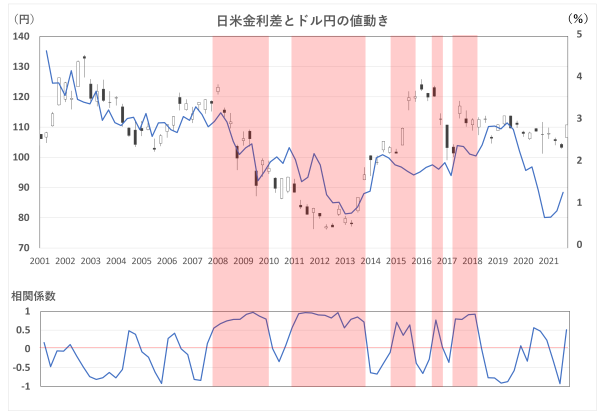
The figure shows a composite chart of the Japanese-U.S. interest rate differential and the USD/JPY exchange rate, along with the correlation of their movements. When the Japanese-U.S. interest rate differential widens, the rule is to buy dollars; when it narrows, to sell dollars. The strength of this relationship (correlation) increases as the correlation coefficient approaches 1, indicating a strong correlation.
In the clearly demarcated red area, the rule based on the Japan-U.S. rate differential was strongly reflected in the market, but it’s also clear that there isn’t a uniform correlation across the entire period.
Markets constantly shift to new main themes, so it is difficult to determine the direction of FX solely by interest rate differentials. However, note that the correlation coefficient toward the end of the chart, in fiscal year 2021, shows a steady rise, suggesting that future USD/JPY moves could be influenced by “interest rates” as a factor.
※The contents of this article are based on the author’s views and do not provide definitive investment judgments; they are for informational purposes only and do not solicit the purchase or sale of any kind of product.
First-class Financial Planning Technician. Worked in financial product sales at a bank, then joined Invast Securities as an FX trader. Currently in the Marketing Department, aiming to spread the enjoyment of investing to the world. Known around town as someone who can answer questions about finance immediately and as a dependable elder brother figure; daily strives to become even more reliable. Also, a sandwich aficionado who constantly handles sandwiches at work. Even makes sandwiches for the next day every night before going to bed, a charmingly domestic trait that he believes to be his charm, in a romanticized sense.