

Sandwich Manase's Market Topic Lecture|Part 4 Turkish Lira Yen
Sandwich Mase explains topics that are of interest in the current market. This time, we pick up one of the high-yield currency pairs: the Turkish lira/yen. Why is the Turkish lira high-yield? We introduce it with economic conditions. (Note: The content of this article is based on the author's views and does not guarantee future profits.)
The Fight with Inflation Behind the High Interest
The currency pair that has gained popularity as a target for swap investments, the Turkish lira/yen. It is regarded as a representative high-interest currency pair, but there is a reason for its high interest. As of March 2021, Turkey's policy rate (one-week repo rate) is 19%. Compared to advanced countries including Japan, policy rates are high; but why are they so high? Let's consider this. Below is the trend of Turkey's inflation rate measured by the Consumer Price Index (year-over-year) and the policy rate.
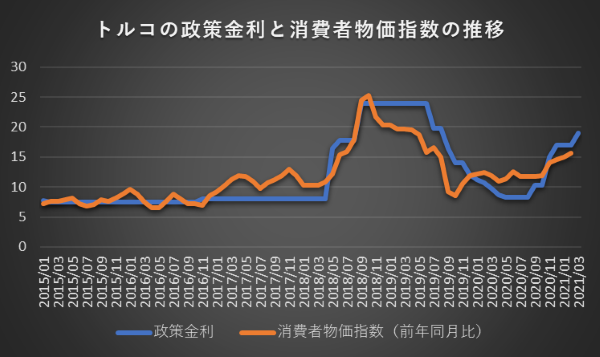
The timing of changes in the Consumer Price Index and the policy rate roughly coincide. From this, it is clear that the Central Bank of Turkey uses monetary policy to control inflation. Inflation is rarely a concern in Japan, but for emerging market central banks, fighting inflation is their mission. For example, a sandwich that cost 100 yen last year now costs 110 yen this year. This indicates 10% inflation, meaning the currency's value has depreciated. To curb inflation, raising interest rates and strengthening the currency value are effective, leading policy rates to rise.
So, can Turkey control inflation? As of February 2021, the inflation rate remained high in the 15% range, indicating the path is still incomplete.
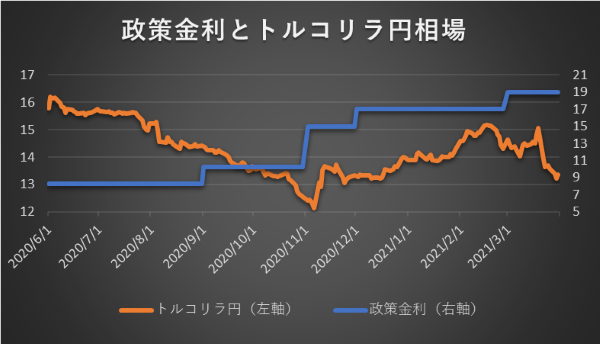
Meanwhile, looking at the USD/TRY (turkish lira/yen) market, since mid-2020 when the Turkish central bank began raising policy rates, the rate had fallen to the teens, but by mid-March 2021 it rebounded to around the mid-teens. The market seems to have welcomed the central bank's stance against inflation.
The Future of the Turkish Lira
On Thursday, March 18, 2021, the Turkish central bank raised the policy rate from 17% to 19%. However, two days later on Saturday, March 20, President Erdogan dismissed the then Governor of the Central Bank, which caused market confusion, and on Monday the 22nd the USD/TRY collapsed. The new governor Kabcioglu (as successor) is seen as dovish and aligned with Erdogan, implying further easing, and the market reacts with lira selling.
Subsequently, statements from Turkish officials seemed to counter expectations of rate cuts, aiming to dispel expectations of rapid easing and to curb further lira selling.
The new governor has denied holding an emergency monetary policy meeting, so attention is focused on the policy directions at the regular Turkish monetary policy meeting on April 15, 2021.
If the new governor does not cut rates and keeps them on hold, there may be a sense of security that rapid easing will not occur, which could allow the USD/TRY to rebound in the short term to fill the previous drop. However, the lira remains a market source of worry, so traders should exercise careful caution.
First-class Financial Planning Technician. Worked in bank sales of financial products, then joined Invast Securities as a currency dealer. Currently in the Marketing Department, promoting the enjoyment of investing to the world. Known on the street as someone who answers financial questions quickly, and strives daily to become a trusted elder brother figure everyone relies on. Also a sandwich enthusiast to the point of being teased by colleagues for never getting bored. Always handles work with a sandwich in hand. Furthermore, every night before bed, he makes the sandwich for the next day—an intimate, homely trait that many find charming and romantic.
Twitter:https://twitter.com/sandwich_market
Note: The content of this article reflects the author's views and does not guarantee future profits.