
Mastering the Market with Kono Hiroshi: Enjoying the Market | Episode 14 [Kono Hiroshi]
Hiroshi Arano Profile

After joining Nihon Kanyo Kakumaru Securities (now Mizuho Securities) in 1971, he worked as an analyst in the research department. After a stint in the United States, he continuously analyzed information and markets for Japanese stocks. In 1996 he transferred to an asset management company (now Asset Management One), serving as head of the research department and head of the investment department, and eventually as Executive Managing Director and Head of the Investment Trust Operations Headquarters. He retired in 2012. Since then, he has been active on TV and radio. His market analysis experience focused on Japanese stocks spans nearly half a century.
Newsletter:https://www.gogojungle.co.jp/finance/salons/8812/
※This article is a reprint/edit of an article from FX攻略.com, April 2021 issue. The market information written in the text may differ from current market conditions, so please note that.
※Data is as of the end of January 2021
* * * * *
A New Perspective and the Ongoing Polarized Market Since Last Year
In this month's issue, we will delve into the new perspectives on “Price-to-Earnings Ratio (PER) thinking,” “the structural changes in the Tokyo market from a demand-supply viewpoint,” and the "momentum" market, as well as the ongoing “polarized market” since last year.
■ Stock prices deviating from fundamentals… Look at investment indicators on a 1-year average. When is the turning point?
The economic trough is estimated to have occurred from March to June 2020, but the Nikkei Average rose since then as performance deteriorations (i.e., a decline in ROE) were offset by expansion in PER.
It was a stock-price rise detached from fundamentals; the key focus for 2021 is when corporate earnings recover to a level that justifies the current stock prices.
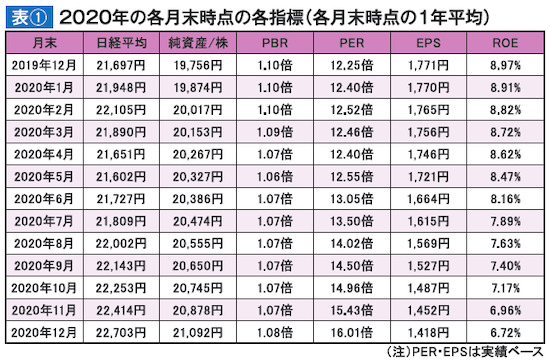
From Table ①, it is clear that the stock price rise compensated for the decline in ROE through PER expansion. At the same time, both earnings per share (EPS) and stock prices rose in step, indicating that the foundation of stock price formation lies in diluted earnings per share (net assets per share).
The actual EPS peaked at 1,892 yen on April 25, 2019, and bottomed at 1,246 yen on June 15, 2020. At the current earnings level, profits are set to turn higher by late May. The growth in profits in the latter half of this year is expected to determine the year-end stock price level.