
Artificial Intelligence, the Market, and Computers | The Birth of the Euro [Naomura Osamu]
Naoto Okumura Profile

Okumura Hisashi. Graduated with a master’s degree in engineering in 1987. Field: AI (artificial intelligence). Developed numerous mathematical models at Nikko Securities. Co-developed investment models with Stanford University Professor Dr. William Sharp (1990 Nobel Prize in Economics) and achieved the world’s first online delivery of Tokyo Stock Exchange prices. Furthermore, he established venture companies with Israeli Mossad science advisors, commercialized AI technologies, and implemented them at major airports. He has a strong track record at the intersection of finance and IT. Currently offers the model “MRA” that evaluates analyst ratings with AI, “FXeye” that AI-predicts near-future FX rates, and “Twilight Zone,” a chart analysis tool that displays risk and return. He also hosts a Financial Literacy School to raise financial literacy in Japan.
Hobbies: audio and sports. He started aerobic competitions 15 years ago, winning NAC Master division singles for nine consecutive times, 2016 Senior runner-up, 2014–2016 Japan Championships Chiba Prefecture representative, 2017–2018 Japan Championships Master 3 runner-up. Although he claims to be sporty, he is actually a “clamper” and is poor at ball sports. His motto is “Never too late to make any decision.”
Blog:https://okumura-toushi.com/
※This article is a reprint/re-edited from FX攻略.com March 2021 issue. Please note that the market information written in the text does not reflect current market conditions.
Currency Union in Europe in January 1999
In January 1999, currency union was established in Europe. The birth of the euro. Until then, France used the franc, Germany the mark, Italy the lira, and so on. This is the true form of a country possessing independent monetary policy. Even when neighboring countries have economic disparities, inflation differences, and business cycle differences, there are advantages to absorbing them through independent monetary policy.
On the other hand, there are benefits to introducing a common currency. Foreign exchange transaction costs disappear. Until the 20th century, traveling in Europe meant changing currencies at borders and struggling with payments. Especially when skiing, crossing borders depending on the course meant currency changes were inconvenient.
Furthermore, price transparency increases. Productivity rises, and those productive powers concentrate in regions with strong competitiveness, which overall benefits the economy. The issues and merits of such a common currency were debated thoroughly, and the course toward adoption was ultimately taken.
Generally, strong economies are reluctant to renounce their own currency. In Europe, the United Kingdom and Germany fit this pattern. The UK did not give up the pound until the end. Germany’s reason for giving up the mark was that currency unification helped avoid Germany’s weaker currency of Italy and Spain from abusing devaluations, and, having lost two world wars, colonial possessions ended, necessitating labor market reforms (for example, German wine is expensive relative to its quality because labor costs are disproportionately high; this contrasts with France, which won the two World Wars). Additionally, Germany, with its export dependence symbolized by automobiles, presumably wanted to avoid exchange rate fluctuations (especially a strong mark).
Relationship Between the euro and the dollar
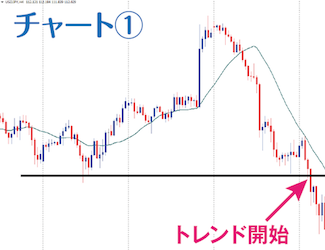
Let’s look at the value trend of the euro from its birth to today (Chart 1). There exists an index that objectively represents the euro’s value, called the Euro Index. It is not as famous as the Dollar Index, but it is a mix of the dollar, pound, yen, Swiss franc, and more.