
【Feature MT4・TradingView Thorough Guide ①】YENZO × Yasushi Yamanaka Dialogue | Professionals Discuss! Evolution of Market Analysis Methods and Two Major Chart Tools
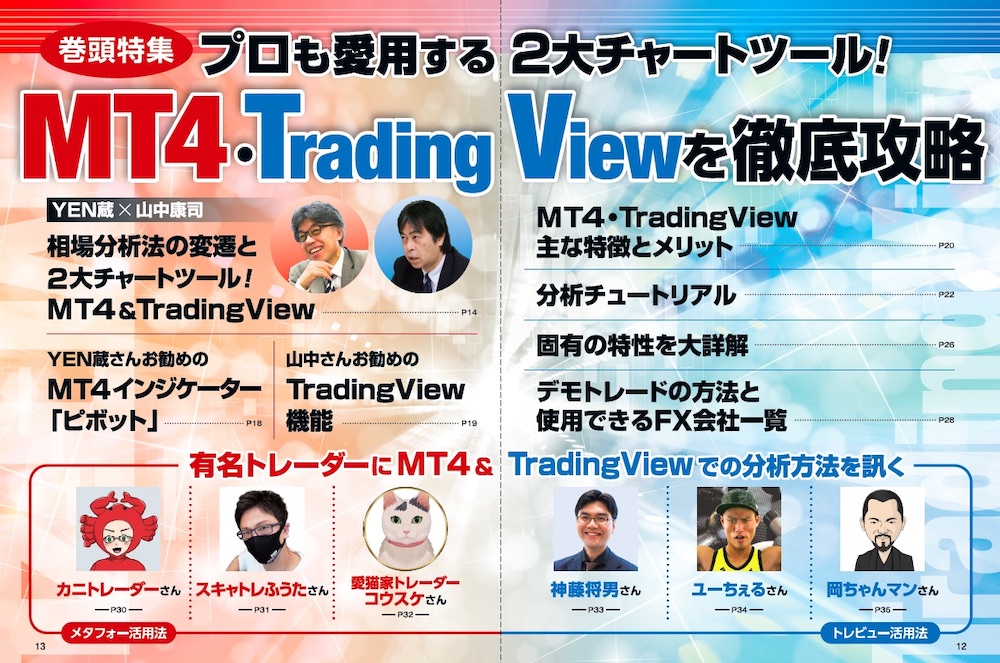
【Feature】 Thorough攻略 of MT4 and TradingView
① YENKura × Yasushi Yamanaka, Dialogue — What professionals say! Evolution of market analysis methods and the two major chart tools ←This article starts here
② Main features and benefits of MT4 and TradingView
③ Analysis Tutorial - MT4 Edition
④ Analysis Tutorial - TradingView Edition
⑤ Detailed explanation of intrinsic characteristics
⑥ How to demo trade and list of FX brokers that can be used
⑦ How Mr. Kani Trader uses MT4
⑧ How Fuuta-san uses MT4 for Scatto Trade
⑨ How Cat-Lover Trader Kousuke uses MT4
⑩ Mr. Shindo Masao’s Use of TradingView
(11) YuCheru’s Use of TradingView
(12) Okachan Man’s Use of TradingView
※This article is a reprint/edit of FX攻略.com November 2020 issue. Please note that the market information described in the main text may differ from the current market.
YENKura’s Profile
Having worked for more than 20 years as a foreign exchange dealer at US-based Citibank, and UK-based Standard Chartered Bank and other foreign banks. Currently, as a top professional trader, he trades currencies, the Nikkei 225, Nikkei options, and individual stocks. President of ADVANCE Co., Ltd., which primarily provides investment information. He is deeply knowledgeable not only in major currencies like the dollar and euro but also in emerging Asian currencies; he also maintains close relationships with foreign traders and fund professionals.
Newsletter:YENKura’s Real-time Newsletter “Real Top Trading”
Blog:http://blog.livedoor.jp/slalom2007/
Twitter:https://twitter.com/YENZOU
Yamanaka Yasushi’s Profile
Joined Bank of America in 1982, became Vice President in 1989, Proprieta ry Manager in 1993. Joined Nikko Securities in 1997, became Deputy Manager of the Foreign Exchange Funds Department at Nikko Citi Trust Bank in 1999. Established Ascendant Co. in 2002 and serves as Director.
Official Blog:Forex information distribution site provided by Ascendant/Yamanaka Yasushi
Twitter:https://twitter.com/yasujiy
Charts Tools: Trader Era vs. Present
■Editorial Team: First, I’d like to hear about chart analysis tools up to the present.
■YamanakaOriginally, chart tools for individual investors were expensive—some software cost around $2,000 just for the software itself. You’d also need to purchase data feeds, costing around 300,000–400,000 yen per year. A big turning point was around 2009–2010 when MT4 began to gain recognition in Japan. From its launch, MT4 was already a highly finished tool and incredibly user-friendly among chart tools of its time. Moreover, MT4 started to be offered by multiple FX brokers as a trading tool. Since rates could be obtained for free, this led to explosive adoption.
■Editorial Team: Recently, TradingView has become hugely popular as well.
■YamanakaTradingView spread when HTML5 became standard about three years ago. Unlike MT4, which is a standalone desktop application, TradingView is usable on the web, so it can be used regardless of environment, and it can display not only currency data but anything. The biggest advantage for FX traders is that they can display charts for currencies and other products like Nikkei 225 and gold simultaneously. It has all the analysis tools and is convenient for creating materials as well.
■YENKuraSince I was at a bank until 2008, my impression after going independent was that MT4 was already widely used. At banks, we pulled various data from Reuters, Bloomberg, etc., but even free FX data on MT4 was practical enough. MT4 and TradingView both feel highly flexible.
■Editorial Team: What kind of chart tools did you use during your trading days?
■YamanakaUp to the mid-1980s, there were no chart tools even in interbank. It was a time when green characters appeared on CRTs. Charts started to appear in the late 80s to early 90s.
■YENKuraAround 1989, Reuters’ dealing system was introduced, and charts became visible. Before that, we attached point-and-figure charts by hand while listening to dealers’ voices. Banks started fully using charts after the early 90s.
■YamanakaWhen I was in New York, charts with moving averages and RSI began to appear around the time of the Plaza Accord. Even in New York’s faster-paced interbank, adoption lagged behind Tokyo. Rapid improvements in computer performance significantly advanced chart tools, and eventually personal tools caught up and surpassed them.
■Editorial Team: I pictured traders trading while viewing many monitors and running powerful computers.
■YENKuraThat kind of setup became common in the late 1990s or when the 2000s began. Trading systems—dealings systems—went digital, and the data were automatically reflected in charts as rates became accessible.