
Foreign Exchange Online - Masakazu Sato's Practical Trading Technique | Tech and Fundamental Analysis Predicting the Future of the 3 Major Currencies [This Month's Theme | Reading the US Presidential Election One Month Ahead from a 4-Year Cycle]
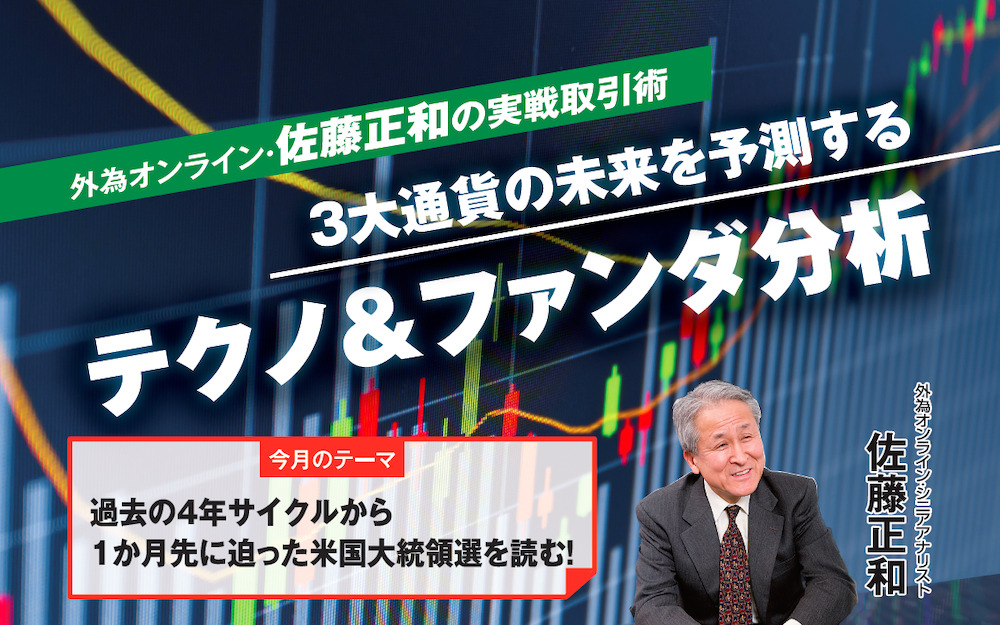
The 46th U.S. presidential election on November 3, 2020 is approaching. After the 2008 Lehman Brothers collapse, the start of Abenomics in 2012, and the Trump rally in 2016, rapid trend reversals and accelerations after elections have tended to occur. This time, with vaccine development for the novel coronavirus in sight, if Biden wins, there may be a relaxation of tensions between the U.S. and China, potentially triggering a stock rise, yen depreciation, dollar depreciation, and euro appreciation—a possible bubble.
※This article is a reproduction and rewrite of an article published in FX攻略.com’s November 2020 issue. Please note that the market information written in the main text may differ from the current market.
Profile of Masakazu Sato

Sato Masakazu. After working at a domestic bank, he joined the Paris-based Banque Paribas (now BNP Paribas). He has served as an interbank chief dealer, head of the funding department, senior manager, and other positions. Subsequently, he became the Senior Analyst at Online Foreign Exchange, which boasted the highest trading volume annually. He has over 20 years of experience in the forex world. He appears on Radiko NIKKEI “Stock Live Commentary! Stock Up,” Stock Voices “Market Wide: Foreign Exchange Information,” and regularly provides market information on Yahoo! Finance.
From the Constriction of Bollinger Bands, the post-presidential election dollar-yen is likely to be highly volatile
With less than a month and a half until the U.S. presidential election on November 3, the forex market, which has been tossed around by President Trump, is approaching a turning point. It goes without saying that 2020 will go down in history as the year when the world suffered from the spread of the novel coronavirus and the resulting record economic downturn.
U.S. GDP for the April–June 2020 period fell at an annualized rate of 32.9%, the steepest drop since quarterly data began being published in 1947. The decline in personal consumption, which accounts for about 70% of U.S. GDP, was 34.6% (annualized), and as trading partners’ economies deteriorated due to the coronavirus, exports plummeted by 64.1%, significantly pulling GDP downward.
However, given such a plunge, there is concern about continued increases in U.S. COVID-19 cases and deaths in July and beyond, but for the next quarter (July–September), a strong quarter-on-quarter growth is highly possible.
Regarding the virus itself, news of successful vaccine development could come soon. Currently, about 30 companies around the world are involved in vaccine development, with Pfizer leading and AstraZeneca following. Therefore, the disruption caused by the coronavirus is likely to move toward resolution; it’s a matter of time. Vaccine supply could begin within the year or early next year, and the anxiety and turmoil caused by COVID-19 may subside to some extent as we approach that period.
With such hopes in mind, since the presidential election is near, we will examine how the forex market has changed over the four-year term of a presidency by looking back at history, and discuss what the next four years might hold.