
Financial literacy comes to you: YEN Kura's Investment University (Academia) | Episode 10 [YEN Kura]

Yenzo's Profile

Enzo. Worked as a foreign exchange dealer for more than 20 years at American banks such as Citibank and Standard Chartered Bank, and at foreign banks with foreign capital. Currently active as a top professional trader in currency, Nikkei 225, Nikkei options, and individual stocks. He is the representative director of ADVANCE Co., Ltd., which primarily distributes investment information. He has deep knowledge not only of major currencies like the dollar and euro, but also of dealing in emerging currencies, including Asian currencies. He also has strong ties with foreign traders and fund personnel.
Newsletter:YENzo Real Top Trading
Blog:YENzo’s FX Investment Techniques - Investing in the World with the Dollar, Yen, Euro, Pound, and Australian Dollar
Twitter:https://twitter.com/YENZOU
*This article is a reprint/edit of FX攻略.com's November 2020 issue. Please note that the market information described in the本文 may differ from the current market.
A Market Where Dollar Strength Is Tested
Among Japanese investors, currency pairs tied to the yen, such as the USD/JPY and cross yen pairs, are popular. However, the king of currency trading is still the dollar. Movements in the dollar have a large impact on the entire FX market, so even investors who usually trade only yen-related pairs should pay attention to the dollar’s moves. From here on, for a while, I would like to write about various aspects of the dollar.
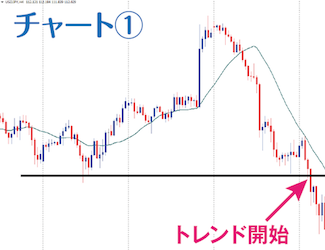
Recently, the trend has been toward dollar weakness. An index that shows dollar strength is the Dollar Index (DXY) (Chart ①). It indicates the relative strength or weakness of the dollar against a basket of major developed-market currencies and does not indicate strength against a single currency. It was developed by the U.S. Federal Reserve in 1973 to measure the dollar’s value against developed-market currencies.
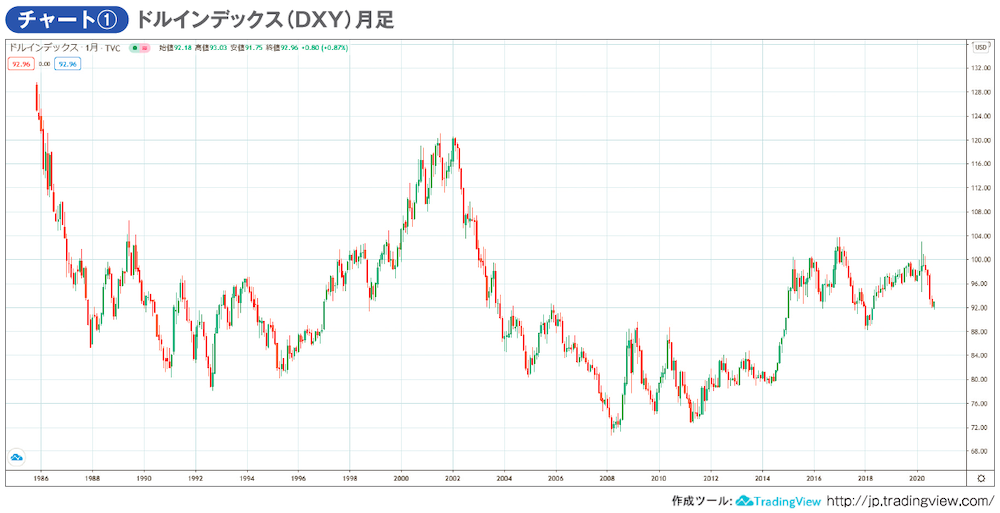
The weights of the currencies that compose the DXY are: euro 57.6%, yen 13.6%, pound 11.9%, Canadian dollar 9.1%, Swedish krona 4.2%, and Swiss franc 3.6%. Because the euro has a large weight, the euro-dollar movement greatly affects the DXY.
Looking at the DXY shows the dollar’s strength. Under the Reagan administration in the 1980s, from the inception, the U.S. pursued a policy of a strong dollar, with a strong-dollar stance. The U.S. benefited from a strong dollar, high interest rates, or the dollar rising precisely because of high interest rates.
One reason interest rates were high was because the inflation rate (CPI) was high. In the early 1980s, the inflation rate was about 15% annually. In the early 1970s it was around 5%, but it rose to near 12% in 1974. It then fell below 5% in 1976, but inflation surged again from the late 1970s to the early 1980s.
Originally, inflation rates worldwide were much higher than today. The rise in global inflation in the 1970s was driven by energy prices, especially the rise in crude oil prices.