
Artificial Intelligence, Markets, and Computers | Episode 7 The Appearance of Apple [Naomura Okumusaku]
Naoto Okumura Profile

Okumura Hisashi. Graduated from the master's program in the Faculty of Engineering in 1987. Theme: AI (artificial intelligence). Developed numerous mathematical models at Nikko Securities. Co-developed investment models with Stanford University professor Dr. William Sharp (1990 Nobel Prize in Economic Sciences) and achieved the world’s first online transmission of Tokyo Stock Exchange prices. Created and commercialized AI technology with Israel’s Mossad science advisor and founded venture companies, implementing AI technology at major airports, among many other accomplishments at the intersection of finance and IT. Currently provides models that evaluate analyst ratings with AI “MRA,” AI-estimated near-future FX rates “FXeye,” and chart analysis displaying risk and return “Twilight Zone.” He also runs a Financial Literacy School to raise financial literacy in Japan.
Hobbies are audio and exercise. Began aerobics competitions 15 years ago, NAC Master Division Single 9 consecutive titles, 2016 Senior 2nd place, 2014–2016 Japan Championship Chiba Prefecture representative, 2017–2018 Japan Championship Master 3 runner-up. Although he is said to be athletic, he is actually “a poor swimmer” and dislikes ball games. His motto is “No decision is ever too late.”
Blog:https://okumura-toushi.com/
※This article is a republication/edit of FX攻略.com October 2020 issue. Please note that market information described herein may differ from current market conditions.
What impact did war have on the world economy?
In the 1970s, following Nixon Shock in 1971 and the first oil crisis in 1973, Japan’s once two-digit growth rate stopped.
From 1955 to 1973, over 18 years, real growth rate peaked at 20.9% (1961) and dropped to as low as 5.0% (1971), averaging 9.2% per year, an astonishing pace. Here is a summary of Japan’s economic growth (Table ①).
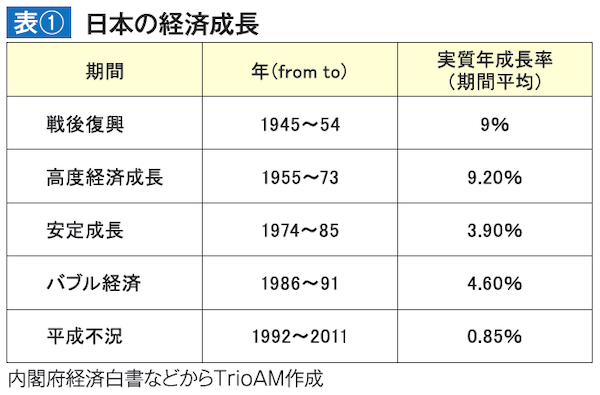
The 1970s were a transition period from high economic growth to stable growth. The high-growth era thrived mainly in the heavy and chemical industries. It was an era of irresponsible waste disposal, dumping of industrial waste, and emission of harmful substances from smokestacks—unbelievable by today’s standards.
In Tokyo, sewerage coverage was below 50%, and concerns about water and air pollution, environmental destruction, and noise from trains and roads were ignored. Incidentally, sewerage coverage in the 23 wards reached 100% only in 1995 (Tokyo Metropolitan Sewerage Bureau homepage).
Pollution issues had become evident in the 1960s, and they became major social problems. Laws were established in 1970, and in 1971 the Environmental Agency was founded. It was a period when Japan was finally transforming into an “ordinary” advanced country with environmental awareness.