
The Future of Foreign Exchange Markets Episode 126 [Tomotaro Tajima]

Tomotaro Tajima (Tomotaro Tajima) Profile

Economic analyst. AlfFunds CEO. Born in Tokyo in 1964. After graduating from Keio University, he shifted career following his stint at Mitsubishi UFJ Securities. He analyzes and researches a wide range from finance and economy to strategic corporate management, and ultimately personal asset formation and fund management. He serves as lecturer for lectures, seminars, and training hosted by private companies, financial institutions, newspapers, local governments, and various chamber of commerce groups, with an annual speaking count of around 150. He has published numerous column pieces and comments in print media such as Weekly Gendai “The Rules of Net Trading,” Examinia “Money Maestro Training Course,” and more. He also writes stock and forex columns on many websites and is highly regarded as a stock and FX strategist. He also writes for the Home Economics section of Kodansha’s “Basic Knowledge of Contemporary Terms.” After regular appearances on TV (TV Asahi “Yaji-Uma Plus,” BS Asahi “Sunday Online”) and radio (MBS “Ryō-chan’s Asaichi Radio”), he currently serves as a regular commentator on Nikkei CNBC “Market Wrap” and Daiwa Securities Information TV “Economy Marche.” His main DVDs include “Super Easy: Tomotaro Tajima’s FX Introduction” and “Super Easy: Tomotaro Tajima’s FX Practical Technical Analysis.” His main books include “Wealth Review Manual” (Pal Publications), “FX Chart ‘Formula for Profit’” (Alchemix), “Why Can FX Make You Asset-Rich?” (Text), among many others. The latest release is “Riding the Rising U.S. Economy to Profit” (Kodansha’s Free Press).
*This article is a reprint/edit from FX攻略.com October 2020 issue. Please note that the market information stated in the text may differ from current market conditions.
Accelerating in the Pandemic!? The Long-Awaited Path to European Integration
Ironically, the spread of the novel coronavirus has become a global catalyst for dramatic changes in society that had long been deemed necessary in various forms. This represents a major current in the broader trend of DX (digital transformation) often discussed lately, but on the other hand, it is very interesting that a long-cherished goal of European integration has finally gained a precious foothold toward realization.
As is known, the European Union (EU) on July 21 agreed to establish a €750 billion recovery fund to foster economic recovery from the pandemic. Initially, talks among EU leaders faced resistance from some member states, and a desirable conclusion seemed uncertain, but ultimately after five days of marathon negotiations they reached a final agreement.
This could accelerate the necessary path toward fiscal integration, a key element of European integration, and serves as a positive development providing a solid backing for European stability. Markets reacted by buying euros once the agreement was announced.
Originally, market expectations for an early agreement on the recovery fund were very strong. As a result, the euro-dollar, which had been around 1.1200 in late June, rose to around 1.1500 during the brief period before the agreement, and by late July surged to the 1.1900s (see Chart 1).
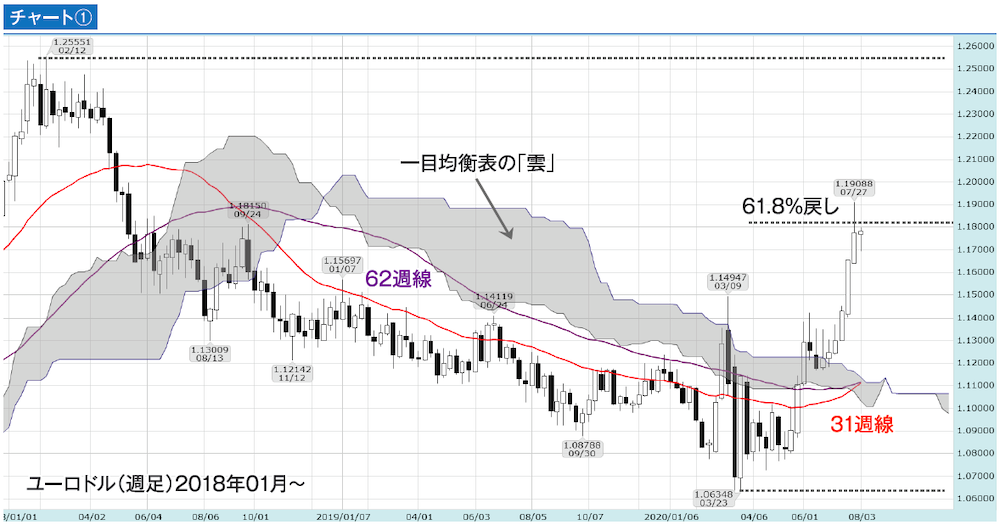
As a result, at present the 62-week moving average is set to cross above the 31-week moving average in a golden cross. This could indicate further upside potential.
However, due to the recent sharp rise, the euro-dollar has retraced about 61.8% of the decline from the February 2018 high to the March 2020 low, suggesting a possible pause in the uptrend at a significant level.
If the euro-dollar continues to move into the 1.2000 range, concerns about euro strength may arise. Depending on circumstances, the European Central Bank (ECB) may take some action.
Incidentally, by the end of July, when the euro-dollar briefly reached as high as 1.1909, it had reached a long-term resistance line that connects the July 2008 high, the May 2014 high, and the February 2018 high, which is worth keeping in mind.
At the very least, it should be noted that this resistance has historically been very strong.