

Virtual Currency Market Analysis [July 21 Issue]
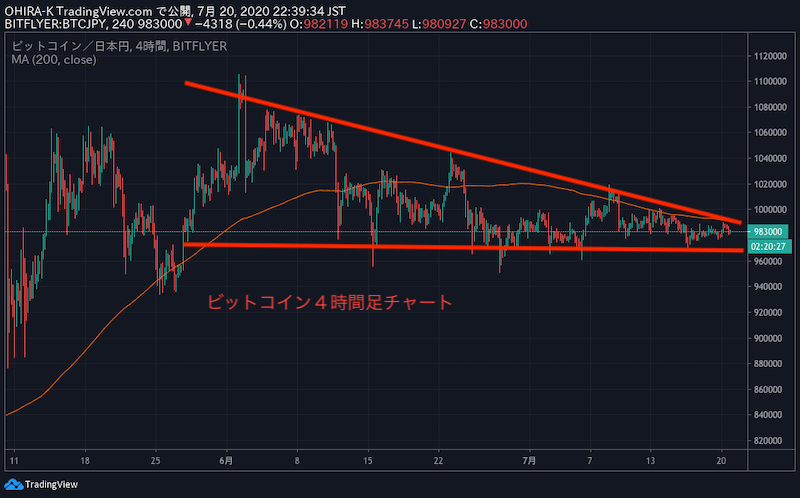
Bitcoin has been trading in almost the same price range as last week’s 980,000 yen.
Trading around the same price band as last week.
There is little movement in the price action,
but the gap between the high and low has narrowed.
The range between highs and lows is becoming tighter.
Bitcoin 4-hour chart
Last week, on the hash ribbon, a Bitcoin
buy signal lit up,
but there is still no bullish signal, and the price
remains subdued, leading some to say this price stagnation
could be a sign of a potential downward move.
for a drop.
As volume dries up like this,
there are many cases where it eventually breaks to the upside or downside at some point.
“Reasons for the price decline”
This is my personal view,
at the end of 2018 Bitcoin’s
volume was low, and from September
to the year-end the price converged
in a confined range.
Here is that chart.
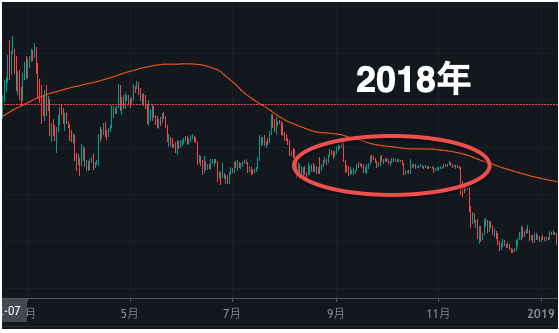
In reality, this covers the period from September to November
two months.
During this period,
the market itself did not fluctuate much,
but the price gradually converged to around 720,000 yen,
and eventually dropped sharply,
falling to 400,000 yen the following month.
Around this time, Bitcoin
and the Bitcoin Cash community
split, with Bitcoin Cash and
BitcoinSV splitting into two
and this was cited as a factor,
but personally I feel large investors waited for a drop and then dumped in one go.
Bitcoin reached a low around 350,000 yen,
and at the beginning of 2019 it was
up to a high of 1.5 million yen by late June,
a roughly 320% rally.
I’m curious how long this price convergence will last,
but the tendency is for prices to move sharply,
so caution is warranted.
[Are institutional investors on the sidelines?]
GBTC— a Bitcoin
trust (an investment fund)—
has reportedly paused purchases.
People say summers are often slow markets
and that institutional investors
staying out can cause prices to stagnate.
However, Bitcoin purchases were resumed on July 10,
but at this low volatility,
GBTC remains cautious.
Also, in the realm of mutual funds
there has been a significant inflow since last year.
In the 2020 Q1 report published this year, for 2019 Q4 (Oct–Dec), BTC fund inflows were $1.9 billion, (about ¥210 billion), and in 2020 Q1 there was a growth to $453.8 million; by Q2 2020, inflows reached a record $9.858 billion, nearly double that of Q1.
In reality, the coronavirus-driven
crash increased Bitcoin’s
demand for buying, which in turn
boosted fund performance,
I think.
[Individual investors should still
use dollar-cost averaging]
In such markets, predicting which way prices will move is very difficult.
Recently, global payments company
PayPal has
announced significant news about entering the crypto business,
but Bitcoin’s price remains unmoved.
Since direction is uncertain,
month after month, with dollar-cost averaging,
investing funds at a steady price,
and aiming to benefit from a long-term upward trend,
seems more efficient.
[PayPal’s entering the crypto business]
—
The major payments company PayPal has begun a unique crypto service by partnering with Paxos,
coindesk reports on the 20th, citing two people with knowledge of the matter.The partnership could be announced as soon as this week.
As described above, PayPal is partnering with a crypto company and may eventually enable
cryptocurrency payments on its platform,
starting with stablecoins aligned to fiat currencies,
and then potentially expanding to other cryptocurrencies.
This is very positive news,
PayPal had initially entered the Facebook Libra project
but withdrew temporarily under government pressure.
This time, in a different form,
PayPal is partnering with crypto firms independently
to incorporate cryptocurrency payments into its payments system,
suggesting that Bitcoin and other cryptocurrencies may be supported in the future.
This is highly positive for the space.
)