
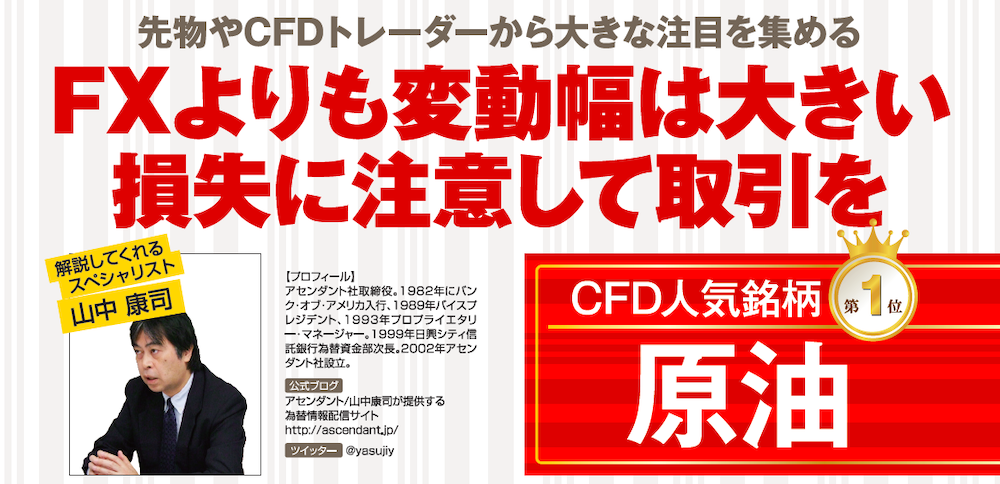
【CFD Special Feature ④】 CFD Popular Stock No.1 Crude Oil | Attracting great attention from futures and CFD traders [Koji Yamanaka]
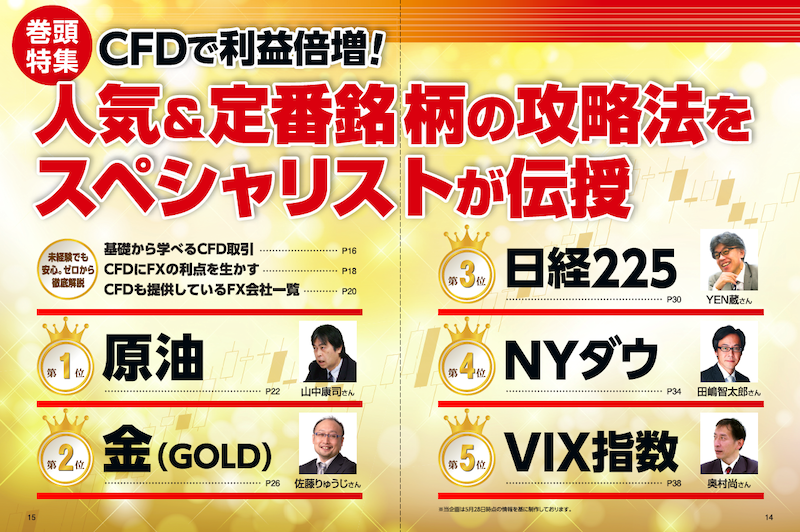
[Feature] Double your profits with CFD! Specialists reveal攻略法 for popular and standard stocks
① FX traders should start CFDs too and seize profits! CFD trading that can be learned from basics
② Because you’re an FX trader, CFDs are a perfect match! Leverage FX advantages in CFDs
③ List of FX companies that also offer CFDs
⑤ CFD Top Popular Stock No.2: Gold | A safe asset with inherent value [Ryuji Sato]
⑥ CFD Top Popular Stock No.3: Nikkei 225 | The closest to Japanese investors [YEN-kura]
※This article is a reprint and revised edition of FX攻略.com August 2020 issue. Please note that the market information described in the main text may differ from current market conditions.
※This project is based on information as of May 28, 2020.
Specialist profiles who provide explanations: Yasushi Yamanaka
Director of Ascendant Co. Joined Bank of America in 1982, promoted to Vice President in 1989, Proprietary Manager in 1993. In 1999 he became Deputy Head of the Foreign Exchange Funds Department at Nikko City Trust Bank. Established Ascendant Co. in 2002.
Official blog:Forex information distribution site provided by Ascendant/Yamanaka
Twitter:https://twitter.com/yasujiy
Not only trading, but also understanding economic trends
We spoke with Mr. Yamanaka about the characteristics of crude oil.
“Crude oil is influenced more by actual demand than speculative movements, and among market participants, it tends to be affected by the trends of industry players. There are derived products such as gasoline and kerosene, and these refined products are strongly influenced by seasonal factors, so looking at crude oil and various petroleum products is important for assessing economic trends.”
He also shared trading points.
“Except for the fact that actual demand has a large influence on trading methods, fundamentals, news, and technicals are no different from FX trading. However, because the price volatility is often significantly larger than in FX, careful attention to trade size and stop-loss levels is necessary. For swing traders, a stance of smaller position sizes with deeper stop losses seems advisable.”